
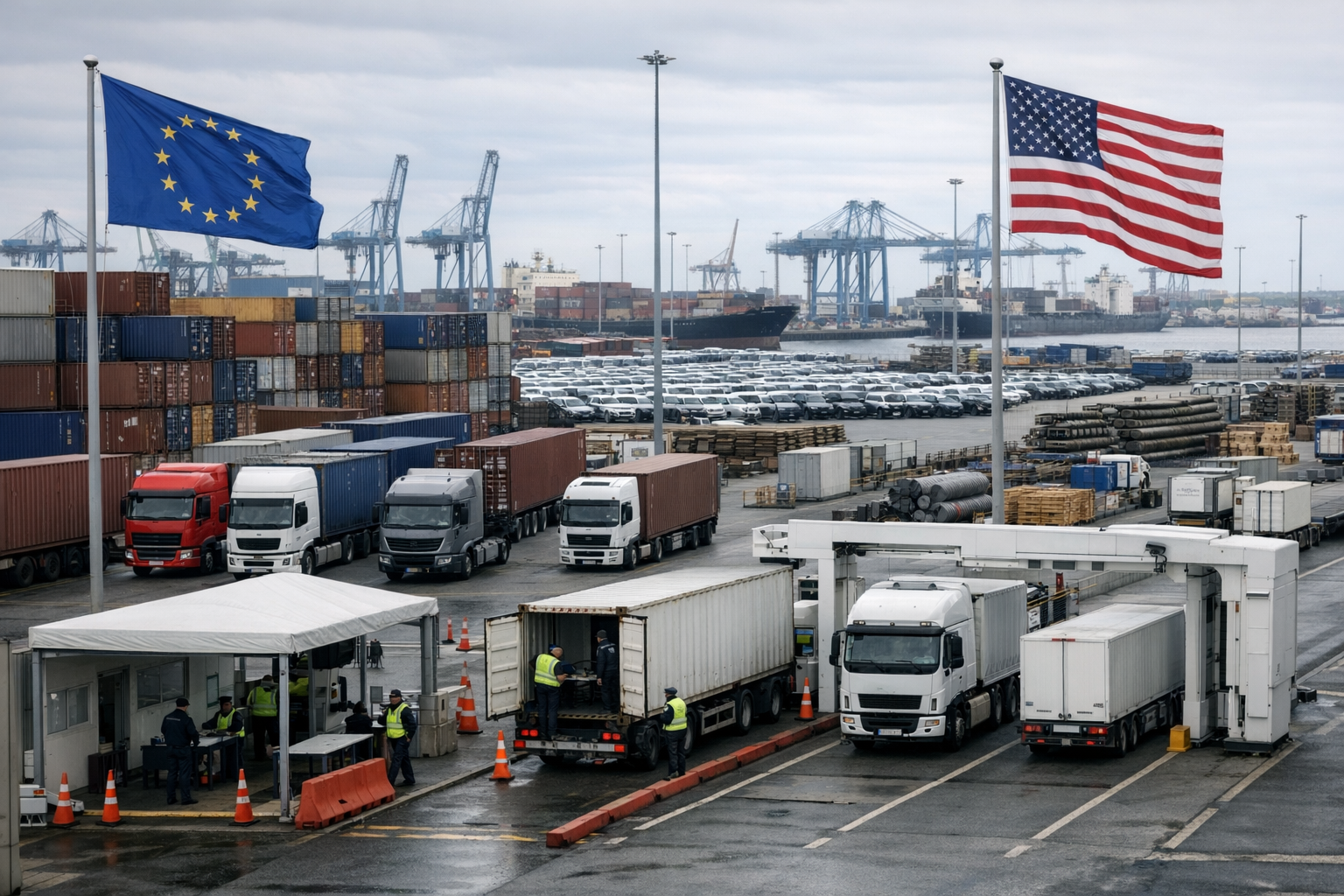
President Trump sharply escalated his trade confrontation with Europe on Tuesday, warning that the European Union had until July 4 to ratify its trade pact with the United States or face “much higher” tariffs, even as a federal trade court moved the same day to block one of his administration’s most sweeping tariff tools.
The twin developments amounted to a more precarious turn in the trans-Atlantic trade dispute: Mr. Trump is pressing Brussels to complete a politically fraught agreement under threat of new penalties, while the courts are narrowing the legal path for his broader strategy of imposing across-the-board tariffs.
In a social media post after speaking with Ursula von der Leyen, the president of the European Commission, Mr. Trump said he had agreed to give the bloc until “our Country’s 250th Birthday” to act. Otherwise, he said, tariffs on European goods would “immediately jump to much higher levels.”
The ultimatum injected fresh uncertainty into a relationship that had only recently appeared to be stabilizing. The trade agreement announced last July at Turnberry in Scotland was billed by both sides as a reset after years of tariff threats and retaliatory measures. It was designed to cap most U.S. tariffs on European exports at 15 percent, while securing tariff concessions from the European Union and restoring some predictability for industries from automobiles to machinery and consumer goods.
But the accord has remained unfinished in Europe, where ratification has become entangled in the bloc’s own legislative process and in concerns about whether Washington will honor its side of the bargain.
Court setback for a central tariff tool
Complicating matters for the White House, the United States Court of International Trade ruled 2 to 1 on Thursday against Mr. Trump’s 10 percent global tariff, finding that the administration had overreached in using Section 122 of the Trade Act of 1974 to justify the measure.
That tariff had been imposed in February after the Supreme Court struck down an earlier set of Trump tariffs that had relied on emergency authorities. Section 122 became the administration’s fallback legal basis for maintaining broad import duties. But the trade court said the law was intended as a narrow, temporary instrument tied to balance-of-payments problems, and that the administration’s rationale — centered on trade deficits and the current account — did not fit the authority Congress had granted.
The ruling was a significant blow, though not a clean nationwide defeat for the administration. The injunction directly covers the Washington state plaintiffs and two small businesses that brought the case, leaving unresolved how broadly it will apply to importers around the country while appeals proceed.
Even so, the decision underscored a vulnerability in Mr. Trump’s trade agenda. His administration has often used tariffs not only as industrial policy but as a negotiating weapon. The court’s ruling suggests that one of the broadest instruments in that arsenal may rest on weaker legal ground than the White House had asserted.
Pressure on Brussels
For European officials, the new July 4 deadline creates an awkward mix of urgency and mistrust.
The Turnberry agreement, announced on July 27, 2025, was supposed to offer a framework for de-escalation after Mr. Trump had earlier threatened 25 percent tariffs on European autos, a step that alarmed Germany and other manufacturing-heavy economies. Yet ratification has moved slowly.
In March, the European Parliament adopted its position on the deal, but it added safeguards reflecting deep concern about the volatility of American trade policy. Among them were a suspension clause, allowing the bloc to pause parts of the agreement if the United States imposed fresh tariffs, and a “sunrise” clause making some European concessions conditional on Washington’s continued compliance. Negotiations with member states are still needed before the pact can be fully implemented.
That process is not easily compressed into an American political deadline, especially one set by presidential threat. European officials have argued that the bloc’s procedures cannot simply be rushed at Washington’s demand, and some member governments are wary of appearing to ratify an agreement under duress.
Still, Mr. Trump’s warning raises the cost of delay. For exporters across Europe, the unresolved question is no longer only whether the deal survives, but what exactly the president might target if he decides it has failed.
The White House has not clearly said which tariffs would rise, or on what categories of goods, if the deadline passes. That ambiguity may itself be part of the leverage. It leaves businesses, investors and European policymakers trying to guess whether the administration would focus on politically sensitive sectors like autos, steel, luxury goods and agriculture, or move more broadly.
A trade fight entering a new phase
What makes this moment different is the convergence of legal constraint and diplomatic pressure.
Until recently, Mr. Trump’s tariff campaign largely followed a familiar pattern: threaten large duties, use them to force negotiation, and keep multiple legal authorities in reserve. The trade court’s ruling has now disrupted that model by calling into question the administration’s use of a broad statutory power after the Supreme Court had already rejected an earlier workaround.
That does not mean the tariff threats are empty. The administration is still pursuing other avenues, including Section 301 investigations launched after the Supreme Court’s February ruling. Those inquiries could eventually support new duties later this year, potentially including tariffs involving the European Union.
But Section 301 cases require a more developed record and a more formal process, making them slower and less flexible than a blanket global tariff. In practical terms, that may leave the president with less immediate legal room for sweeping action even as he seeks to intensify pressure on Europe.
For Brussels, the result is a negotiation that has become harder to read. On one hand, the court decision appears to weaken Mr. Trump’s hand by limiting a fallback mechanism for universal tariffs. On the other, his willingness to set a hard political deadline and threaten unspecified punishment suggests he is determined to preserve maximum negotiating pressure.
That tension is likely to shape the next two months of trans-Atlantic trade diplomacy. The United States and Europe remain each other’s largest economic partners, with deeply integrated supply chains and major stakes in sectors ranging from autos and pharmaceuticals to aerospace and clean energy technology. A renewed tariff escalation would reverberate well beyond customs schedules, affecting inflation, investment planning and already fragile confidence in the rules governing global trade.
The question now is whether the Turnberry deal can still serve as a truce — or whether it becomes the next front in a trade conflict increasingly fought at once in negotiating rooms and in court.
Sources
Further reading and reporting used to add context:
- https://www.axios.com/2026/05/07/trump-tariffs-trade-court
- https://apnews.com/article/df01218b89ca925015fe41c700d6beb9
- Trump says EU has until July 4 to approve trade deal | AP News
- https://www.thedailybeast.com/trump-gives-allies-independence-day-ultimatum/
- https://www.thedailybeast.com/trump-humiliated-as-his-backup-plan-gets-struck-down/
- https://www.theguardian.com/us-news/2026/may/07/trump-global-tariffs-trade-court-ruling
- https://www.theguardian.com/us-news/2026/may/07/trump-gives-eu-until-4-july-to-ratify-trade-deal-or-face-much-higher-tariffs
- The EU-US trade deal – European Commission
- https://www.investing.com/news/economy-news/trump-warns-eu-on-trade-deal-deadline-ahead-of-july-4th-93CH-4669540
- https://www.streetinsider.com/Reuters/Trump%2Bsays%2Bgiving%2BEU%2Buntil%2BJuly%2B4%2Bto%2Bfulfill%2Btrade%2Bdeal%2Bor%2Bwill%2Braise%2Btariffs/26452187.html
- https://www.ey.com/en_gl/technical/tax-alerts/us-implements-global-10-percent-import-tariff-under-section-122-of-the-trade-act-of-1974
- https://www.marketscreener.com/news/trump-says-giving-eu-until-july-4-to-fulfill-trade-deal-or-will-raise-tariffs-ce7f5bdadb8af420
- https://toronto.citynews.ca/2026/05/07/federal-court-rules-against-new-global-tariffs-trump-imposed-after-loss-at-the-supreme-court/
- https://www.pwc.com/ca/en/services/tax/publications/tax-insights/us-supreme-court-invalidates-ieepa-based-tariffs-2026.html
- https://www.aa.com.tr/en/americas/trump-gives-eu-july-4-deadline-to-comply-with-trade-deal/3930654
- https://www.inquirer.com/politics/nation/trump-tariffs-european-union-trade-deal-20260507.html
- https://www.marketscreener.com/news/us-trade-court-weighs-legality-of-trump-10-global-tariff-ce7e50d8d18bfe24
- https://en.wikipedia.org/wiki/United_States_Court_of_International_Trade
- https://en.wikipedia.org/wiki/V.O.S._Selections%2C_Inc._v._Trump
- https://en.wikipedia.org/wiki/Tariffs_in_the_second_Trump_administration
- https://www.europarl.europa.eu/pdfs/news/expert/2026/3/press_release/20260323IPR38830/20260323IPR38830_en.pdf
- https://en.wikipedia.org/wiki/Von_der_Leyen_Commission_II
- https://www.europarl.europa.eu/news/en/agenda/plenary-news/2026-03-25/1/vote-on-the-eu-us-trade-deal
- https://www.europarl.europa.eu/news/en/press-room/20260323IPR38830/eu-us-trade-deal-meps-set-conditions-for-lowering-tariffs-on-us-products
- https://www.europarl.europa.eu/news/it/agenda/plenary-news/2026-03-25/1/accordo-commerciale-ue-usa
- https://www.europarl.europa.eu/news/de/agenda/plenary-news/2026-03-25/1/abstimmung-uber-us-handelsabkommen
- https://www.europarl.europa.eu/news/en/press-room/20260223IPR36005/
- https://www.europarl.europa.eu/news/de/press-room/20260323IPR38830/eu-us-handelsabkommen-ep-stellt-bedingungen-fur-zollsenkung-auf-us-produkte
- https://www.europarl.europa.eu/news/en/press-room/20260325IPR39214/ep-today
- https://www.europarl.europa.eu/news/it/press-room/20260323IPR38830/sumfonia-ee-ipa-to-ek-thetei-orous-sti-meiosi-dasmon-sta-amerikanika-proionta
- https://www.europarl.europa.eu/news/cs/agenda/plenary-news/2026-03-25/1/vote-sur-l-accord-commercial-ue-etats-unis
- https://www.europarl.europa.eu/news/es/agenda/plenary-news/2026-03-25/1/vote-on-the-eu-us-trade-deal
- https://www.europarl.europa.eu/legislative-train/carriage/implementation-of-certain-tariff-aspects-of-the-2025-eu-us-framework-agreement/report?sid=10001
- https://www.europarl.europa.eu/doceo/document/CRE-10-2026-03-26-INT-2017069450678_EN.html
- https://www.europarl.europa.eu/news/fr/agenda/plenary-news/2026-03-25/1/vote-sur-l-accord-commercial-ue-etats-unis
- https://www.europarl.europa.eu/RegData/etudes/ATAG/2026/785691/EPRS_ATA%282026%29785691_EN.pdf
- https://ec.europa.eu/commission/presscorner/api/files/document/print/en/statement_25_1915/STATEMENT_25_1915_EN.pdf
- https://ec.europa.eu/commission/presscorner/api/files/document/print/en/qanda_25_1930/QANDA_25_1930_EN.pdf
- https://www.europarl.europa.eu/RegData/etudes/ATAG/2026/785687/EPRS_ATA%282026%29785687_EN.pdf
- https://ec.europa.eu/transparency/documents-register/api/files/COM%282025%29471_0/090166e5215d0508?rendition=false
- https://www.cit.uscourts.gov/
- https://www.cit.uscourts.gov/about-court
- https://www.cit.uscourts.gov/news/notice-amendment-and-proposed-amendment-uscit-rules
- https://www.cit.uscourts.gov/content/slip-opinions-2026
- https://www.cit.uscourts.gov/sites/cit/files/Slip%20Op%2004-122%20%28public%29.pdf
- https://www.cit.uscourts.gov/content/slip-opinions-2026-0
- https://www.cit.uscourts.gov/metadata
- https://www.cit.uscourts.gov/news/information-regarding-coronavirus-disease-covid-19-and-united-states-court-international-trad-0
- https://www.cit.uscourts.gov/sites/cit/files/06-128.pdf
- https://www.cit.uscourts.gov/slip-opinions-year
- https://www.cit.uscourts.gov/audio-recordings-select-public-court-proceedings
- https://www.cit.uscourts.gov/20th-judicial-conference-written-materials
- https://www.cit.uscourts.gov/cmecf-faq
- https://www.cit.uscourts.gov/content/50-i-tried-file-document-and-there-message-says-error-document-not-well-formed-pdf-document
- https://www.cit.uscourts.gov/sites/cit/files/10-122.pdf
- https://www.cit.uscourts.gov/sites/cit/files/23-122.pdf
- https://www.cit.uscourts.gov/sites/cit/files/25-58.pdf
- https://www.cit.uscourts.gov/sites/cit/files/17-122.pdf
- https://www.moneycontrol.com/world/us-trade-court-rules-against-trump-s-10-global-tariffs-article-13912302.html
- https://www.streetinsider.com/Reuters/US%2Btrade%2Bcourt%2Brules%2Bagainst%2BTrumps%2B10%25%2Bglobal%2Btariff/26455041.html
- https://libertyjusticecenter.org/pressrelease/liberty-justice-center-victorious-in-lawsuit-challenging-trumps-section-122-tariffs/
- https://www.axios.com/2026/02/20/trump-global-tariffs-supreme-court-10-percent
- https://www.cbh.com/insights/alerts/section-122-tariffs-challenged-in-court-of-international-trade/
- https://www.axios.com/2025/06/11/trump-tariffs-stay
- https://www.axios.com/2025/05/29/trump-tariffs-court-appeal
- https://www.investing.com/news/economy-news/us-supreme-court-rejects-trumps-global-tariffs-4516593
- https://libertyjusticecenter.org/pressrelease/liberty-justice-center-sues-to-block-trump-administrations-new-global-tariffs-under-section-122-after-supreme-court-ruled-ieepa-tariffs-unconstitutional/
- https://www.investing.com/news/economy-news/trump-furious-after-supreme-court-upends-his-global-tariffs-vows-new-10-levy-4517377
- https://taxprofblog.aals.org/2026/03/11/section-122-tariffs-challenged-in-the-court-of-international-trade/
- https://terms.law/Blog/scotus-ieepa-tariff-alternatives/
- https://archive.ph/2026.01.09-121024/https%3A/www.reuters.com/legal/government/supreme-court-set-issue-rulings-trump-awaits-fate-tariffs-2026-01-09/?lctg=67bc5dc1faa491e8530572cd
- https://archive.ph/2026.01.08-142333/https%3A/www.reuters.com/legal/government/market-risk-mounts-supreme-court-weighs-trumps-emergency-tariff-powers-2026-01-08/?lctg=6617a728f4468d7ab60b7482
- https://www.reddit.com/r/AntiTrumpAlliance/comments/1t6sby6/trade_court_rules_trumps_10_global_tariff_is/
- https://www.investing.com/news/economy-news/ustr-expects-new-section-301-probes-to-cover-most-major-trading-partners-4517414
- https://www.investing.com/news/economic-indicators/us-opens-new-unfairtrade-probes-to-rebuild-trumps-tariff-pressure-4555888
- https://www.axios.com/2026/03/11/trump-tariffs-trade-301
- https://www.investing.com/news/economy-news/trump-orders-temporary-10-global-tariff-to-replace-duties-struck-down-by-us-supreme-court-4516938
- https://radiousa.com/2026/05/05/us-industries-trade-groups-split-over-trumps-tariff-probe-on-excess-factory-capacity/
- https://www.bworldonline.com/world/2026/03/12/735866/us-opens-unfair-trade-probes-to-rebuild-trumps-tariff-pressure/
- https://apnews.com/article/6f4243502a1d8ce6c301f39c083a93e9
- https://www.tomshardware.com/pc-components/gpus/gpu-prices-are-threatening-to-climb-but-at-least-tariffs-wont-make-it-worse-25-percent-import-tax-on-chinese-made-electronics-suspended-once-again
- https://www.ksl.com/article/51451265/us-supreme-court-rejects-trumps-global-tariffs
- https://www.marketscreener.com/news/ustr-expects-new-section-301-probes-to-cover-most-major-trading-partners-ce7e5dd2d98bf624
- https://www.pbs.org/newshour/amp/politics/trump-administration-starts-new-process-to-try-to-replace-tariffs-struck-down-by-supreme-court
- https://m.investing.com/news/stock-market-news/us-launches-unfairtrade-probes-to-rebuild-trumps-tariff-pressure-4559010?ampMode=1
- https://www.khaleejtimes.com/business/us-launches-unfair-trade-probes-to-rebuild-trumps-tariff-pressure
- https://www.business-standard.com/amp/world-news/us-opens-new-unfair-trade-probes-to-rebuild-trump-s-tariff-pressure-126031200049_1.html