
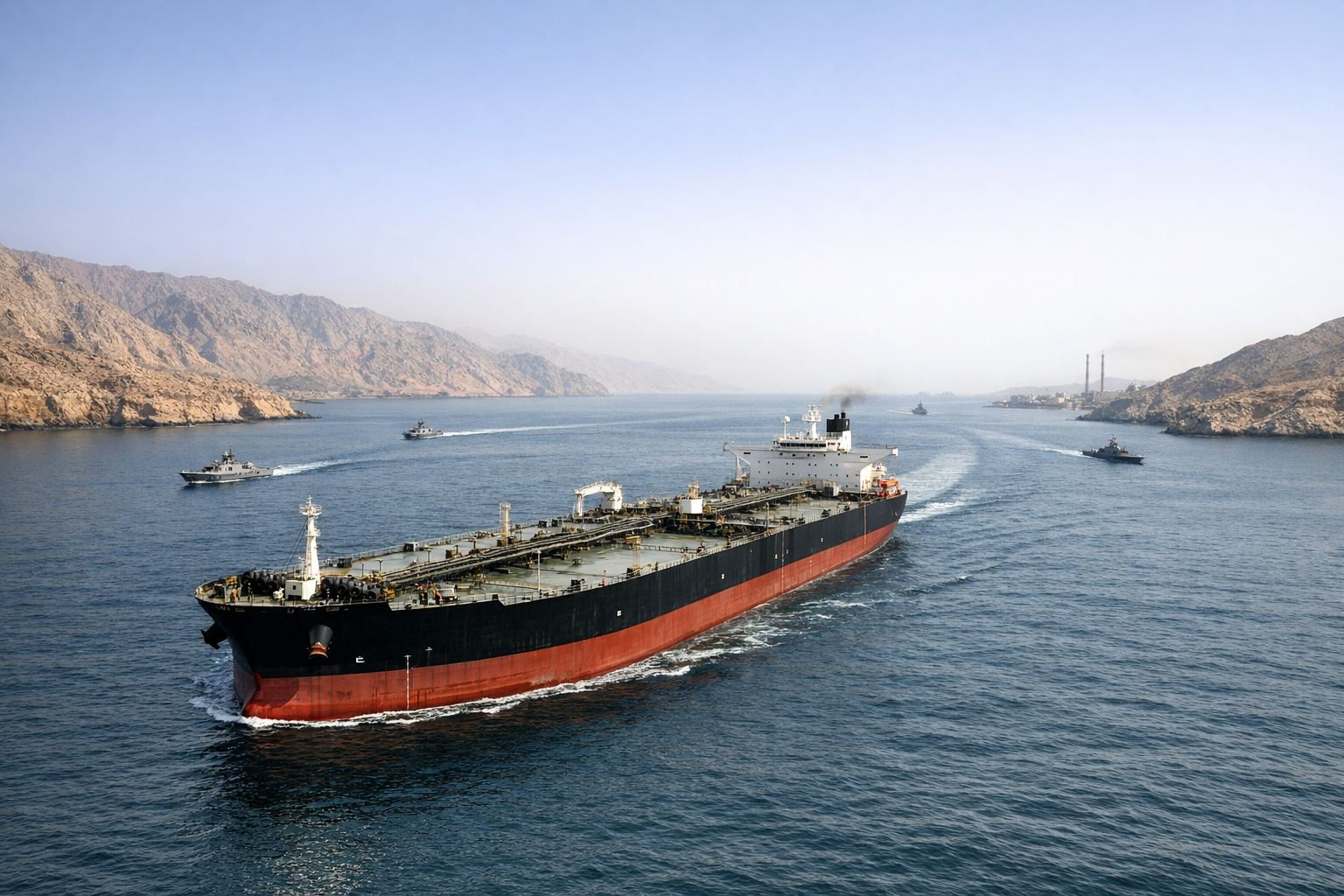
A Fragile Reopening in the Strait of Hormuz
The story of the Strait of Hormuz has shifted in recent weeks from the language of war and closure to the more technical, but no less consequential, questions of who controls passage, what ships may be asked to pay and whether the world’s energy trade can move with anything close to normal confidence again.
Since the mid-June truce between the United States and Iran, crude shipments from the Gulf have begun to recover, led in part by Saudi Arabia’s return to one of the world’s most sensitive maritime corridors. But the reopening has come with new ambiguities. Oman, which borders the strait and has long cast itself as a careful regional mediator, has offered mixed signals over whether ships could face charges related to navigation or maritime services. Iran, meanwhile, has warned tankers to follow routes it approves or risk a “forceful response.”
The result is a new phase of uncertainty for oil markets: not a simple question of whether the strait is open, but under what conditions.
Saudi Cargoes Resume, Testing Market Confidence
Saudi Arabia has increased crude shipments through Hormuz after relying more heavily during the conflict on export routes that bypass the waterway. Tanker tracking data cited by Reuters showed that at least five supertankers carrying roughly 10 million barrels loaded at Ras Tanura, the kingdom’s key Gulf terminal, and then passed through the strait after the June 17 U.S.-Iran agreement.
Aramco has also turned to spot sales to help place cargoes more quickly in Asia, an indication that Riyadh is moving to restore normal export rhythms after months of disruption.
That matters well beyond Saudi Arabia. The kingdom’s decisions are widely watched as a practical gauge of confidence in Gulf shipping lanes. If the region’s largest exporter is willing to send more barrels through Hormuz, traders and refiners tend to see that as evidence that risks, while still elevated, have become manageable enough to resume business.
The rebound in flows has already helped cool oil prices from the spikes seen during the fighting. Additional prompt supply from the Gulf has eased some immediate fears of a sustained shortage. But market participants say the recovery remains tentative, with shipowners, banks and insurers still treating the route as unusually exposed.
Oman’s Ambiguity Creates a New Market Fault Line
The latest unease has centered on Oman, whose territory helps frame the southern side of the strait and whose diplomatic role has often depended on saying less than its neighbors. In recent discussions about navigation and maritime services, Omani officials and related regional statements raised the prospect that vessels might face charges associated with pollution response, pilotage or other support functions. Muscat later said that any future arrangements would not involve transit fees.
That distinction has done little to settle nerves in shipping and energy markets.
For tanker operators, the legal and commercial line between a transit fee and a mandatory service charge can be thin if the cost becomes a condition of passage. Even limited charges could ripple outward through freight rates, insurance premiums and contract disputes over who bears the added expense. For oil buyers in Asia, where much Gulf crude is headed, the practical issue is whether cargoes arrive on time and at a predictable landed cost.
Muscat’s carefully calibrated language has left what analysts describe as a blind spot for markets. Oman may be trying to preserve room for diplomacy with Iran while reassuring trading partners that freedom of navigation is not being formally curtailed. But ambiguity itself carries a price when so much of the world’s energy trade depends on legal clarity.
Tehran Reasserts Leverage
Any hope that the truce would produce a straightforward return to prewar shipping patterns was further complicated on July 2, when Iran warned tankers to use routes approved by Tehran or face a “forceful response.”
The message underscored how much leverage Iran still retains even without physically closing the waterway. By shaping routing, clearances and security expectations, Tehran can influence the speed and cost of maritime traffic without resorting to an outright blockade.
For shipowners, that means risk is being reintroduced in a more bureaucratic form. A vessel may be able to pass, but only under conditions that raise operational uncertainty or expose crews and companies to conflicting legal demands. Insurers, already cautious after months of conflict, may respond by keeping war-risk premiums high or imposing stricter terms. Some owners could continue to avoid the route altogether unless charterers absorb the extra costs.
Why Hormuz Still Matters So Much
The stakes are high because the Strait of Hormuz remains one of the world’s indispensable energy chokepoints. Roughly one-fifth of global oil consumption moves through the passage, along with a significant share of the world’s liquefied natural gas trade.
During the war that began in late February, traffic through Hormuz dropped far below normal levels as exporters and shipowners sought alternatives where they could. Saudi Arabia leaned more heavily on its Red Sea outlet at Yanbu, one of the few partial workarounds available to a major Gulf producer. But bypass routes are limited, and for many producers and buyers there is no substitute for Hormuz at scale.
That is why the current moment is so important. The market is trying to determine not merely whether the worst has passed, but whether the strait can function as a reliable commercial artery again. A managed reopening that includes new charges, routing demands or ad hoc security conditions would be very different from a true normalization.
A Recovery That Could Still Unravel
For now, more cargoes are moving, and that alone has brought relief to oil consumers and policymakers wary of another supply shock. Yet the recovery is still vulnerable.
It is not clear whether Oman’s assurance that there will be no transit fees will hold in practice, or whether comparable costs might emerge under another label. It is also unclear how far Iran intends to go in asserting authority over vessel routes and whether international shipowners will accept such conditions. A single new security incident could quickly reverse the tentative improvement in sentiment.
Banks, insurers and maritime executives have warned that even after a cease-fire, confidence in a corridor as critical as Hormuz returns slowly. The waterway may be open, but the terms of passage are still being negotiated in real time — and with them, the cost of moving the world’s energy.
Sources
Further reading and reporting used to add context:
- https://www.axios.com/2026/06/29/oil-transit-rebound-iran-war-hormuz
- https://www.axios.com/2026/07/01/oil-strait-hormuz-transit
- https://apnews.com/article/de981ef87afe8da617076fe494c37482
- https://www.axios.com/newsletters/axios-future-of-energy-14c4d140-72eb-11f1-aa60-8985593ba519
- https://netzender.com/saudi-arabia-has-ramped-up-oil-shipments-through-the-strait-of-hormuz-since-us-iran-deal
- https://boereport.com/2026/07/02/saudi-aramco-ramps-up-exports-from-ras-tanura-switches-to-spot-sales-sources-say/amp/
- https://ca.investing.com/news/commodities-news/oil-falls-as-supply-starts-moving-through-strait-of-hormuz-4699568
- https://www.investing.com/news/commodities-news/three-saudiflagged-supertankers-sail-through-hormuz-after-iran-deal-signed-data-shows-4749811
- https://www.investing.com/news/commodities-news/oil-climbs-following-renewed-us-iran-strikes-in-middle-east-4764172
- https://www.investing.com/news/commodities-news/shipping-slows-after-iran-says-it-has-again-shut-the-strait-of-hormuz-4751688
- https://www.al-monitor.com/originals/2026/06/three-saudi-flagged-supertankers-sail-through-hormuz-after-iran-deal-signed-data
- https://oilprice.com/Latest-Energy-News/World-News/Saudi-Arabia-Rushes-Crude-Exports-Through-Reopened-Strait-of-Hormuz.amp.html
- https://www.internazionale.it/ultime-notizie-reuters/2026/06/18/three-saudi-flagged-supertankers-sail-through-hormuz-after-iran-deal-signed-data-shows
- https://english.aaj.tv/news/amp/330461951
- https://www.fidelity.com/news/article/company-news/202607020318RTRSNEWSCOMBINED_L1N43405Z_1
- https://www.shipping-now.com/article/210732/three-saudiflagged-supertankers-sail-through-hormuz-after-iran-deal-signed-data-shows
- https://www.axios.com/2026/04/08/iran-ceasefire-oil-shipping-impact-prices
- https://www.gmanetwork.com/news/topstories/world/983000/explainer-can-iran-charge-fees-for-ships-to-transit-the-strait-of-hormuz/story/
- https://www.moneycontrol.com/world/will-ships-pay-to-cross-hormuz-oman-says-no-transit-fees-will-be-imposed-in-any-future-arrangement-article-13958869.html
- https://www.investing.com/news/economy-news/some-eu-nations-now-see-hormuz-transit-fees-as-unavoidable-report-4773404
- https://www.theguardian.com/world/2026/may/15/iran-oman-coordinating-management-strait-of-hormuz-tolls-ships
- https://www.moneycontrol.com/world/will-ships-pay-to-cross-hormuz-oman-says-no-transit-fees-will-be-imposed-in-any-future-arrangement-article-13958869.html/amp
- https://www.investing.com/news/world-news/us-warns-oman-not-to-engage-in-facilitating-tolls-for-strait-of-hormuz-4714966
- https://www.internazionale.it/ultime-notizie-reuters/2026/06/08/hormuz-strait-will-be-open-but-with-transit-fees-iran-envoy-to-moscow-quoted
- https://www.marketscreener.com/news/us-warns-oman-not-to-engage-in-facilitating-tolls-for-strait-of-hormuz-ce7f5ddadc88f220
- https://ca.investing.com/news/economy-news/oman-tells-europe-ships-may-face-fees-for-strait-of-hormuz-4709758
- https://particle.news/story/oman-proposes-fees-for-strait-of-hormuz-transit-challenging-us-freepassage-position
- https://maritimetechnologyreview.com/2026/06/08/strait-of-hormuz-reopens-with-transit-fees/
- https://m.economictimes.com/news/international/world-news/us-warns-oman-not-to-engage-in-facilitating-tolls-for-strait-of-hormuz/articleshow/131373160.cms
- https://apnews.com/article/03af894eaddb8ede53928babc76f80e2
- https://time.com/7382242/strait-of-hormuz-closure-threat-iran-war-trade-gas-oil-prices/
- https://www.lemonde.fr/en/international/article/2026/07/02/iran-and-us-negotiations-stall-over-future-of-strait-of-hormuz_6755074_4.html
- https://www.spglobal.com/content/dam/spglobal/energy/en/documents/news-research/special-reports/crude-oil/0526-platts-strait-of-hormuz-defining-open-complex-market.pdf
- https://en.wikipedia.org/wiki/Strait_of_Hormuz
- https://en.wikipedia.org/wiki/2026_Strait_of_Hormuz_crisis
- https://www.reddit.com/r/oil/comments/1ug9k4s/exclusive_oman_tells_allies_ships_going_through/
- https://uk.investing.com/news/economy-news/oman-tells-europe-ships-may-face-fees-for-strait-of-hormuz-4746628
- https://www.investing.com/news/commodities-news/only-five-ships-pass-through-strait-of-hormuz-in-24-hours-4635274
- https://ca.investing.com/news/commodities-news/more-vessels-transit-hormuz-qatarlinked-lng-tankers-return-data-show-4702478
- https://www.investing.com/news/commodities-news/trump-says-no-toll-on-strait-of-hormuz-unless-us-imposes-one-4751631
- https://ca.investing.com/news/commodities-news/hormuz-reopening-to-release-wave-of-oil-supply-depress-prices-4697752
- https://ca.investing.com/news/commodities-news/oil-flows-through-hormuz-will-take-time-to-recover-banks-say-4698614
- https://ca.investing.com/news/world-news/oil-back-to-prewar-levels-as-hormuz-traffic-rebounds-us-tries-to-reassure-gulf-allies-4707356
- https://ca.investing.com/news/commodities-news/oil-prices-edge-up-on-new-supply-worries-after-cargo-ship-hit-near-oman-4708148
- https://media.fidelity.com/assets/Fidelity.com_VMS/486/803/040926_ITM_Show-Notes.pdf
- https://media.fidelity.com/assets/Fidelity.com_VMS/845/154/061626_PODCAST_MarketSense.pdf
- https://www.fidelity.com/bin-public/600_Fidelity_Com_English/documents/learning-center/031226_EXTERNAL_PODCAST_ITM.pdf
- https://clearingcustody.fidelity.com/app/proxy/content?literatureURL=%2F9922560.PDF
- https://clearingcustody.fidelity.com/app/proxy/content?literatureURL=%2F9922537.PDF
- https://media.fidelity.com/assets/Fidelity.com_VMS/175/419/032426_Market-Sense_show-transcript.pdf
- https://thepeninsulaqatar.com/article/25/06/2026/oman-says-no-transit-fees-in-any-future-arrangement-on-hormuz
- https://www.naharnet.com/stories/en/320931-oman-says-no-transit-fees-in-any-future-arrangement-on-hormuz
- https://www.anews.com.tr/middle-east/2026/06/25/oman-says-no-transit-fees-in-any-future-arrangement-on-hormuz
- https://caliber.az/en/post/oman-says-no-transit-fees-planned-under-future-hormuz-arrangements
- https://www.lbcgroup.tv/news/world-news/942873/oman-says-no-transit-fees-in-any-future-arrangement-on-hormuz/en
- https://www.thearabianstories.com/2026/06/25/oman-says-no-transit-fees-will-be-imposed-in-future-strait-of-hormuz-arrangements/
- https://english.news.cn/20260625/e2915e3b137e43cfbf2d459a636d279c/c.html
- https://view.asiae.co.kr/en/article/2026062603191681496
- https://www.reddit.com/r/NeutralPolitics/comments/1u9h4jj/can_iran_impose_fees_to_transit_the_strait_of/
- https://www.reddit.com/r/NoSpinMedia/comments/1ueqau0/oman_opens_temporary_hormuz_corridors_officials/
- https://www.reddit.com/r/RWATimes/comments/1udkd0t/iran_and_oman_say_theyll_work_on_pact_for_hormuz/
- Oil flows through Hormuz will take time to recover, banks say By Reuters
- Hormuz reopening to release wave of oil supply, depress prices By Reuters
- US warns Oman not to engage in facilitating tolls for Strait of Hormuz By Reuters