
After Ankara, the Real Test for NATO Begins
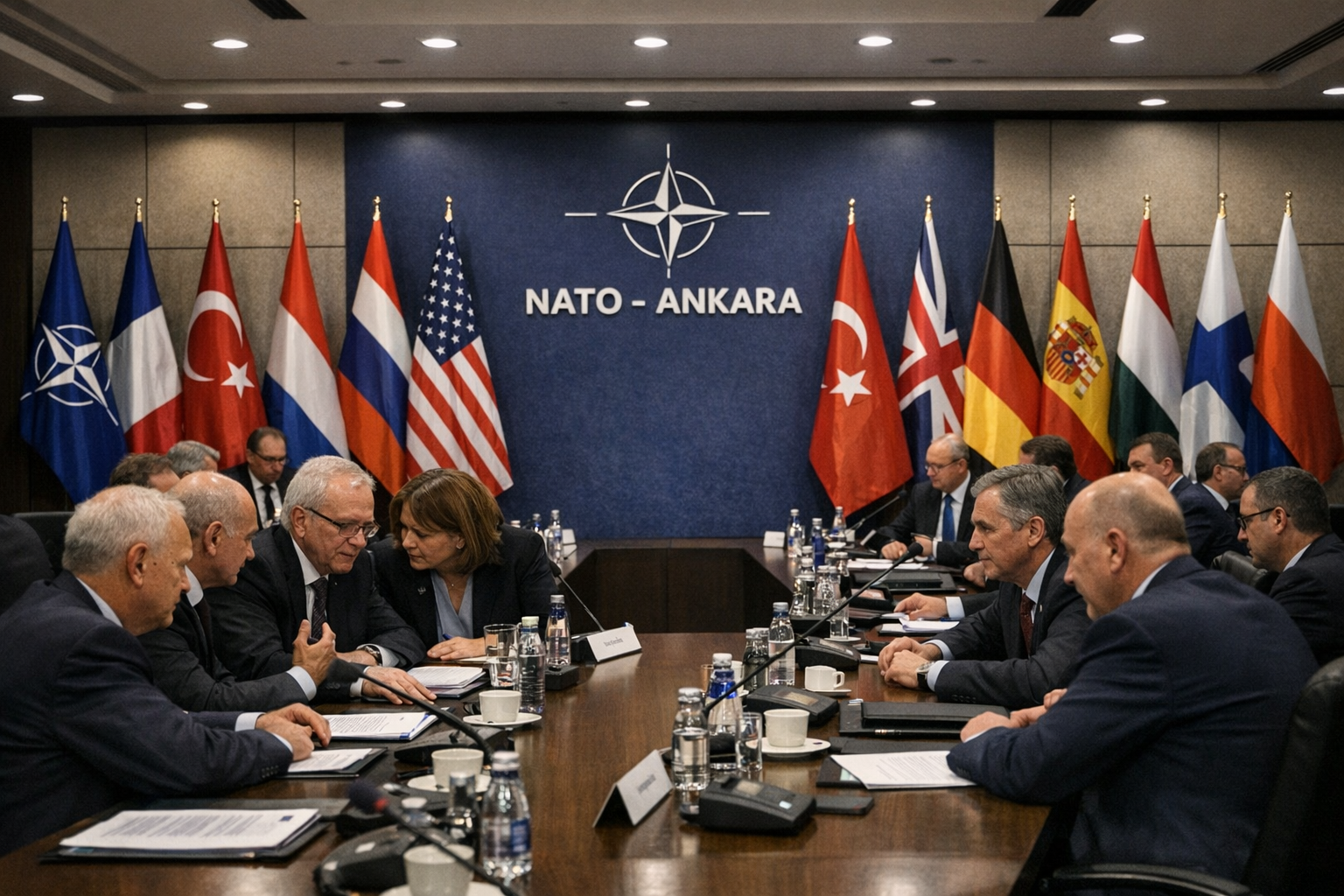
The NATO summit in Ankara ended, at least on the surface, with a familiar ritual of reassurance: President Trump told allies he still wanted the United States to remain in the alliance, and European leaders emerged eager to present the gathering as another crisis managed rather than another rupture endured.
But in the days since, the most consequential fallout has moved beyond the summit hall. What looked like a contained bout of trans-Atlantic turbulence is hardening into something more consequential: widening European distance from Washington over Iran, and a renewed threat by Mr. Trump to turn an alliance dispute with Spain into economic coercion.
The immediate question is no longer whether NATO survived two dramatic days in Turkey. It did. The more pressing one is whether the alliance is entering a new phase in which American support remains available, but increasingly conditional — shaped by personal deference, transactional bargaining and the possibility that disputes over security could spill into trade.
A Summit Shaped by One Man
Officials and diplomats who worked through the summit described an atmosphere in which leaders spent much of the meeting not simply debating policy, but trying to anticipate Mr. Trump’s mood, priorities and red lines. His shifting public tone on alliance solidarity and the Middle East repeatedly forced others to adjust.
That dynamic has become central to NATO management under Secretary General Mark Rutte, who has pursued a strategy of praising Mr. Trump, highlighting rising European military spending and avoiding public confrontation. The approach reflects a blunt calculation shared by many European capitals: keeping Mr. Trump invested in NATO requires presenting the alliance in terms he values, above all as proof that allies are paying more and that American pressure is producing results.
That strategy appeared to work, in narrow terms, in Ankara. Mr. Trump again stopped short of threatening withdrawal and gave allies enough reassurance to avert a larger panic. But the choreography also laid bare how dependent alliance cohesion has become on accommodating him personally.
Europe Puts Space Between Itself and Washington on Iran
The sharper policy divide has emerged over Iran.
At the summit, Mr. Trump pressed allies over their posture toward the war, seeking stronger alignment with Washington after a conflict that many European governments had not endorsed at the outset. Since then, several allies have signaled they want to keep their distance from the administration’s broader Iran policy, even while continuing practical cooperation in areas like maritime security and protection of shipping routes.
That distinction is important. European governments do not want to be seen as abandoning regional stability or commercial security. But neither do they want to be pulled more deeply into a confrontation that began without broad allied backing and that carries obvious escalation risks.
For NATO, the split matters because it exposes a limit to the alliance’s show of unity. Allies may be prepared to spend more on defense and reaffirm mutual obligations in Europe, yet still resist following Washington on conflicts beyond the alliance’s core theater. In that sense, Ankara underscored that the debate over burden-sharing has not resolved a deeper argument about political alignment.
The concern in European capitals is that support for the alliance itself could become entangled with support for American policy choices elsewhere. That is precisely the linkage many leaders have tried to avoid.
Spain Becomes the Next Pressure Point
If Iran has opened a strategic rift, Spain may become the next institutional one.
Mr. Trump revived pressure on Madrid over defense spending during and after the summit, singling out Spain as an example of an ally falling short. The criticism itself was not new; complaints about uneven defense spending have shadowed NATO for years. What is new is the possibility that Mr. Trump could try to punish a fellow ally through emergency economic powers.
Legal and trade specialists say that even after the Supreme Court rejected Mr. Trump’s sweeping use of the International Emergency Economic Powers Act, or IEEPA, to impose broad tariffs on nearly every country, the law could still be invoked more narrowly to restrict certain types of commerce with Spain. Any such move would almost certainly face immediate legal challenge, and it remains uncertain whether the administration would proceed or prevail.
Still, the threat alone is significant. It suggests that arguments once largely confined to NATO communiqués and defense pledges could migrate into trade policy, introducing a new layer of instability into trans-Atlantic relations.
For European governments, that possibility is especially unsettling because it blurs lines that had long been kept separate. NATO has historically functioned on the premise that internal disputes, however bitter, would not be prosecuted as economic warfare among allies. If that assumption weakens, the alliance could face not just strategic mistrust but commercial uncertainty as well.
The Rutte Formula — and Its Limits
Mr. Rutte’s handling of Mr. Trump has won quiet praise from some officials who see little alternative to tact, flattery and persistence. His pitch to Washington in recent weeks has emphasized what some around NATO have called a “Trump trillion” argument: that allied defense spending is rising sharply and can be framed as a political victory for the president.
The formula has helped buy time. European leaders went into Ankara determined to avoid a public blowup and to show Mr. Trump that pressure on allies was yielding concrete gains. In that limited sense, they succeeded.
But the aftermath has shown the limits of the strategy. Praise can help keep the United States formally anchored to NATO; it cannot guarantee alignment on Iran, prevent bilateral grievances from resurfacing, or stop Mr. Trump from using public threats to extract concessions.
The risk for Europe is that alliance management becomes an endless exercise in personalization — one that secures tactical calm while leaving the underlying volatility untouched.
A Truce, Not a Reset
For now, NATO has escaped the worst-case scenario many feared before the Ankara meeting. There was no rupture, no explicit American threat to leave, no dramatic collapse in summit diplomacy.
Yet the sense of relief may prove misleading.
Several questions remain unresolved: whether Mr. Trump will actually pursue punitive economic measures against Spain; whether courts would allow any narrower use of emergency powers to stand; and how far major European allies are willing to separate themselves from Washington on Iran beyond careful rhetorical distancing.
There is also a broader uncertainty hanging over the alliance. Was the summit’s calm ending the start of a more durable accommodation, or merely a temporary truce before the next clash over troop deployments, defense burdens, Greenland or Middle East policy?
What Ankara appears to have settled is only this: NATO can still function under pressure from Mr. Trump. What it has not settled is the cost of functioning that way.
Sources
Further reading and reporting used to add context:
- https://apnews.com/article/3f5033e82933afe6d70d8bb3cbf9fd1d
- https://apnews.com/article/1be2097870a203c28469246077da4fd1
- https://www.axios.com/2026/07/08/trumps-nato-trouble-europe-tour
- https://www.thedailybeast.com/donald-trumps-filthy-mood-has-goons-worried-about-whats-to-come/
- https://www.investing.com/news/world-news/explainercan-us-president-trump-cut-off-all-trade-with-spain-4781909
- https://www.investing.com/news/world-news/nato-leaders-meet-in-ankara-after-trump-rekindles-disputes-over-iran-greenland-4780634
- https://www.investing.com/news/world-news/nato-weathers-another-trump-storm-but-braces-for-more-after-ankara-summit-4783318
- https://www.reutersconnect.com/item/trump-and-rutte-disagree-on-europe-defense-spending-in-oval-office-meeting/dGFnOnJldXRlcnMuY29tLDIwMjY6bmV3c21sX1ZBMjE2NzI0MDYyMDI2UlAx
- https://www.investing.com/news/world-news/trump-told-nato-leaders-he-wants-to-keep-us-in-alliance-source-says-4781624
- https://www.investing.com/news/world-news/exclusivenatos-rutte-brushes-off-disputes-between-trump-and-allies-4782150
- https://www.investing.com/news/world-news/nato-leaders-to-gather-in-ankara-aiming-to-smooth-over-tensions-with-trump-4775040
- https://www.internazionale.it/ultime-notizie-reuters/2026/07/09/nato-weathers-another-trump-storm-but-braces-for-more-after-ankara-summit
- https://www.internazionale.it/ultime-notizie-reuters/2026/07/08/nato-leaders-meet-in-ankara-after-trump-rekindles-disputes-over-iran-greenland
- https://www.reutersconnect.com/item/us-president-donald-trump-meets-with-nato-secretary-general-mark-rutte-at-the-white-house-in-washington/dGFnOnJldXRlcnMuY29tLDIwMjY6bmV3c21sX1JDMkswTUFOVThKRA
- https://www.investing.com/news/economy-news/us-supreme-court-rejects-trumps-global-tariffs-4516593
- https://www.investing.com/news/world-news/turkey-says-nato-should-reset-ties-with-trump-at-next-summit-prepare-for-future-4609931
- https://apnews.com/article/f8379b038dfbbf7afde80bb50a0bd96e
- https://apnews.com/article/4821e7c6f2ab0b8a729d0e798bfe6359
- https://www.thedailybeast.com/trump-hit-with-immediate-nato-snub-on-overseas-trip/
- https://www.investing.com/news/commodities-news/nato-allies-to-discuss-hormuz-tensions-mission-with-gulf-arabs-4778470
- https://www.internazionale.it/ultime-notizie-reuters/2026/07/07/nato-allies-to-discuss-hormuz-tensions-mission-with-gulf-arabs
- https://www.investing.com/news/world-news/trump-cites-tremendous-unity-at-nato-summit-progress-on-defense-spending-4782095
- https://www.investing.com/news/world-news/explainerwhat-are-the-key-challenges-facing-nato-4775049
- https://www.fidelity.com/news/article/default/202606240104RTRSNEWSCOMBINED_KBN3SQ0FQ-OUSWD_1
- https://www.marketscreener.com/news/trump-says-nato-allies-were-not-there-for-us-in-iran-conflict-ce7f5ed8da8cf026
- https://www.nato.int/en/news-and-events/articles/news/2026/06/25/secretary-general-meets-president-trump-in-washington-europe-is-stepping-up
- https://www.themoscowtimes.com/2026/07/07/kremlin-says-its-closely-following-nato-summit-a93182/pdf
- https://www.europarl.europa.eu/RegData/etudes/BRIE/2026/785722/EPRS_BRI%282026%29785722_EN.pdf
- NATO leaders meet in Ankara after Trump rekindles disputes over Iran, Greenland By Reuters
- NATO weathers another Trump storm but braces for more after Ankara summit By Reuters
- Explainer-Can U.S. President Trump ’cut off all trade’ with Spain? By Reuters