
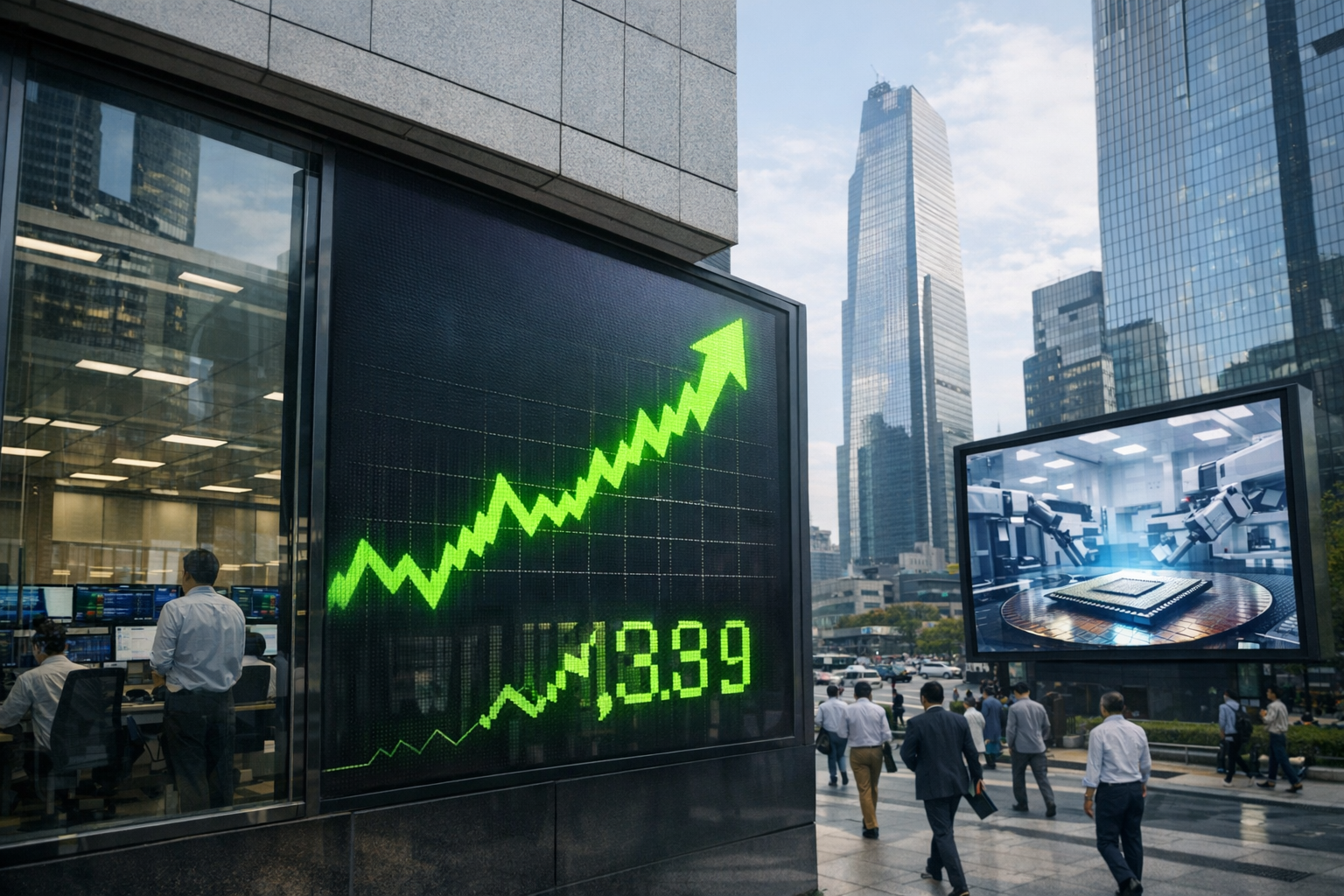
South Korea’s stock market delivered one of its most violent reversals on record on Friday, roaring back from a three-day rout as investors piled once more into the semiconductor makers at the center of the global artificial-intelligence boom.
The benchmark KOSPI index surged 17.9 percent, its biggest one-day gain on record, after falling more than 17 percent over the previous three sessions. The rebound was driven overwhelmingly by Samsung Electronics and SK Hynix, the country’s two chip giants, whose shares jumped roughly 28 percent and 30 percent, respectively, as enthusiasm for A.I.-linked stocks revived in the wake of a strong rally in U.S. technology shares.
The sudden swing laid bare the increasingly narrow forces driving South Korea’s equity market. What might once have been interpreted as a broad vote of confidence in the economy now looks more like a concentrated wager on whether the A.I. spending boom can continue to lift memory-chip profits.
A Market Ruled by Chips
Few major stock markets are as exposed to a single global theme as South Korea’s. Samsung and SK Hynix together make up roughly half, and at times slightly more than half, of the KOSPI by market weight, giving the country’s equity benchmark an unusually direct link to the fortunes of the semiconductor cycle.
That concentration has turned South Korea into a regional barometer for the A.I. trade, but also a volatile one. When investors embrace the view that demand for high-bandwidth memory and advanced chips will remain strong, Seoul can outperform dramatically. When they begin to question how long that boom can last, the selling can be just as fierce.
Friday’s rebound followed a sharp rise in Wall Street technology stocks after strong results from Microsoft helped reassure investors that the huge sums being poured into A.I. are still translating into revenue growth for some of the world’s largest companies. That optimism spilled quickly into Asian trading, lifting the South Korean chip makers seen as crucial suppliers to the global A.I. supply chain.
From Bear Market to Record Rally
The comeback capped a month of extraordinary instability.
Earlier in July, the KOSPI had tumbled into a bear market after dropping about 25 percent from its late-June peak, a decline that reflected growing unease over how far and how fast South Korean chip shares had risen. Investors had begun to fret about stretched valuations, heavy retail speculation, and the possibility that a surge in planned capacity spending could eventually weaken pricing power.
There were also broader anxieties about competition from China, where domestic memory and chipmaking capabilities have advanced faster than many in the market once expected. For South Korea’s biggest technology companies, which dominate key niches in memory chips, the question is no longer simply whether demand exists, but whether today’s elevated profits can be protected as rivals expand and supply catches up.
Yet even during the sell-off, the industry’s underlying earnings picture remained robust. Samsung reported record second-quarter operating profit of 89.5 trillion won on July 30, bolstered by strong demand tied to A.I. applications. SK Hynix also posted record quarterly revenue, underscoring that the market’s doubts have not centered on current business conditions so much as on how long this pace can endure.
Strong Profits, Fragile Confidence
That tension — between exceptional present-day earnings and uncertainty about the future — helps explain the market’s “bipolar” behavior.
For believers, the latest earnings offer evidence that the A.I. build-out remains a real industrial shift, not merely a speculative story. Memory chips used in A.I. servers have become one of the most lucrative corners of the semiconductor business, and South Korean companies are among the clearest beneficiaries.
But for skeptics, the velocity of the recent gains is itself a warning sign. Much of the market’s ascent this year has been fueled by a small group of stocks, leaving valuations vulnerable to even modest disappointment. Analysts have also been watching for signs that memory-chip price increases could cool in the second half of 2026, particularly if capacity additions begin to outpace demand growth.
The result is a market in which conviction can reverse with unusual speed. South Korean retail investors, who have played an outsized role in trading the country’s technology winners, have at times amplified those moves through leveraged positions and concentrated bets, including through single-stock exchange-traded products.
Why This Matters Now
The latest rally matters well beyond Seoul because it offers a concentrated read on one of the biggest questions hanging over global markets: whether investors still believe the A.I. boom can justify the enormous valuations attached to chipmakers and technology platforms.
In the United States, that debate is spread across software groups, cloud providers and semiconductor designers. In South Korea, it is compressed into two names. That makes the KOSPI a sharper — and often harsher — expression of shifting sentiment.
Friday’s rebound suggests that, for now, investors are still willing to buy the argument that A.I. spending will remain powerful enough to support elevated earnings for the companies supplying its hardware backbone. But the scale of the whipsaw also showed how fragile that belief remains.
The market has not resolved its central question. It has simply swung back toward optimism. Whether that marks the start of a more durable recovery, or just another burst of enthusiasm in an unstable market, may depend on what comes next from U.S. technology earnings, semiconductor pricing and the race to expand production without flooding the market.
Sources
Further reading and reporting used to add context:
- Asian markets rise as AI-related stocks soar, pushing Kospi up nearly 18% | AP News
- https://apnews.com/article/10c2c548a392988862d8c7bd3f6fae05
- https://www.tomshardware.com/tech-industry/sk-hynix-operating-profit-rises-557-percent
- https://www.pcgamer.com/hardware/memory/ram-prices-be-damned-sk-hynixs-record-breaking-usd55-6-billion-quarter-still-failed-to-meet-investors-wild-ai-expectations/
- https://fortune.com/2026/07/19/korea-ai-stocks-sk-hynix-samsung-kospi-index-global-markets/
- https://www.reutersconnect.com/item/south-koreas-kospi-hits-record-as-sk-hynix-tops-1-trillion-club-for-first-time-in-ai-driven-rally/dGFnOnJldXRlcnMuY29tLDIwMjY6bmV3c21sX1ZBMzgyODI3MDUyMDI2UlAx
- https://en.yna.co.kr/view/AEN20260703007752320
- SK Hynix shares surge 13% on AI hopes as US tech stocks resume their climb By Reuters
- Analysis-Inside South Korea’s world-beating bear market By Reuters
- https://www.policyrix.com/news/2026-07-04/south-korea-kospi-whipsaws-on-ai-chip-swings-as-inflation-climbs
- https://ca.marketscreener.com/news/s-korea-s-kospi-tumbles-8-triggering-circuit-breakers-for-sixth-time-this-year-ce7f5edbdf8ef122
- Asian chip stocks slide as China competition fears rattle AI trade By Reuters
- https://english.hani.co.kr/arti/english_edition/e_business/1266651.html
- https://biz.chosun.com/en/en-finance/2026/07/14/73GMTC2ADFAMPMKJKTSAN7W5RU/?outputType=amp
- https://www.marketscreener.com/news/chipmakers-and-other-high-flying-stocks-slide-as-ai-trade-wobbles-ce7f51dad880f024
- https://uk.marketscreener.com/news/s-korea-s-kospi-breaks-7-000-as-ai-chip-rally-lifts-samsung-into-1-trillion-club-ce7f58ddda88f520
- https://smifs.com/uploads/SMIFS_Research_Morning_Note_02_July_2026_5d223ea4db.pdf
- https://www.reddit.com/r/korea/comments/1vbcs0b/sk_hynix_shares_surge_25_while_samsung_soars_over/
- https://blog.syzgroup.com/hubfs/Equity_Weekly_15-22%20May_2026.pdf?hsLang=en
- https://ceomorningbrief.theedgemalaysia.com/pdf/2026/20260507_CMB_1149/260507pf0trl.pdf
- https://www.reddit.com/r/ValueInvesting/comments/1vaumuk/my_lifes_screwed_korean_investors_stress_out/
- https://www.reddit.com/r/stocks/comments/1vbeqva/south_korean_index_soared_16_biggest_1_day_gain/
- https://www.reddit.com/r/DeepFuckingValue/comments/1upvrsy/wtf_is_going_in_south_korea_from_an_all_time_high/
- https://www.reddit.com/r/SKHynix/comments/1um6avw/recent_30_pull_down_from_ath_breakdown/
- https://thepeninsulaqatar.com/pdf/20260528_1779916857-978.pdf
- https://www.reddit.com/r/RWATimes/comments/1vbg7m5/south_koreas_bipolar_stock_market_meltdowns_a/
- https://www.reddit.com/r/wallstreetbets/comments/1vbb95o/sk_hynix_and_samsung_shares_surge_over_20_as_ai/
- https://www.reddit.com/r/stocks/comments/1v4l5l5/kospi_to_10000_south_korean_equities_poised_to/
- https://www.reddit.com/r/smallstreetbets/comments/1vbet8z/south_korean_index_soared_16_biggest_1_day_gain/
- https://www.reddit.com/r/SKHynix/comments/1uscvua/samsungs_stock_dropped_48_right_after_its_best/