
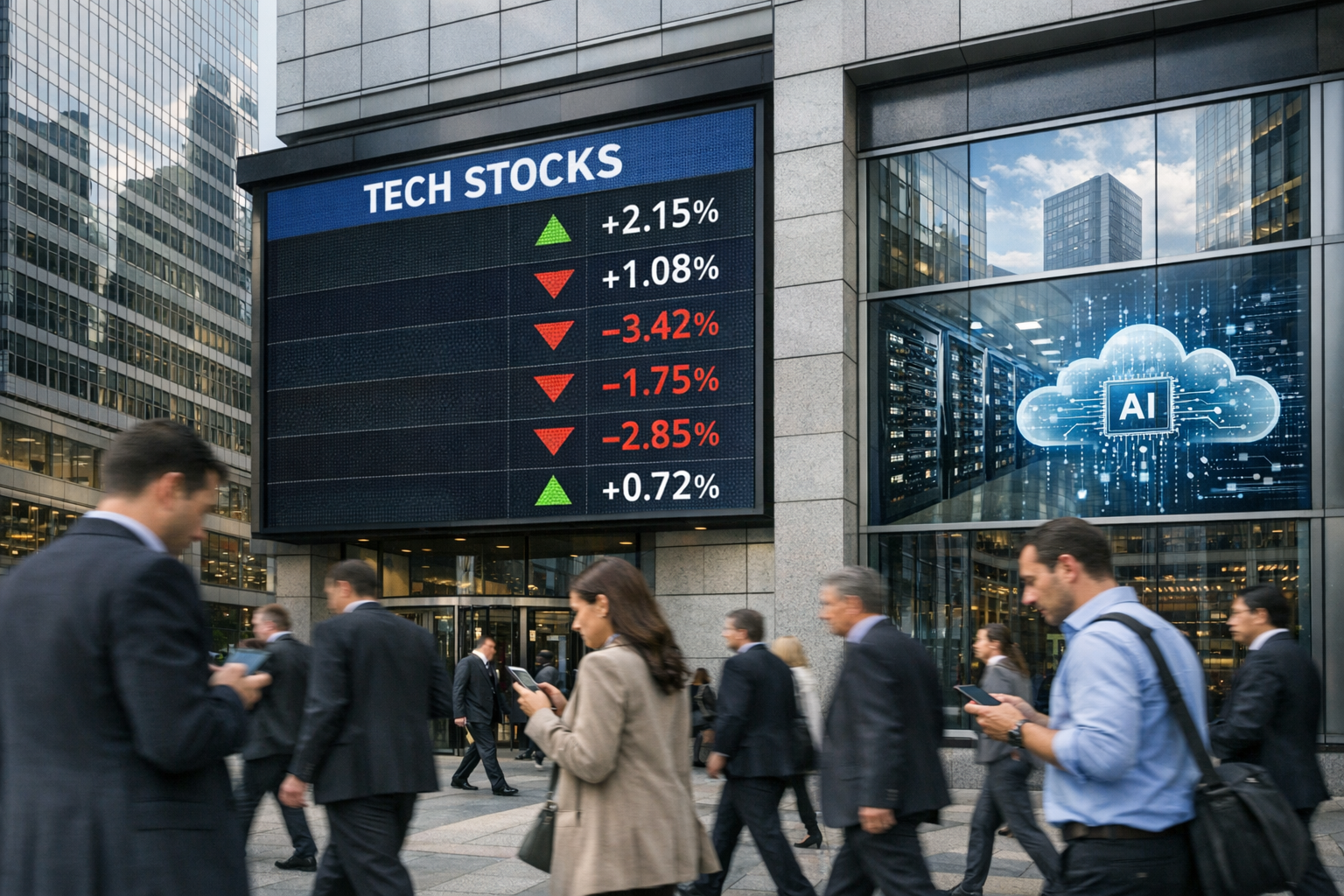
The stock market’s latest verdict on Big Tech was unusually blunt: It is no longer enough to talk about artificial intelligence. Investors want proof that the spending is turning into growth.
That message reverberated across a new round of earnings reports this week, sending shares of Amazon and Microsoft sharply higher while knocking down Apple, Meta and Reddit. The divergence offered one of the clearest signs yet that Wall Street is sorting technology companies into distinct camps — those showing tangible returns from the A.I. boom, and those still asking shareholders for patience.
Amazon surged after reporting that its cloud division, Amazon Web Services, grew 37 percent from a year earlier, well ahead of expectations, and after signaling that it would increase capital expenditures in 2026 to roughly $220 billion, citing rising memory costs and continued infrastructure demand. Microsoft, too, won a warm reception after reporting strong Azure growth and saying the business had crossed $100 billion in annual revenue, a milestone that underscored how central cloud computing has become to the company’s A.I. strategy.
The reaction was different for companies whose results left more ambiguity.
Apple shares fell even after the company delivered results helped by resilient iPhone sales. The decline reflected a concern that has shadowed the company for months: while rivals are pouring vast sums into data centers, chips and cloud capacity, Apple has yet to persuade investors that its more restrained approach to A.I. spending will be enough. For a company that remains enormously profitable and generates prodigious cash flow, the question is not near-term financial health, but whether it risks falling behind in the next major computing shift.
Meta’s shares also slid after earnings, despite revenue that topped expectations. Investors focused instead on weakening profitability, including a steep drop in free cash flow, as the company contended with mounting costs tied to A.I., legal matters and severance. The market response suggested that even strong sales growth may not shield a company if the underlying economics appear to be deteriorating.
And Reddit, which reported quarterly results that exceeded Wall Street’s forecasts and offered upbeat guidance, still saw its stock fall after executives described search referrals as “choppy.” That comment touched a growing nerve in the internet industry: as users increasingly encounter answers through A.I.-generated search tools rather than traditional links, companies that depend on traffic from Google and other search engines face a more uncertain future.
From A.I. promise to A.I. proof
The split did not emerge from nowhere. For months, investors have been grappling with a basic tension at the heart of the A.I. trade. The largest technology companies have committed extraordinary sums to building the computing infrastructure needed to train and run advanced models. But as those costs rise, so has pressure to show that the investment is producing durable demand and, eventually, attractive profits.
That scrutiny intensified earlier in the earnings season, when investors responded coolly to signs that capital spending across the sector would keep climbing. By the time Amazon, Microsoft, Apple, Meta and Reddit reported this week, the standard had changed. Markets were no longer rewarding ambition alone. They were rewarding evidence of monetization, capacity utilization and customer appetite.
Amazon and Microsoft met that test more convincingly than their peers. In both cases, cloud growth offered a measurable signal that companies are paying for A.I. tools and the computing power behind them. Microsoft has increasingly tied its fortunes to Azure and to products like Copilot, betting that A.I. can deepen enterprise spending across its software ecosystem. Amazon, long a dominant provider of cloud infrastructure, showed that demand for computing capacity remains robust enough for investors to accept yet another escalation in spending.
That acceptance carries significance well beyond the companies themselves. A.I.-related capital expenditures are now large enough to influence not just individual stocks but broader market leadership, earnings expectations and confidence in the technology sector. A handful of megacap companies account for an outsized share of major stock indexes, meaning that investor judgments about who is winning the A.I. race can ripple through the entire market.
The outliers and the risks
Apple remains the most conspicuous exception among the largest technology companies. Unlike Amazon, Microsoft, Meta and Alphabet, it is not matching the same scale of infrastructure spending. That could ultimately prove prudent if the economics of A.I. become less attractive than today’s enthusiasts expect. But it could also leave Apple looking underprepared if consumers come to expect more powerful A.I. features deeply embedded in devices and services.
Meta faces a different challenge. The company has made clear that it intends to spend aggressively to compete in A.I., but investors are signaling limits to their tolerance when those outlays coincide with pressure on margins and cash flow. The question now is whether Meta can restore confidence that its spending spree will translate into stronger, more profitable growth rather than simply bigger bills.
For Reddit, the problem is less about the scale of spending than the fragility of traffic sources. The company’s strong quarter showed that its business continues to improve, but the concern raised by uneven search referrals points to a deeper structural issue: if A.I.-driven search products reshape how people discover information online, platforms that rely on traditional referral patterns may become more vulnerable.
What comes next
The sharp moves in these stocks suggest that the market’s A.I. story has entered a more demanding phase. The winners are being granted room to spend, but only so long as they can show accelerating usage and revenue. The losers — or at least the questioned companies — are being asked to explain why the payoff is taking longer, costing more or depending on shakier assumptions.
That leaves several unresolved questions hanging over the sector. Can Amazon convert its enormous infrastructure investment into sustained AWS growth without eroding cash generation? Can Microsoft maintain its lead as competition in enterprise A.I. broadens? Will Meta stabilize profitability while continuing to fund its ambitions? Can Apple’s lighter-spend model become a strategic advantage rather than a liability? And can Reddit adapt if A.I. search permanently alters the flow of users across the internet?
For now, investors have drawn a hard line. In the A.I. race, spending alone is no longer impressive. Results are.
Sources
Further reading and reporting used to add context:
- https://apnews.com/article/b4ce02b4666a35b8975823c5c22072ee
- https://www.axios.com/2026/07/30/amazon-earnings-revenue-ai
- https://www.kiplinger.com/investing/stocks/markets-weigh-peace-hope-against-ai-fear-stock-market-today
- https://www.reddit.com/r/RWATimes/comments/1vb96dp/reddit_shares_sink_11_on_choppy_search_referrals/
- https://www.reddit.com/r/stocks/comments/1vb4uhh/reddit_crushes_revenue_and_earnings_estimates/
- https://www.reddit.com/r/stocks/comments/1vb6jyg/reddit_shares_slide_despite_strong_q2_beat_and/
- https://www.investing.com/news/stock-market-news/wall-st-futures-rise-after-tech-rout-mideast-tariffs-in-focus-4810955
- https://www.investing.com/news/economy-news/wall-st-futures-rise-as-us-iran-pause-hostilities-4813225
- https://www.fidelity.com/news/article/us-markets/202607241600RTRSNEWSCOMBINED_L6N43Q17C_1
- https://www.investing.com/news/economy-news/us-stocks-face-tests-from-fed-decision-techled-earnings-deluge-4810946
- https://www.investing.com/news/economy-news/us-stock-futures-up-as-chip-shares-recover-oil-prices-decline-4775958
- https://www.reddit.com/r/stocks/comments/1io291r/reddit_shares_plunge_15_after_company_misses_on/
- https://www.investing.com/news/stock-market-news/google-quarterly-cloud-revenue-growth-beats-expectations-4806844
- https://www.investing.com/news/stock-market-news/wall-st-falls-as-tech-earnings-spark-ai-spending-worries-oil-jumps-4808085
- https://www.marketscreener.com/news/reddit-expects-revenue-above-estimates-as-ai-tools-fuel-ad-growth-ce7f58d8dc8ef52c
- https://apnews.com/article/94102918cb3592ebc1d2a38c4d7d819a
- https://apnews.com/article/bcbc62dde6d2cac724e3b3385fcabeab
- https://apnews.com/article/f7dff4fb9d51a2bdec56a13e5da1053d
- https://www.kiplinger.com/investing/stocks/17494/next-week-earnings-calendar-stocks
- https://www.axios.com/2026/07/29/microsoft-earnings-azure-2026
- https://www.apple.com/investor/earnings-call/
- https://www.microsoft.com/en-us/investor/events/fy-2026/earnings-fy-2026-q2
- https://www.reddit.com/r/RDDT/comments/1us1l6r/reddit_to_announce_second_quarter_2026_results_on/
- https://investor.atmeta.com/investor-news/press-release-details/2026/Meta-to-Announce-Second-Quarter-2026-Results/default.aspx
- https://investor.atmeta.com/investor-events/event-details/2026/Q2-2026-Earnings-Call/default.aspx
- https://www.microsoft.com/en-us/Investor/earnings/FY-2026-Q2/press-release-webcast
- https://investor.atmeta.com/investor-events/default.aspx?ShowEvents=FUTURE
- https://investor.atmeta.com/investor-events/default.aspx
- https://www.reddit.com/r/redditstock/comments/1uz61ei/q2_earnings/
- https://www.reddit.com/r/stocks/comments/1v3wyds/google_q2_earnings_top_expectations_cloud_revenue/
- https://investor.atmeta.com/investor-news/press-release-details/2025/Meta-Reports-Second-Quarter-2025-Results/
- https://investor.atmeta.com/investor-news/press-release-details/2026/Meta-Reports-First-Quarter-2026-Results/
- https://investor.salesforce.com/financials/quarterly-results/
- https://www.reddit.com/r/redditstock/comments/1v96jxc/my_2_cents_on_the_earnings/
- https://www.sec.gov/Archives/edgar/data/723125/000072312526000013/a2026q3ex991-pressrelease.htm
- https://www.reddit.com/r/redditstock/comments/1us1m8i/reddit_to_announce_second_quarter_2026_results_on/
- https://www.microsoft.com/en-us/investor/earnings/fy-2026-q2/press-release-webcast
- https://www.reddit.com/r/amd_fundamentals/comments/1v4hnfs/intel_q2_2026_earnings_jul_23_2026_200_pm_pdt/
- https://www.apple.com/newsroom/2026/04/apple-reports-second-quarter-results/
- https://investor.apple.com/investor-relations/default.aspx
- https://www.apple.com/newsroom/2020/07/apple-reports-third-quarter-results/
- https://www.apple.com/newsroom/2016/07/apple-reports-third-quarter-results/
- https://www.microsoft.com/en-us/investor/events/fy-2026/earnings-fy-2026-q3
- https://www.microsoft.com/en-us/investor/earnings/fy-2026-q3/intelligent-cloud-performance
- https://www.apple.com/newsroom/topics/company-news/
- https://www.microsoft.com/en-us/investor/earnings/fy-2026-q3/press-release-webcast
- https://www.microsoft.com/en-us/Investor/earnings/fy-2025-Q4/press-release-webcast?msockid=035cde200e1d6402354dc86b0fbe6539
- https://www.microsoft.com/en-us/investor/events/fy-2026/earnings-fy-2026-q1
- https://investor.apple.com/investor-relations/faq/default.aspx
- https://investor.redditinc.com/news-events/news-releases/news-details/2026/Reddit-Reports-First-Quarter-2026-Results/default.aspx
- https://investor.redditinc.com/news-events/news-releases/news-details/2026/Reddit-to-Announce-Second-Quarter-Results-on-Thursday-July-30-2026/default.aspx
- https://investor.redditinc.com/news-events/news-releases/default.aspx
- https://investor.redditinc.com/news-events/news-releases/news-details/2025/Reddit-Announces-Second-Quarter-2025-Results/default.aspx
- https://investor.redditinc.com/financials/quarterly-results/default.aspx
- https://investor.redditinc.com/overview/default.aspx?trk=public_post_comment-text
- https://investor.redditinc.com/financials/annual-reports/default.aspx
- https://investor.redditinc.com/news-events/news-releases/news-details/2024/Reddit-Announces-First-Quarter-2024-Results/
- https://investor.redditinc.com/news-events/investor-events/default.aspx
- https://investor.redditinc.com/financials/sec-filings/default.aspx
- https://investor.redditinc.com/events/event-details/2026/Reddit-Q126-Earnings-Call/default.aspx
- https://investor.redditinc.com/financials/sec-filings/sec-filings-details/default.aspx?FilingId=19397835
- https://investor.redditinc.com/files/doc_financials/2024/q1/Q1-24-RDDT-Letter-to-Shareholders-vF-1.pdf
- https://investor.redditinc.com/files/doc_financials/2024/q1/Reddit-Q1-24-Earnings-Call_Transcript.pdf
- https://investor.redditinc.com/files/doc_financials/2024/q1/3b378252-da7b-4f74-9ace-d6c8630bdaae.pdf
- https://www.fidelity.com/news/article/company-news/202607221605RTRSNEWSCOMBINED_KBN3TI2HM-OUSBS_1
- https://www.fidelity.com/news/article/us-markets/202607240617RTRSNEWSCOMBINED_KBN3TK12F-OUSBS_1
- https://www.reddit.com/r/fidelityinvestments/comments/1vaf51j/removed/
- https://www.reddit.com/r/fidelityinvestments/comments/1vakayp/removed/
- https://www.fidelity.com/news/article/default/202607151401RTRSNEWSCOMBINED_KBN3TA26Z-OUSBS_1
- https://www.fidelity.com/news/article/technology/202606101613RTRSNEWSCOMBINED_KBN3SC2L0-OUSBS_1
- https://www.reddit.com/r/technology/comments/1vb9io7/amazon_hikes_2026_capex_to_220_billion_due_to/
- https://www.reddit.com/r/fidelityinvestments/comments/1ups1tq/removed/
- https://www.reddit.com/r/fidelityinvestments/comments/1v1kgcu/removed/
- https://m.investing.com/news/stock-market-news/microsoft-and-meta-fuel-500billion-gain-in-ai-stocks-4161409?ampMode=1
- https://www.reddit.com/r/fidelityinvestments/comments/1uuo3aq/removed/
- https://www.investing.com/news/stock-market-news/amazon-capex-outlook-ahead-of-july-30-earnings-and-the-ai-infrastructure-race-93CH-4812069
- https://www.reddit.com/r/SNDK_Stock/comments/1vbgv52/amzn_on_memory_during_quarterly_earning_report/
- https://www.investing.com/news/stock-market-news/why-is-reddit-stock-rallying-today-93CH-4814454
- https://gummysearch.com/r/Fidelity/
- https://www.investing.com/news/stock-market-news/wall-st-futures-hit-record-peaks-as-meta-microsoft-results-get-ai-boost-4162272
- https://finance.yahoo.com/markets/stocks/articles/stock-markets-winners-losers-big-133502949.html
- https://finance.yahoo.com/markets/stocks/articles/why-reddit-rddt-stock-nosediving-002855726.html
- https://ca.finance.yahoo.com/quote/RDDT/
- https://au.finance.yahoo.com/news/tech-stocks-today-meta-stock-jumps-on-cloud-computing-plans-to-rival-amazon-microsoft-151053436.html
- https://finance.yahoo.com/sectors/technology/articles/ai-demand-earnings-optimism-lift-145850324.html
- https://finance.yahoo.com/markets/stocks/articles/rddt-stock-plunges-hours-p-222934332.html
- https://finance.yahoo.com/news/google-ai-killing-reddit-traffic-123000219.html
- https://finance.yahoo.com/news/us-megacap-results-test-markets-111936351.html
- https://finance.yahoo.com/news/reddit-stock-slides-as-investors-weigh-google-search-traffic-user-growth-concerns-134057772.html
- https://au.finance.yahoo.com/news/big-techs-first-half-was-a-story-of-hardware-versus-software-120311290.html
- https://www.reddit.com/r/stocks/comments/1v1i27r/rstocks_daily_discussion_monday_jul_20_2026/
- https://www.reddit.com/r/StockMarket/comments/1varjrn/meta_tanks_nearly_9_microsoft_jumps_9_as_the_ai/
- https://www.reddit.com/r/NBIS_Stock/comments/1vaknu8/meta_fell_7_on_the_same_ai_demand_that_lifted/
- https://www.reddit.com/r/stockstobuytoday/comments/1vapk2i/msft_8_while_meta_85_premarket_is_the_ai_trade/
- https://www.reddit.com/r/stocks/comments/1vauby1/microsoft_meta_reported_last_night_microsoft_is/
- https://www.reddit.com/r/StockMarket/comments/1vaiv0x/my_thoughts_on_msft_and_meta_earnings_and_the/
- https://www.reddit.com/r/redditstock/comments/1vb5lz9/who_has_a_link_to_this_search_referrals_were/
- https://www.reddit.com/r/redditstock/comments/1vb4sjt/reddit_recap_q226_by_the_numbers/
- https://www.reddit.com/r/redditstock/comments/1vbi1p7/where_are_we_bottoming_after_this_earnings_dump/
- https://www.reddit.com/r/thewallstreet/comments/1vb4hbq/nightly_discussion_july_30_2026/
- https://www.reddit.com/r/RDDT/comments/1vb4oe8/reddit_announces_q226_earnings_plus_ama/
- https://www.reddit.com/r/redditstock/comments/1vb80o4/thoughts_on_q2/
- https://www.reddit.com/r/stocks/comments/1vb2hn2/everything_you_need_to_know_about_rddt_earnings/
- https://investor.redditinc.com/overview/default.aspx?creative=680328857022&dv=c&mt=e
- https://www.sec.gov/Archives/edgar/data/1713445/000171344526000020/0001713445-26-000020-index-headers.html
- https://www.sec.gov/Archives/edgar/data/1713445/000171344526000088/0001713445-26-000088-index.htm
- https://qz.com/reddit-stock-google-ai-content-deal-072226
- https://www.techspot.com/news/113199-reddit-major-publishers-consider-blocking-google-ai-search.html
- https://www.fool.com/investing/2026/07/27/reddit-incs-next-earnings-report-on-july-30-could-send-the-stock-soaring-heres-why/
- https://support.reddithelp.com/hc/en-us/articles/27958169342996-Reddit-Developer-Funds-H1-2026-Terms
- https://www.benzinga.com/trading-ideas/movers/26/07/60602499/reddit-stock-hasnt-missed-an-eps-estimate-in-two-years-will-q2-break-the-streak
- https://s203.q4cdn.com/380862485/files/doc_financials/2025/q2/Reddit-Q2-25-Earnings-Call_Transcript.pdf
- https://s203.q4cdn.com/380862485/files/doc_events/2025/Feb/12/Reddit-Q4-24-Earnings-Call-Transcript.pdf
- https://s203.q4cdn.com/380862485/files/doc_financials/2026/q1/Reddit-Q1-26-Earnings-Call-Transcript.pdf
- https://fm.cnbc.com/applications/cnbc.com/resources/editorialfiles/2025/12/16/TOPLINES_250313_CNBC_AAES_Q4_2025_new.pdf
- https://www.cnbc.com/2025/07/30/ai-meta-zuckerberg-superintelligence.html?_bhlid=e80835572f2ec8d18be15b47a1aa9a2c820d93a1
- https://fm.cnbc.com/applications/cnbc.com/resources/editorialfiles/2026/06/30/Donald-J-Trump-2026-278ANNUAL.pdf
- https://www.cnbc.com/2025/08/27/mongodb-mdb-q2-earnings-report-2026.html?msockid=1021c870605665fe28dade1f618164ed
- https://www.cnbc.com/2025/07/30/microsoft-market-cap-tops-4-trillion-after-hours-on-earnings-beat.html?msockid=15cf12aa23496b4d1a8d04e222036af2
- https://apps.cnbc.com/view.asp?symbol=RGTI&uid=stocks%2FdelayedQuotes
- https://www.cnbc.com/2025/03/03/amazon-backed-ai-firm-anthropic-valued-at-61point5-billion-after-latest-round.html?msockid=204b79c8ad91618631e36f80ac456038
- https://www.cnbc.com/2025/09/03/figma-fig-q2-earnings-report-2025.html?msockid=30d5510cd3bd6f6308924751d2a96eaf
- Amazon to boost spending on AI and other technology by $20 billion after strong Q2 results
- Nasdaq lags on angst over AI spending ahead of earnings reports By Reuters