
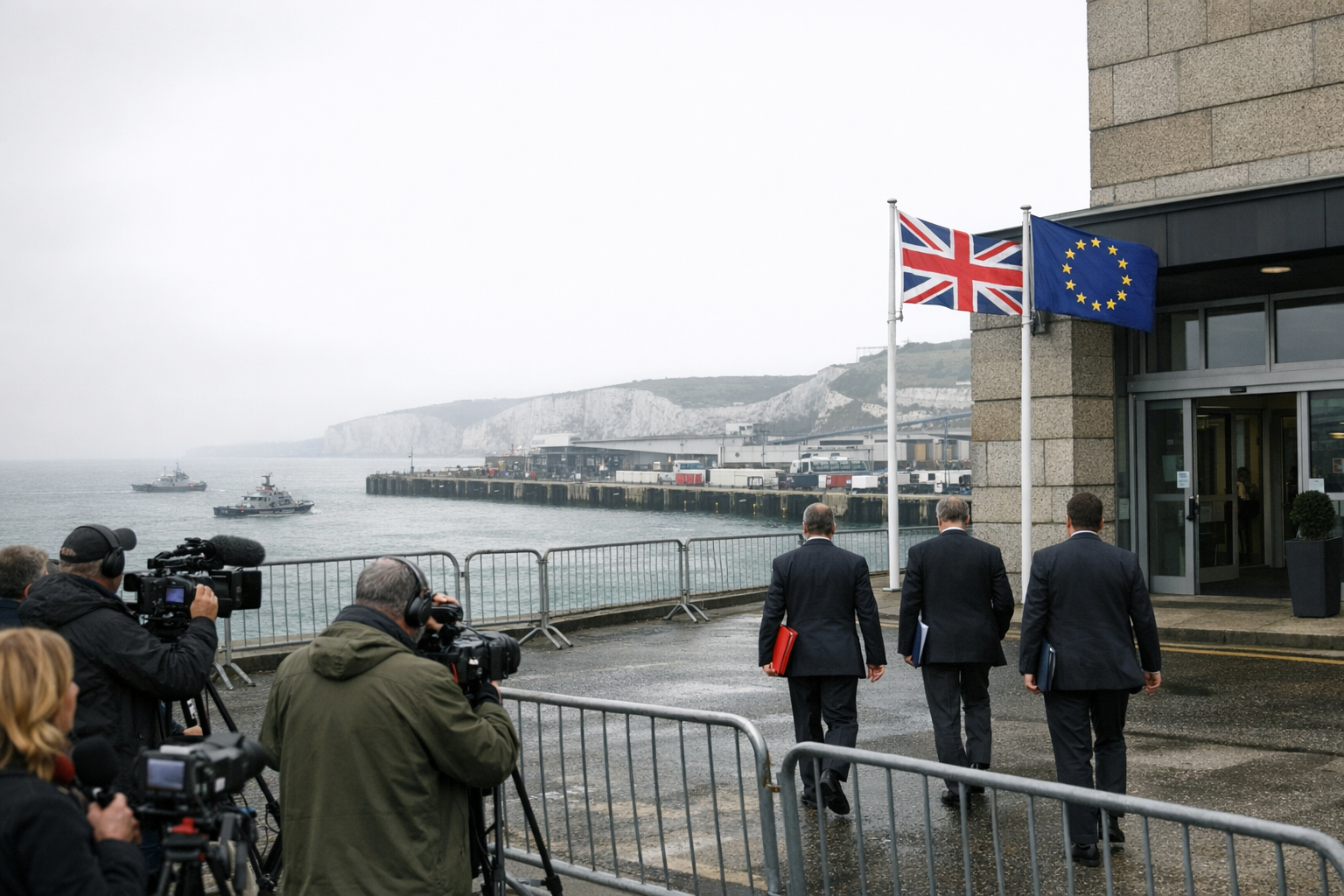
Prime Minister Andy Burnham has opened the most expansive debate yet over Britain’s future in Europe just as one of the government’s most closely watched post-Brexit migration arrangements appears poised to lapse, exposing the political and practical limits of Britain’s effort to recalibrate its relationship with the continent one issue at a time.
Burnham said on Wednesday that the government should examine the full range of options for ties with the European Union, from the current settlement to a customs union, closer single-market alignment or even, as he put it, “going all the way” to rejoining the bloc. At nearly the same moment, officials indicated that the Anglo-French “one in, one out” migrant returns pilot — a centerpiece of efforts to deter small-boat crossings of the English Channel — was expected to expire on Thursday after negotiations over its future stalled.
Taken together, the two developments amount to more than a coincidence of timing. They suggest that Britain’s post-Brexit strategy is entering a more candid new phase: one in which questions of trade, regulation, migration and sovereignty are increasingly colliding, and in which bilateral fixes are proving harder to sustain without a broader understanding with Europe.
A wider opening on Europe
Burnham, who became prime minister in July, has moved faster than many in Westminster expected to challenge the political assumptions that governed Labour’s approach after Brexit. For years, the party largely accepted a set of red lines intended to avoid reopening the divisive arguments of the 2016 referendum. But speaking after his Labour conference speech, Burnham argued that Brexit had caused “more harm than good” and said ministers would now examine “what is doable” and weigh the “pros and cons” of different models for Britain’s future relationship with Brussels.
He has said he wants those options set out ahead of a planned U.K.-E.U. summit in November, giving the government a near-term deadline to turn broad rhetoric into a more defined negotiating position.
That shift is significant not only because of what Burnham said, but because of who is saying it. A British prime minister openly discussing the possibility of rejoining the European Union would have been politically unthinkable for much of the decade after Brexit. Even now, Burnham has not committed to a specific destination. But by making clear that no option is off the table, he has widened the field of debate far beyond the narrower “reset” language that has dominated recent years.
A migration deal reaches its limit
The pressure for a wider European approach is also being driven by migration.
The “one in, one out” pilot with France was agreed in July 2025 and took effect on Aug. 6 that year. Under the arrangement, for each eligible migrant arriving in Britain by small boat and returned to France, one vetted asylum seeker with links to Britain could be transferred legally from France to the United Kingdom. The deal was presented by London as a way to combine deterrence with legal routes, while showing that post-Brexit Britain could strike practical arrangements outside the structures of the E.U.
Official British data through June 30 showed 1,087 people had been returned to France and 1,117 transferred into Britain under the scheme.
Yet from the start, critics questioned whether the numbers were large enough to alter the calculations of smuggling networks or those risking the crossing. The current impasse appears to have sharpened that question. Negotiations over renewal have stalled amid French demands that any successor arrangement be folded into a broader E.U.-U.K. framework, according to reporting citing government sources, while Britain had wanted the bilateral scheme expanded to allow larger-scale returns.
If the arrangement now expires, it will strip away a policy ministers had held up as evidence that cooperation with France could produce a measurable deterrent. It would also underscore a deeper reality: Channel migration may be too entangled with European asylum rules, border enforcement and burden-sharing politics to be managed durably through a two-country pilot alone.
The limits of bilateralism
That lesson reaches beyond migration. Since Brexit, successive British governments have often tried to separate disputes into discrete baskets — trade in one, mobility in another, security in a third — in hopes that practical deals could be struck without reopening the larger constitutional question of Britain’s place in Europe.
But the agenda has proved stubbornly interconnected. Even a planned U.K.-E.U. “reset” has been slowed by disagreements over proposed “Made in Europe” rules, a reminder that questions of market access and regulatory alignment can quickly become politically charged. What applies to goods and standards can also apply to migration: a bilateral accord may work up to a point, but the European side increasingly prefers solutions that fit within a larger bloc-wide framework.
For Britain, that raises an uncomfortable strategic question. If Brussels and key member states such as France are more willing to deal through E.U.-level structures, then London may find that the price of practical cooperation is some degree of renewed institutional or regulatory alignment — precisely the terrain that British politics spent years trying to avoid.
The politics at home
Burnham’s intervention comes as he is also testing the public’s appetite for broader domestic change. A poll reported on Wednesday suggested voters backed his proposal to scale back the pension triple lock to help fund social care reform, indicating that he may believe the electorate is more open to difficult trade-offs than recent governments assumed.
That matters because any move toward closer European integration would require not only diplomatic openness from Brussels but political durability at home. Burnham appears to be gambling that the economic disappointments and administrative frictions of Brexit have created space for a more forthright national conversation. Whether that space extends from support for specific practical fixes to backing for something as far-reaching as customs-union membership, single-market alignment or eventual re-entry into the E.U. remains deeply uncertain.
There is also the question of sequencing. Burnham has opened a debate, not settled it. It is still unclear which option, if any, he will champion at the November summit. Nor is it clear how receptive European leaders would be to a British government that wants to explore closer ties while preserving political room to maneuver at home.
Why this moment matters
The convergence of these two issues — Europe and Channel migration — has made visible the central dilemma of Britain’s post-Brexit era. The country can continue to seek narrowly tailored agreements while insisting on maximal political distance from the European Union. Or it can acknowledge that on trade, migration and regulation alike, durable cooperation may require a more fundamental rethinking of that distance.
The possible expiry of the France deal is, in that sense, more than an operational setback. It is a sign of how hard it is for Britain to solve shared cross-border problems without a broader settlement with its nearest neighbors. And Burnham’s willingness to speak openly about options once treated as politically untouchable suggests that, a decade after the referendum, that broader settlement may no longer be a forbidden subject in British politics.
Sources
Further reading and reporting used to add context:
- https://apnews.com/article/631cfab59c902a99304c16107a04cec3
- UK's Labour holds its first conference under new party leader Burnham | AP News
- https://www.theguardian.com/politics/2026/sep/30/andy-burnham-uk-could-go-all-the-way-rejoining-eu
- UK-France ‘one in one out’ deal to expire on Thursday, say sources | Immigration and asylum | The Guardian
- https://www.theguardian.com/politics/2026/sep/29/andy-burnham-vows-long-term-relationship-eu-labour-conference-speech
- https://www.theguardian.com/politics/live/2026/sep/30/andy-burnham-eu-brexit-rejoin-customs-union-fuel-duty-budget-latest-news-updates?page=with%3Ablock-6abca9988f08d2f5d21fe74b
- https://www.theguardian.com/politics/2026/sep/30/andy-burnham-review-uk-relationship-with-eu-options
- https://www.lemonde.fr/societe/article/2026/09/30/immigration-la-france-va-mettre-fin-a-l-accord-un-qui-entre-un-qui-sort-avec-le-royaume-uni_6785930_3224.html
- https://www.marketscreener.com/news/uk-s-burnham-pledges-action-on-social-care-eu-relations-in-conference-speech-ce785addd18ef523
- https://www.theguardian.com/uk-news/2026/sep/11/asylum-seekers-removed-uk-to-france-disappeared-children-one-in-one-out
- https://www.theguardian.com/politics/2026/sep/24/tony-blair-britain-rejoin-eu-next-10-years-brexit
- https://www.theguardian.com/uk-news/2026/jun/22/uk-and-france-rewrite-one-in-one-out-treaty-to-stop-removed-migrants-returning
- https://www.abc.net.au/news/2026-09-30/key-takeaways-from-uk-pm-andy-burnham-labour-conference-speech/107205962
- https://www.euronews.com/2026/09/29/uk-pm-burnham-to-lay-out-options-for-eu-relations-later-this-year
- https://www.reddit.com/r/unitedkingdom/comments/1wu1fbi/ukfrance_one_in_one_out_deal_to_expire_on/
- https://www.reddit.com/r/unitedkingdom/comments/1wu1vgt/andy_burnham_uk_could_go_all_the_way_by_rejoining/
- https://www.reddit.com/r/europe/comments/1wtyrid/france_to_end_one_in_one_out_immigration/
- https://www.reddit.com/r/ukpolitics/comments/1wtxps4/breaking_andy_burnham_confirms_he_could_campaign/
- https://www.gov.uk/government/news/uk-france-treaty-targeting-illegal-crossings-comes-into-force
- https://www.gov.uk/government/news/uk-and-france-agree-major-deal-to-crack-down-on-illegal-channel-crossings
- Burnham says Britain should weigh EU options, including rejoining bloc | MarketScreener
- https://www.gov.uk/government/speeches/prime-ministers-remarks-at-the-uk-france-summit-press-conference-10-july-2025
- https://www.gov.uk/government/news/uk-brings-forward-worlds-first-sanctions-regime-to-smash-the-gangs-responsible-for-irregular-migration
- https://www.gov.uk/government/news/manchester-to-host-world-leaders-at-the-2027-g20-summit
- https://www.gov.uk/government/news/major-immigration-reforms-delivered-to-restore-order-and-control
- https://www.cps.gov.uk/cps/news/people-smugglers-jailed-uk-france-operation
- https://www.gov.uk/government/people/andy-burnham
- https://www.gov.uk/government/news/specialised-committee-on-the-implementation-of-the-windsor-framework-joint-statement-15-september-2026
- https://www.gov.uk/government/news/uk-to-have-worlds-strongest-online-child-safety-laws-as-government-prepares-legislation-on-nude-images
- https://www.gov.uk/government/publications/the-border-security-commanders-annual-report-data/transfers-into-and-returns-from-the-united-kingdom-under-the-uk-france-agreement-on-the-prevention-of-dangerous-journeys-between-6-august-2025-and-30
- https://assets.publishing.service.gov.uk/media/6889e1088b3a37b63e738fd0/Immigration_Rules_-_Archive_22-07-25.pdf
- https://assets.publishing.service.gov.uk/media/691ae05b493305b49ce6e845/Restoring_Order_and_Control_-_A_statement_on_the_Government_s_asylum_and_returns_policy_final.pdf
- https://assets.publishing.service.gov.uk/media/68909bb2486754ec288783c2/CS_France_2.2025_Dangerous_Journeys_Agreement.pdf
- https://assets.publishing.service.gov.uk/government/uploads/system/uploads/attachment_data/file/455162/Joint_declaration_20_August_2015.pdf
- https://assets.publishing.service.gov.uk/media/6a18713db95db968c8f3bbfd/The_King_s_Speech_2026_-_background_briefing_notes.pdf
- https://www.wolverhampton.gov.uk/sites/default/files/2026-01/WMSMP%20September%202025%20Newsletter.pdf
- UK and France agree major deal to crack down on illegal Channel crossings – GOV.UK
- The Rt Hon Andy Burnham MP – GOV.UK