
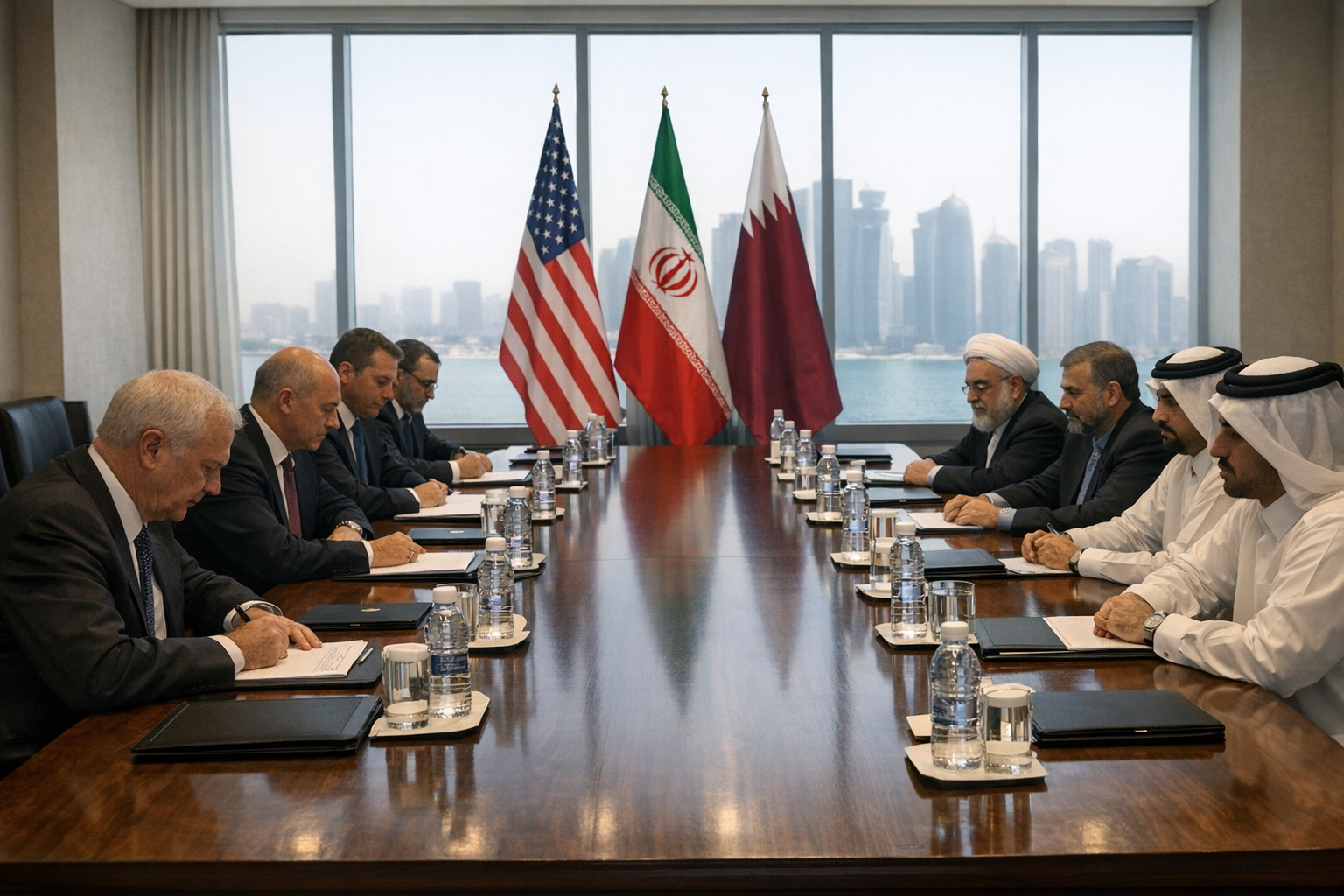
Diplomacy Resumes, but Terms Remain Elusive
The haze surrounding renewed nuclear diplomacy between the United States and Iran thickened on Tuesday, as Tehran said it had received an official American response to its latest proposal even while President Trump publicly denied offering any sanctions relief in exchange for nuclear concessions.
The exchange, funneled through Qatari mediators after indirect contacts in New York during the United Nations General Assembly, underscored a familiar pattern in U.S.-Iran relations: quiet movement behind the scenes paired with sharp public signaling designed to preserve leverage.
What had initially appeared to be a narrow effort to reduce tensions around the Strait of Hormuz has now broadened into a more consequential question — whether the two sides can find a pathway back to substantive nuclear negotiations after months of confrontation, sanctions pressure and regional disruption.
Iranian officials said they had received Washington’s formal reply to proposals passed through intermediaries. But any sense of momentum was tempered almost immediately by Mr. Trump’s insistence that reports of sanctions relief, or the release of frozen Iranian funds, were false.
That contradiction — a private diplomatic channel still functioning even as the White House disavows concessions in public — has become the central fact of the moment.
A Channel Stays Open
Qatar, which has been the principal go-between, said this week that it was still trying to bridge the gap between the two sides. Qatari officials have cast their role not as heralding a breakthrough but as searching for the minimum common ground needed to keep talks alive.
The mediation comes after roughly seven to eight months of U.S.-Iran confrontation that has shaken regional trade routes and repeatedly raised fears over the security of shipping through Hormuz, the narrow waterway through which a large share of the world’s oil and gas passes.
In recent weeks, Iran had floated the possibility of reopening the strait fully and moving back toward nuclear discussions if Washington eased pressure. But the administration’s public posture has remained resistant. On Sept. 26, Mr. Trump rejected an earlier Iranian seven-day roadmap, and the United States has since announced new sanctions aimed at parts of Iran’s military supply chain.
The dual-track approach — sanctions escalation alongside continued mediation — suggests that Washington is trying to preserve negotiating leverage while avoiding a complete diplomatic rupture.
The Old Dispute: Who Moves First?
At the heart of the latest exchanges is an issue that has long blocked U.S.-Iran agreements: sequencing.
Any serious understanding would almost certainly require reciprocal steps involving sanctions, access to frozen funds and verifiable limits or rollbacks in Iran’s nuclear activities. The question is which side acts first, and what assurances each would receive that the other will follow through.
That has been especially difficult after years of mistrust, broken arrangements and political reversals in both capitals. Tehran wants relief from economic pressure before undertaking major nuclear steps. Washington, wary of appearing to pay in advance for promises that may not be kept, appears determined to resist any public suggestion that it is backing down.
Mr. Trump’s denial may reflect that reality as much as any firm rejection of a private proposal. In high-stakes negotiations with Iran, public messaging often serves a domestic and strategic purpose distinct from the details being tested through intermediaries.
Still, the gap appears substantial. No breakthrough has been confirmed, and it remains unclear what the new American response actually contains.
Why the Stakes Have Shifted
The significance of the latest contact lies in the fact that the discussion is no longer centered only on de-escalation in Hormuz.
Attention has shifted to whether the maritime crisis can be converted into a broader bargain on the nuclear file — one with implications not only for regional security, but also for oil markets, sanctions enforcement and the balance of power across the Gulf.
If there is an opening, it is a narrow one. Continued mediation indicates that neither side wants the channel to collapse entirely. But the parallel imposition of sanctions, coupled with conflicting public accounts of what is being offered, shows just how far apart Washington and Tehran may still be on substance.
Pressure at Home and Abroad
The diplomacy is unfolding as Iran remains under intense international scrutiny not only over its nuclear program but also over its domestic repression.
That pressure sharpened this week after an Iranian court upheld a sentence of 74 lashes against the singer Parastoo Ahmadi, whose online performance without a hijab became a symbol of defiance for many Iranians. Rights groups denounced the punishment as torture and said it illustrated the government’s continuing crackdown on women and artists accused of violating the country’s religious and cultural codes.
The case is separate from the nuclear talks, but it is part of the broader climate in which any Western engagement with Tehran is judged. For Washington and its regional partners, diplomacy with Iran rarely concerns only centrifuges or shipping lanes; it is entangled with questions of coercion, legitimacy and the conduct of the Iranian state.
No Breakthrough Yet
For now, the strongest indication is simply that diplomacy has not died.
Messages are still moving. Qatar is still mediating. Iran says it has an American answer in hand. And Washington, even while tightening sanctions and publicly rejecting reports of relief, has not shut the door.
Whether that amounts to the start of a real negotiation or merely another episode of managed ambiguity remains uncertain. What is clear is that the dispute has entered a more delicate phase, one in which the outcome may depend less on dramatic public declarations than on the hidden mechanics of timing, reciprocity and trust.
Sources
Further reading and reporting used to add context:
- https://apnews.com/article/2c42d71d8a4be3443147cd65a6ee9193
- https://apnews.com/article/30db5eef515ed1d06591a0254292afdd
- https://apnews.com/article/4f949bd0fd2777fa6960b56d8bf3169b
- https://apnews.com/article/871504dbd98d9b08b226b9805d8f4606
- https://www.aljazeera.com/news/2026/9/26/pezeshkian-says-iran-no-longer-trusts-talks-with-washington
- https://www.axios.com/2026/09/29/trump-iran-war-qatar-diplomacy
- https://www.marketscreener.com/news/trump-denies-offering-iran-sanctions-relief-for-nuclear-concessions-ce785addd888f12c
- https://www.axios.com/2026/09/26/trump-iran-un-proposal
- https://www.cbsnews.com/live-updates/iran-war-us-trump-talks-strait-of-hormuz/
- https://www.allsides.com/news/2026-09-29-0700/middle-east-trump-denies-offering-iran-sanctions-relief-nuclear-concessions
- https://www.aljazeera.com/news/2026/9/29/us-iran-talks-in-new-york-whats-the-latest
- https://www.axios.com/2026/09/28/trump-iran-war-sanctions-blockade-nuclear
- https://www.washingtonpost.com/national/2026/09/25/iran-us-war-negotiations-strait-hormuz/93f94860-b8e6-11f1-94cb-d3d8f22a8c8b_story.html
- https://www.internazionale.it/ultime-notizie-reuters/2026/09/30/trump-denies-offering-iran-sanctions-relief-tehran-says-ready-for-talks
- https://www.cbsnews.com/live-updates/iran-war-us-trump-strait-of-hormuz-7-day-proposal/
- https://1-e8259.azureedge.net/news/2026/9/26/trump-rejects-irans-seven-day-roadmap-to-reopen-strait-of-hormuz
- https://www.reddit.com/r/moderatepolitics/comments/1wqsnw7/iran_awaits_us_move_after_wsj_report_says_trump/
- https://www.congress.gov/crs_external_products/R/PDF/R47467/R47467.6.pdf
- https://www.axios.com/2026/09/27/trump-iran-war-hormuz-blockade-negotiations
- https://mofa.gov.qa/en/qatar/latest-articles/latest-news/details/2026/09/29/advisor-to-prime-minister-and-official-spokesperson-of-ministry-of-foreign-affairs–qatar-continues-mediation-efforts-between-usa–iran
- https://www.publicnow.com/view/F4387A41B4220FB296F1F65B59627CEE7BE0B141
- https://mofa.gov.qa/en/qatar/latest-articles/latest-news/details/2026/09/04/qatar-rejects-iran-claims-in-two-identical-letters-to-un-chief-and-security-council-president
- https://www.aljazeera.com/news/2026/9/1/qatar-says-efforts-under-way-to-end-iran-us-war-and-reopen-strait-of-hormuz
- https://www.aljazeera.com/video/newsfeed/2026/9/20/qatar-says-it-is-working-to-revive-iran-us-talks
- https://www.aljazeera.com/news/2026/9/29/irans-araghchi-meets-qatari-mediators-as-us-insists-on-nuclear-talks
- https://www.aa.com.tr/en/middle-east/iran-says-it-conveyed-conditions-for-reviving-diplomacy-with-us-through-qatar/4066625
- https://thepeninsulaqatar.com/article/27/09/2026/indirect-us-iran-talks-make-some-positive-progress-pm
- https://2021-2025.state.gov/briefings/department-press-briefing-september-26-2023/
- https://www.aljazeera.com/amp/news/2026/9/19/iran-says-conditions-to-re-engage-in-talks-end-war-sent-to-us-via-qatar
- https://www.reddit.com/r/unusual_whales/comments/1wo40ha/iran_has_been_in_negotiations_with_the_us_through/
- Iran indicates it's received an official US response to its latest offer on ending the war
- Mediators are working to broker a US-Iran deal, but major hurdles remain
- Where things stand after Iran's new pitch for a deal to open the Strait of Hormuz