
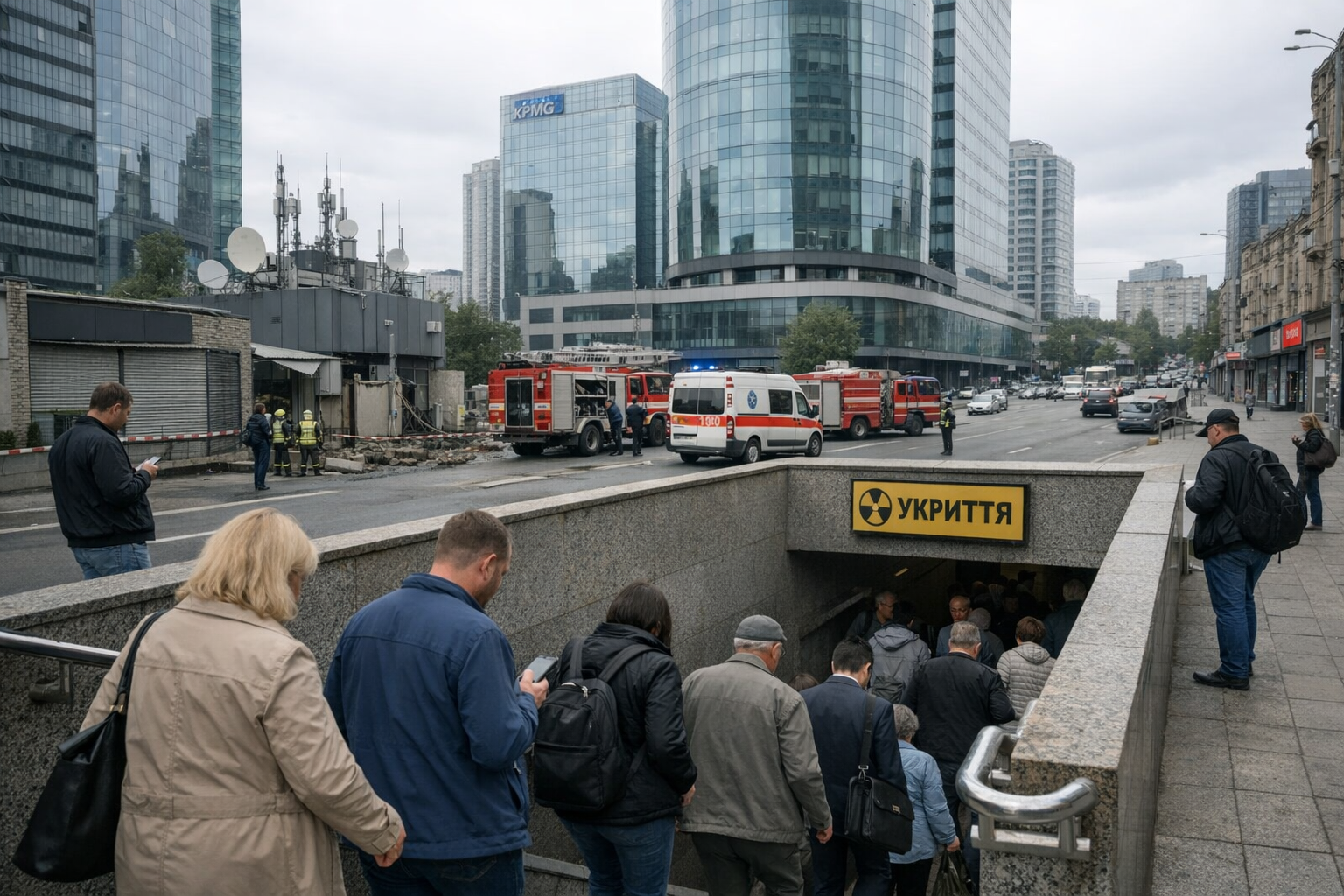
Russia Broadens Its Pressure Campaign on Ukraine’s Nerve Centers
Russia has stepped up a campaign against the systems that allow Ukraine to function beyond the battlefield, striking data centers and communications nodes in Kyiv while intensifying the barrage of missiles and drones that repeatedly send civilians and workers into shelters.
The latest attacks, which Russian officials said included strikes on two Kyiv data centers and vessels carrying military cargo, fit a broader pattern that Ukrainian officials and Western allies say is aimed less at seizing territory than at wearing down the country’s ability to operate — economically, digitally and psychologically.
In recent days, targets around the capital have included data facilities, a key internet exchange point and parts of the power grid, according to Ukrainian and allied accounts. NATO added to the sense of mounting escalation by publicly condemning what it called Moscow’s “irresponsible nuclear rhetoric” after Russian officials warned that they could use “the entire arsenal,” including nuclear weapons, if Kaliningrad were threatened.
Together, the attacks and the threats point to a new stage in the war, one in which the contest is not only for front lines in eastern and southern Ukraine, but for endurance: whether Ukraine can keep its economy running, its communications online and its foreign backers committed as the strain deepens.
The Cost of Every Siren
For Ukraine, the economic toll is becoming easier to quantify and harder to absorb.
Ukraine’s economy minister has said that missile alerts cost the country roughly $45 million for every hour they force businesses to halt operations. In a capital where workdays are now regularly interrupted by warnings of incoming drones or missiles, that figure captures the hidden attrition of the war: factories idled, warehouses paused, office towers emptied, deliveries delayed.
“If people are in a bunker, business stops,” the minister said, summarizing a dilemma that has become central to wartime governance in Kyiv. The government is trying to preserve some degree of normality while protecting civilians under increasingly frequent bombardment.
Those disruptions are landing on an economy already under severe wartime pressure. Prime Minister Sergii Koretskyi has said Ukraine’s total war costs this year will reach $155 billion, and that the government faces a $27 billion funding gap that must be closed to sustain operations into the start of 2027. Kyiv plans to cover about $7 billion through postponed spending, reallocations and cuts, while seeking outside help for the remaining $20 billion.
That arithmetic underscores why attacks on civilian-enabling infrastructure matter so much. Damage to a data center or logistics hub does not simply create a temporary outage; it compounds the burden on a state already balancing military survival with fiscal exhaustion.
A Shift Toward Digital and Business Infrastructure
Russia has long targeted Ukraine’s energy system, especially in winter. But the recent focus on data centers, communications infrastructure, warehouses and logistics sites suggests an effort to reach deeper into the connective tissue of daily life and commerce.
Ukrainian officials say the aim is to disrupt not only military functions but also the systems that support banking, internet traffic, supply chains and routine business activity. Strikes on industrial sites and digital infrastructure can ripple outward quickly, affecting everything from inventory management to financial transactions and public services.
The campaign has accelerated since late August, when Russia expanded its aerial assaults around Kyiv and made greater use of jet-powered drones that have proved more difficult for Ukrainian air defenses to intercept. That shift has increased both the pace of alerts and the unpredictability of attacks, complicating Ukraine’s attempts to calibrate public safety measures.
Kyiv had introduced a two-tier alert system intended to keep more of the economy open. Under “yellow” drone alerts, some businesses were permitted to continue operating rather than shutting down automatically. But recent deadly strikes during those lower-level alerts have exposed the limits of that approach, forcing Ukrainian officials to weigh economic survival against the risk of casualties.
NATO Rebuke and Europe’s Anxiety
The military pressure has unfolded alongside a hardening of Russian nuclear messaging that has unnerved European officials.
After Moscow warned that it could resort to its full arsenal in the event of a threat to Kaliningrad, NATO criticized the statement as reckless. The alliance’s response reflected a broader concern in Europe that Russia is pairing battlefield pressure with coercive signaling designed to weaken Western resolve and raise the perceived risks of continued support for Ukraine.
European officials have increasingly described the confrontation with Moscow as extending beyond conventional combat into a wider struggle over resilience, rearmament and hybrid pressure. The warnings from NATO coincide with a growing sense in European capitals that the years before 2030 may constitute a dangerous period of vulnerability, with Ukraine serving as the clearest test case of how Russia applies pressure across military, economic and informational domains at once.
For Ukraine, that means the battle for support abroad is becoming inseparable from the battle to keep the lights on and the networks functioning at home.
A War of Endurance
How much lasting damage the latest strikes have done to Ukraine’s data and communications capacity remains unclear. So does whether Kyiv can continue to refine a system that protects civilians without freezing economic life each time sirens sound.
What is already evident is that Russia is pressing on a broader front. The war is no longer measured only by villages taken or lost, but by server rooms knocked offline, freight routes delayed, office hours erased and budget gaps widened.
Ukraine’s challenge, increasingly, is to prove that a state under relentless bombardment can still function as a state — paying for the war, protecting its people and keeping enough of ordinary life intact to outlast the pressure. Russia, by contrast, appears to be betting that if it cannot break Ukraine’s defenses quickly, it can erode the machinery that sustains resistance over time.
Sources
Further reading and reporting used to add context:
- Russia's barrage of Kyiv kills 4, targets power grid | AP News
- https://apnews.com/article/d640f7f9862fdd801256f7208eb229d8
- https://apnews.com/article/aceadaec18c41244dc6e9d17732ba256
- https://www.theatlantic.com/national-security/2026/09/trump-russia-putin-ukraine-sanctions/688808/?utm_source=openai
- https://apnews.com/article/f91ac88ee287bad2a3c99d2608975f53
- ‘If people are in a bunker, business stops’: Missile alerts cost Ukraine $45m for every hour they halt businesses | Ukraine | The Guardian
- https://www.theguardian.com/world/europe-news/2026/sep/30/all
- https://united24media.com/life-in-ukraine/if-people-are-in-a-bunker-business-stops-missile-alerts-cost-ukraine-45-million-an-hour-22975
- https://www.theguardian.com/world/2026/sep/30/ukraine-war-briefing-nato-condemns-moscows-irresponsible-nuclear-rhetoric-as-strikes-on-kyiv-intensify
- https://kommersant.in.ua/2026/09/30/povitryani-tryvogy-koshtuyut-ekonomiczi-ukrayiny-do-45-mln-dolariv-za-godynu/
- https://sandouq.tech/articles/missile-alerts-cost-ukraine-45m-for-every-hour-they-halt-businesses-00jwd8uk
- https://videoembed.ansa.it/sito/notizie/mondo/2026/09/30/ministro-kiev-ogni-allarme-missilistico-costa-45-milioni-dollari-allora_e1b49f5a-b44e-4393-9db1-2274a767f119.html
- https://www.internazionale.it/ultime-notizie-reuters/2026/09/30/russia-issues-nuclear-warning-to-nato-as-tensions-rise-in-the-baltic
- https://www.rbc.ua/ukr/news/raketni-trivogi-koshtuyut-ukrayini-45-mln-1790755984.html/amp
- https://unn.ua/en/news/one-hour-of-an-air-raid-alert-costs-ukraine-dollar45-million-ministry-of-economy
- https://situation.mto.sh/
- https://www.kmu.gov.ua/en/news/serhii-koretskyi-proviv-naradu-z-minoborony-shchodo-zakryttia-dodatkovoho-oboronnoho-zapytu-na-27-mlrd-tsoho-roku
- https://www.reddit.com/r/GUARDIANauto/comments/1wtvegl/world_missile_alerts_cost_ukraine_45m_for_every/
- https://www.reddit.com/r/worldnews/comments/1wu0x7x/russia_issues_nuclear_warning_to_nato_as_tensions/
- https://www.reddit.com/r/UkrainianConflict/comments/1wsn3xx/russia_raises_2027_military_spending_by_27_budget/
- https://www.devdiscourse.com/article/international/3984361-ukraines-war-costs-for-2026-hit-155-billion-pm-says
- https://stacks921.com/2026/09/30/ukraine-struggling-to-cover-funding-gap-as-war-costs-surge/
- https://www.internazionale.it/ultime-notizie-reuters/2026/09/29/russia-to-cut-welfare-education-funding-in-2027-as-war-spending-soars
- https://www.marketscreener.com/news/russia-raises-2027-military-spending-by-27-budget-documents-show-ce785adcd18bf02d
- https://www.devdiscourse.com/article/international/3984427-roi-the-8-trillion-arms-surge-fuelling-ai-and-spooking-bonds-mikedolan
- https://ca.marketscreener.com/news/russia-to-cut-welfare-education-funding-in-2027-as-war-spending-soars-ce785addd18ef320
- https://www.aol.com/articles/eu-imf-understand-help-ukraine-101457000.html
- https://www.internazionale.it/ultime-notizie-reuters/2026/09/16/ukraine-proposes-record-defence-spending-next-year-as-war-costs-soar
- https://english.nv.ua/business/russia-plans-200b-defense-spending-in-2027-50645566.html
- https://d2233.cms.socastsrm.com/2026/09/25/eu-imf-understand-need-to-help-ukraine-finance-budget-gap-zelenskiy-says/
- https://conflictalert.news/russia-is-budgeting-for-a-longer-war/
- https://www.reddit.com/r/CollapseOfRussia/comments/1wsmebw/russia_will_increase_its_war_spending_by_another/
- https://ae.marketscreener.com/news/iran-war-cost-hits-38-billion-forecast-to-rise-3-billion-a-month-cbo-says-ce785bddde81f32d