
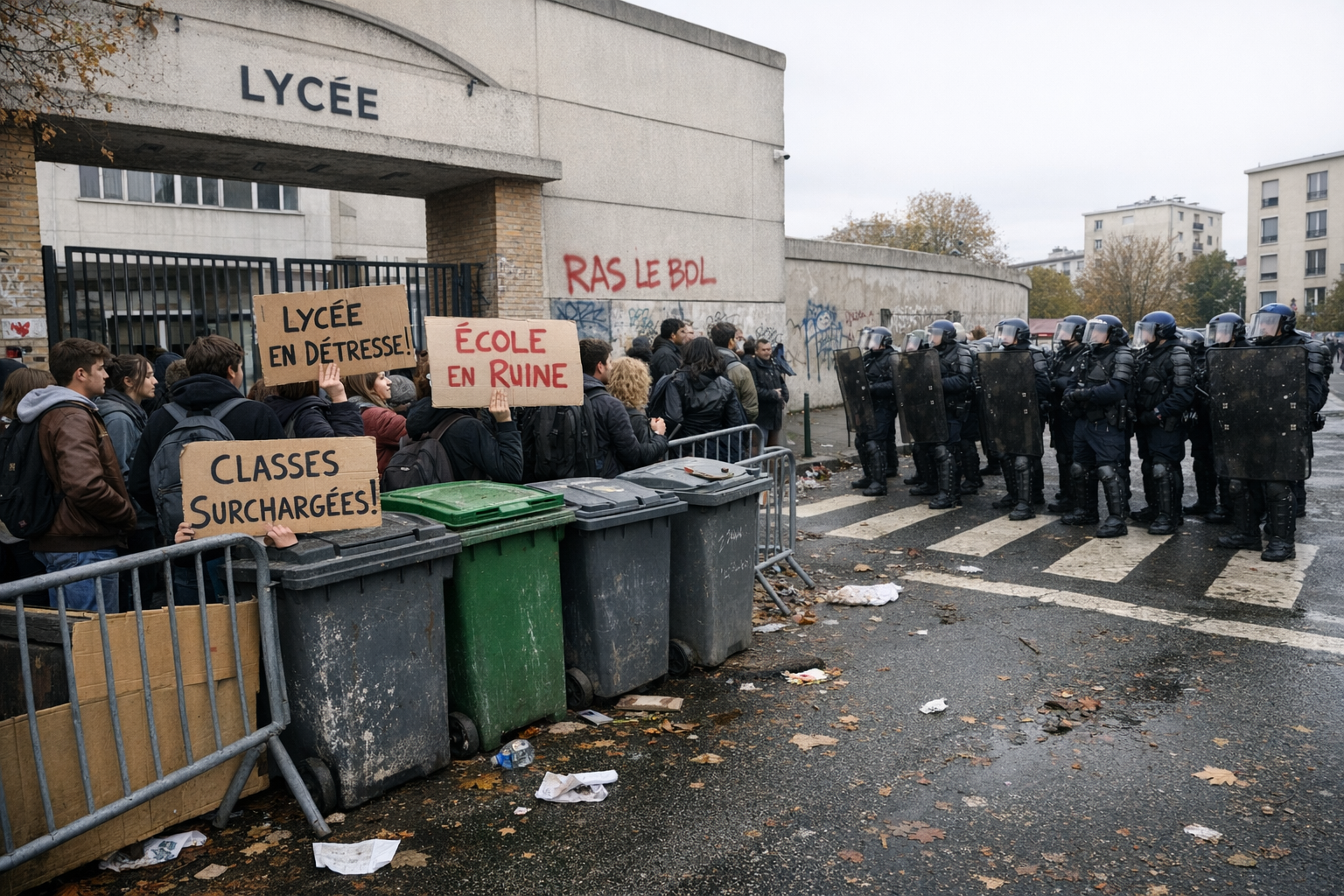
A student revolt widens into a national crisis in France
What began as a protest over overcrowded classrooms and crumbling school buildings has erupted into one of France’s most volatile domestic crises of the autumn, shutting hundreds of schools, drawing thousands of police into the streets and thrusting education policy into a broader struggle over public order and political power.
Across France on Friday, 564 schools and other educational establishments were still disrupted by the unrest, according to midday figures reported by French media, even after the government had ordered about 400 schools closed in an effort to prevent further clashes. By midday, roughly 600 people had been arrested, adding to the nearly 2,000 arrests reported on Thursday alone.
The speed and scale of the upheaval have startled French officials. Since protests began around Sept. 21 in the Paris suburbs, the Education Ministry has said more than 1,020 high schools have been affected and 222 blockaded. Dozens of campuses have been damaged. Vehicles have been burned. In some cities, demonstrations that started at school gates spilled into surrounding neighborhoods, where barricades, vandalism and confrontations with riot police transformed a student movement into something closer to urban unrest.
Prime Minister Sébastien Lecornu convened an emergency meeting as the government struggled to contain a crisis that is now testing both the state’s ability to restore calm and its willingness to address the grievances that ignited the protests in the first place.
Complaints rooted in daily school life
At the center of the movement are longstanding complaints from students and some teachers: overcrowded classes, teacher shortages, decaying facilities and punishingly long school days. In many schools, students say the conditions have become intolerable, especially in poorer suburbs where public services have long been strained.
Teacher representatives and unions have said those frustrations are real and should not have been dismissed in the early days of the movement. The protests initially reflected familiar anxieties in French education, where debates over equality, discipline and state investment are often national in scope because schools are so central to the republic’s social contract.
But officials now say the demonstrations have, in many places, been infiltrated or overtaken by more violent groups. The Interior Ministry has pointed to arson, vandalism and organized clashes with police as evidence that the unrest is no longer simply a student mobilization over school conditions.
The toll has mounted quickly. French news reports have said that since the protests began, 65 education staff members and 170 students have been injured. On Thursday alone, the Interior Ministry said, 305 police officers, gendarmes and firefighters were hurt.
A familiar French fault line: order versus grievance
The crisis has reopened a recurring fault line in French public life: how to distinguish legitimate social anger from destructive violence, and whether a heavy police response calms unrest or inflames it.
That question has become more urgent as scrutiny grows over police tactics, including serious eye injuries suffered by several teenagers. Critics have accused the authorities of responding too aggressively to school protests rooted in social neglect. The government, for its part, argues that failing to act forcefully would allow intimidation and destruction to spread.
The result is a combustible political argument that reaches far beyond education. Ministers have framed the unrest as a law-and-order emergency. Figures on the left, particularly in the radical-left France Unbowed movement, have accused the government of exploiting the violence to avoid confronting deeper failures in public services and youth policy. Government officials, in turn, have suggested that parts of the left have minimized or politicized the violence.
That clash is already bleeding into the early positioning for France’s 2027 presidential race, with competing camps using the turmoil to reinforce broader narratives about authority, inequality and the state.
Signs of a broader movement
Another source of official alarm is the possibility that the unrest will keep spreading. While the movement has been centered on high schools, universities have begun joining protests in some areas, raising the prospect of a wider student mobilization at a moment when the government can least afford one.
France has a long history of student demonstrations swelling into national political crises when they tap into broader frustrations over opportunity, public services and the state’s treatment of young people. This latest wave appears to be following that pattern, beginning with concrete complaints about daily conditions and expanding into a referendum on government competence.
Talks with student unions and parents were expected to test whether the government could lower tensions. But the immediate challenge for officials is proving they can separate peaceful protest from criminal violence without hardening the sense among many students that they are being met first with batons and arrests, and only later with answers.
For now, France faces a crisis that is no longer confined to the classroom. It has become a national confrontation over whether a generation’s anger at deteriorating schools can be heard before it is buried beneath the politics of fear and force.
Sources
Further reading and reporting used to add context:
- High school protests in France prompt crisis meeting and arrests | AP News
- https://apnews.com/article/7afcf9f3f078303f2ea00db13200b1aa
- High school student protests spread across France as tensions escalate
- https://www.lemonde.fr/societe/live/2026/10/01/en-direct-blocages-de-lycees-edouard-geffray-annonce-que-400-etablissements-seront-fermes-demain-et-annule-la-mesure-budgetaire-sur-les-frais-d-inscriptions-en-bts-et-en-classes-preparatoires-pour-les-etudiants-non-boursiers_6786491_3224.html
- https://www.theguardian.com/world/2026/oct/01/france-school-protests-escalate-pm-crisis-cabinet-meeting
- https://www.lemonde.fr/societe/video/2026/09/29/la-video-d-une-violence-policiere-envers-un-lyceen-de-14-ans-touche-a-bout-portant-au-visage_6785609_3224.html
- https://www.education.gouv.fr/le-ministre-de-l-education-nationale-467601
- https://www.lemonde.fr/en/france/article/2026/09/29/high-school-protests-spread-across-france-pitting-radical-left-against-government_6758067_7.html
- https://www.lemonde.fr/societe/live/2026/10/01/en-direct-blocage-de-lycees-en-ile-de-france-plus-de-200-lycees-perturbes-et-une-cinquantaine-sont-le-theatre-de-violences-edouard-geffray-recevra-vendredi-les-associations-lyceennes_6786491_3224.html
- https://www.lemonde.fr/societe/article/2026/10/01/mobilisation-dans-les-lycees-face-a-l-aggravation-de-la-situation-le-ministre-de-l-interieur-laurent-nunez-fait-appel-aux-crs-et-aux-gendarmes-mobiles_6786588_3224.html
- https://www.lemonde.fr/societe/live/2026/10/02/en-direct-blocages-de-lycees-ce-qui-remonte-des-blocus-c-est-qu-on-n-est-pas-entendus-qu-on-est-meprises_6786491_3224.html
- https://www.lemonde.fr/campus/video/2026/10/01/on-a-des-cafards-dans-les-classes-les-lyceens-et-les-enseignants-expliquent-pourquoi-ils-manifestent_6786562_4401467.html
- https://www.education.gouv.fr/modalites-de-la-negociation-prealable-un-preavis-de-greve-dans-l-enseignement-du-premier-degre-456936
- https://www.education.gouv.fr/toute-l-actualite
- Facing 'worsening situation' in high schools, French government sends riot police
- https://www.lemonde.fr/en/politics/article/2026/10/02/french-government-struggles-to-contain-escalating-high-school-protests_6758172_5.html
- https://www.lemonde.fr/en/opinion/article/2026/10/02/french-high-school-protests-authorities-should-have-listened-to-students-first_6758174_23.html
- https://apnews.com/article/5fc1201a104e6f5a1b044a7ceb39fb1a
- https://amp.dw.com/en/france-400-schools-closed-as-student-protests-continue/a-79512732
- https://www.theguardian.com/world/live/2026/oct/02/france-schools-protests-violence-ukraine-kallas-rome-pope-latest-news-updates
- https://www.theguardian.com/world/live/2026/oct/02/france-schools-protests-violence-ukraine-kallas-rome-pope-latest-news-updates?page=with%3Ablock-6abf5e898f0881a4fbc3c66a
- https://www.local10.com/news/world/2026/10/01/france-gripped-by-spreading-student-protests-as-pm-calls-crisis-meeting/
- https://www.lemonde.fr/societe/live/2026/10/01/en-direct-blocage-des-lycees-le-mouvement-doit-etre-entendu-des-etudiants-manifestent-aux-cotes-des-plus-jeunes-de-rennes-a-henri-iv_6786491_3224.html
- https://www.reutersconnect.com/item/student-protests-continue-across-france-as-violence-increases/dGFnOnJldXRlcnMuY29tLDIwMjY6bmV3c21sX09XQU5BQ0FBVklERU8yMDI2MTAwMjQyNjMwOTI4
- https://www.abc.net.au/news/2026-10-02/france-protests-school-fires/107219364
- https://www.reddit.com/r/worldnews/comments/1wvr9rm/hundreds_of_french_schools_to_stay_closed_after/
- https://www.reddit.com/r/europe/comments/1wu61w3/dozens_hurt_and_hundreds_arrested_in_wave_of/
- https://www.reddit.com/r/europe/comments/1wvrdhz/2000_arrested_in_france_as_student_protests/
- https://www.reddit.com/r/neofrance/comments/1wvo0bq/whats_happening_with_the_student_protests/