
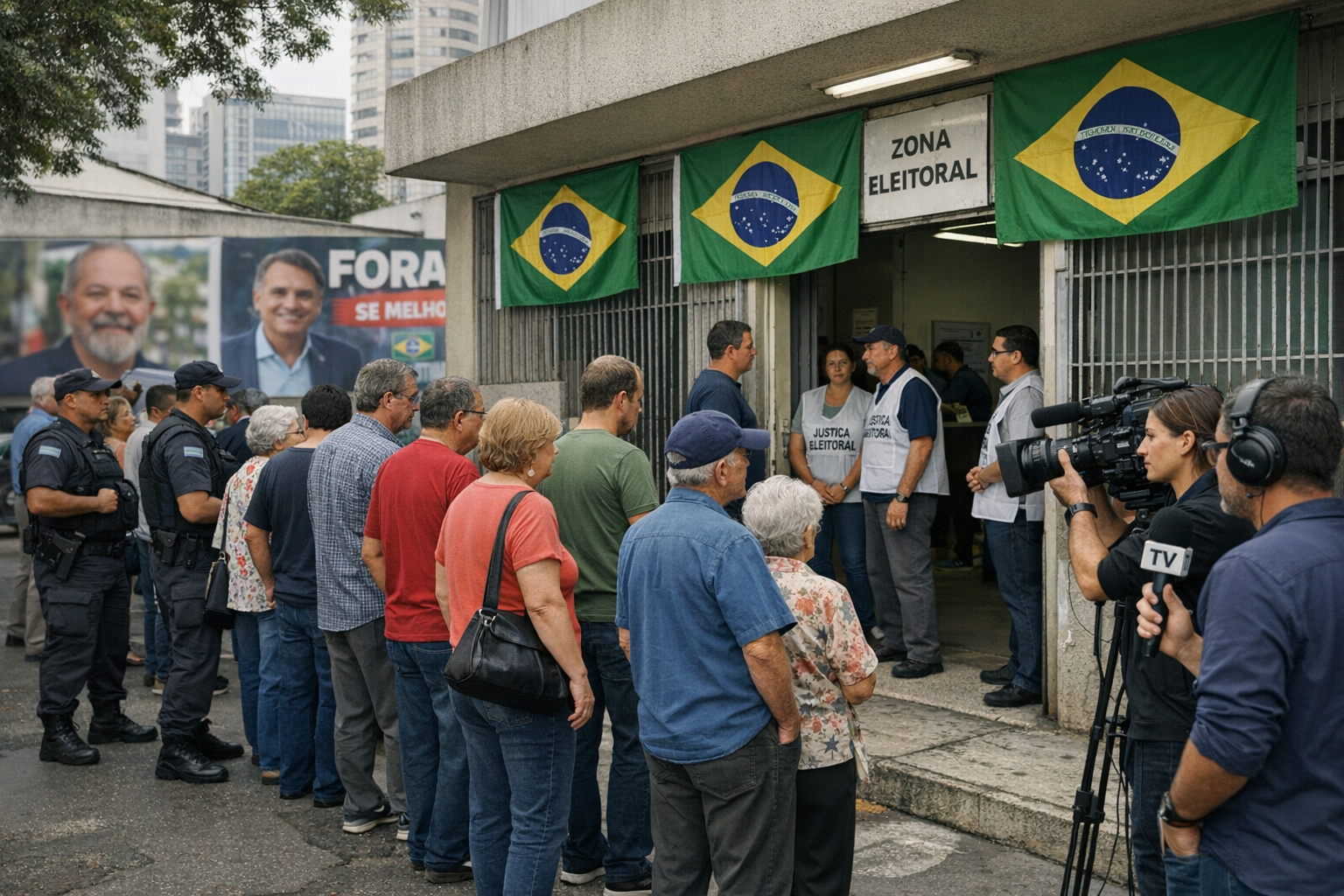
Brazil Votes in a Contest Shadowed by Sovereignty Fears and the Return of the Bolsonaro Name
Brazilians began voting Sunday in a presidential election that has come to embody far more than a choice between two rivals. The contest, pitting President Luiz Inácio Lula da Silva against the right-wing senator Flávio Bolsonaro, has become a test of the country’s democratic resilience, its independence from outside pressure and the enduring force of a political movement that many thought had been broken.
With polls showing a razor-thin race and suggesting that neither candidate is likely to win outright in the first round, attention has turned to a probable runoff on Oct. 25. But even before ballots were cast, the final days of the campaign had already sharpened the stakes: both candidates skipped a planned televised debate, a furor over alleged foreign meddling drew an unusual warning from Brazil’s attorney general, and an emotionally charged dispute involving the country’s patron saint spilled into the campaign’s closing stretch.
The convergence of those fights has underscored how unsettled Brazil remains four years after Lula’s narrow 2022 victory over Jair Bolsonaro and one year after the former president was convicted over an attempted coup and sentenced to a long prison term. Rather than ending the family’s grip on the Brazilian right, that conviction helped recast the movement around his son.
Flávio Bolsonaro, campaigning in part on a promise to free his father, has turned the election into a referendum on whether Bolsonarismo can survive without Jair Bolsonaro on the ballot — and whether it can return to power despite the legal and political wreckage left by his presidency.
A Race With Global Implications
The choice before voters is also being watched well beyond Brazil. As Latin America’s largest economy and a diplomatic heavyweight, Brazil plays an outsized role in a world increasingly shaped by rivalry between the United States and China, trade dependencies and debt anxieties.
A Bolsonaro victory is widely seen as likely to draw Brasília closer to a Washington influenced by Donald Trump and to a more ideological alignment with the global right. Lula, by contrast, has tried to preserve Brazil’s room to maneuver, maintaining relations with the United States while deepening ties with China, Brazil’s largest trading partner.
That balancing act has economic consequences. Investors are not only assessing who wins but also whether the next president can manage Brazil’s mounting fiscal strains. Debt concerns and questions about public spending have become central to market calculations, limiting how dramatically any administration might shift course, even if its rhetoric changes.
Still, diplomacy matters. Brazil’s posture toward Beijing, Washington and multilateral institutions can shape trade, investment and its role as a voice for the Global South. For that reason, Sunday’s vote is being read abroad as a measure of whether one of the world’s most important democracies moves toward nationalist confrontation or pragmatic nonalignment.
Interference Allegations Stir a Sovereignty Backlash
In the campaign’s final days, accusations of foreign interference injected a new layer of tension. Jorge Messias, Brazil’s attorney general, said outside meddling in Brazil’s institutions and democracy “cannot be tolerated,” framing the issue as a direct challenge to national sovereignty.
His comments came after reports that figures linked to Trump-era networks were pushing funding toward a campaign against Brazil’s Supreme Court. Messias called the revelations a serious warning, particularly given the ongoing election and what he described as episodes of external pressure on Brazilian institutions.
The dispute has offered Lula and his allies a potent closing argument: that this election is not only about ideology or economic management, but also about whether Brazil will allow foreign actors to influence its democratic system. In a country with a long sensitivity to outside interference, that message carries weight across partisan lines.
Whether the allegations will produce a formal investigation or measurably sway the result remains unclear. But politically, they have broadened the campaign’s central question. Lula’s camp has sought to portray Bolsonaro’s movement not just as polarizing, but as entangled with external forces hostile to Brazil’s institutions. Bolsonaro’s allies, for their part, have cast such claims as an effort to distract from voter anger over the economy and public security.
Faith and Symbolism Enter the Final Stretch
If the sovereignty fight has given the campaign a geopolitical charge, a separate dispute over religion has shown how symbolic issues can become electorally explosive in a deeply divided country.
In recent days, social media has been flooded with claims that Flávio Bolsonaro would seek to strip Our Lady of Aparecida — Brazil’s patron saint and one of its most revered religious figures — of that status. The suggestion struck a nerve among Catholic voters and quickly became a potent line of attack.
Bolsonaro has denied the accusation, and the claim is misleading on its face: only the Vatican could alter the saint’s formal status. But in an election this close, literal accuracy is not always the point. The controversy has fed broader anxieties among moderate and religious voters about culture-war politics and the tone a Bolsonaro presidency might bring.
That such an issue could emerge as a possible factor in the campaign’s closing hours speaks to the fragmented emotional terrain of Brazilian politics. Religion, national identity and partisan loyalty have become increasingly entwined, and campaigns have learned that even symbolic disputes can move small but decisive slices of the electorate.
The Shadow of 2025
Hovering over all of it is the legacy of Jair Bolsonaro’s fall.
His 2025 conviction over an attempted coup was supposed to mark a decisive break, proof that Brazil’s democratic institutions had withstood one of the gravest challenges since the end of military rule. Instead, it helped transform him into a martyr for supporters and made his imprisonment a rallying cry for the right.
Flávio Bolsonaro has harnessed that grievance while trying to soften some of the movement’s roughest edges. The strategy reflects a calculation that enough Brazilians remain angry with the political establishment, distrustful of the courts and receptive to the Bolsonaro family brand to make a comeback possible.
That possibility alone is a measure of how incomplete Brazil’s political reckoning has been. The institutions that held after the coup attempt remain standing, but the electorate is still split almost evenly between those who see Bolsonarismo as a threat to democracy and those who see it as a persecuted movement.
What Comes Next
The most immediate question is whether Lula can outperform expectations and build enough of an edge to dominate the first round, even if he falls short of the majority needed to avoid a runoff. Polls have suggested a second-round showdown is the likeliest outcome, but turnout, tactical voting and late shifts among religious and undecided voters could still alter the margin.
Beyond the horse race, the result will help determine how Brazil defines sovereignty in an era of ideological cross-border alliances and economic interdependence. Any next president will face hard constraints: China’s importance to Brazilian trade, the United States’ enduring strategic role and domestic pressure to restore economic confidence.
But Sunday’s vote is about more than policy room for maneuver. It is about whether Brazilians, still living with the aftershocks of a coup attempt and years of bitter polarization, want stability under a familiar leftist incumbent or are willing to hand power back to a family name that remains as electrifying as it is divisive.
By the time the ballots are counted, Brazil may not yet know its next president. But it will know something important about itself: whether the politics of rupture still hold the upper hand, or whether the country is prepared, however uneasily, to choose continuity over confrontation.
Sources
Further reading and reporting used to add context:
- https://www.theguardian.com/world/2026/oct/01/brazil-attorney-general-election-meddling-trump-funding-plans
- https://www.theguardian.com/world/2026/oct/02/brazil-election-lady-of-aparecida-lula-bolsonaro-row
- https://www.theguardian.com/us-news/trump-administration
- https://www.theguardian.com/world/americas/2026/oct/02/all
- https://www.theguardian.com/us-news/us-foreign-policy
- https://www.theguardian.com/world/catholicism%2Breligion
- https://www.theguardian.com/world/2026/sep/01/us-trump-rubio-meddling-brazil-election
- https://www.theguardian.com/law/us-constitution-and-civil-liberties
- https://www.theguardian.com/commentisfree/2026/sep/30/the-guardian-view-on-lula-v-the-bolsonaros-the-decision-of-brazilian-voters-will-affect-us-all
- https://www.theguardian.com/world/2026/sep/27/viscerally-dedicated-to-social-issues-behind-lulas-drive-to-win-final-term-in-brazils-crunch-election
- https://www.theguardian.com/world/2026/sep/15/brazil-supreme-court-presidential-election
- https://www.theguardian.com/tv-and-radio/2026/sep/28/john-oliver-brazil-flavio-bolsonaro
- https://apnews.com/article/fc73f3be09c08045b0c97141dd058db2
- https://apnews.com/article/e7ea25e0920e76c78b40d6eeaa8f589d
- https://apnews.com/article/322e2f78fcdbddb8232a4825139cf7fe
- https://apnews.com/article/238ac61a6828fbe9c37028984a67b4b7
- https://apnews.com/article/814fa97cd9dd9923d0ddd6e2907a5244
- https://apnews.com/article/4caaab2ddf818b0791e1cefec601f50f
- https://apnews.com/article/a7ef1a7a142884aab3f58a802384615a
- https://support.google.com/websearch/answer/18323542?hl=en
- https://ae.marketscreener.com/news/brazil-next-us-midterms-coming-in-impactful-global-election-year-ce785ddadf81f622
- https://primexbt-broker.com/news/brazil-holds-knife-edge-vote-as-u-s-china-rivalry-and-debt-pressure-loom/
- https://primexbt.ch/news/brazil-holds-knife-edge-vote-as-u-s-china-rivalry-and-debt-pressure-loom/
- https://whistlebuzz.com/politics-2/2026/10/02/brazil-election-us-china-conflict-and-huge-government-debt/
- https://foreignpolicy.com/2026/09/28/brazil-election-president-lula-bolsonaro-china-america/
- https://www.internazionale.it/ultime-notizie-reuters/2026/10/01/brazil-vote-approaches-with-lula-and-bolsonaro-polling-in-close-race
- https://globalaffairs.org/commentary/podcasts/could-brazils-election-push-it-closer-us
- https://www.investing.com/news/world-news/brazils-lula-widens-firstround-lead-runoff-withbolsonaro-stays-tight-btgnexus-pollshows-4919931
- https://currently.att.yahoo.com/att/lula-beat-bolsonaro-brazilian-runoff-120253380.html
- https://capwolf.com/brazil-election-debt-risk-and-u-s-china-rivalry/
- Brazil's leading presidential candidates snub TV debate ahead of Sunday's election
- Brazil next, US midterms coming, in impactful global election year | MarketScreener UAE Emirates
- Echoes of cold war as US accused of meddling in another Brazilian election | Brazil | The Guardian
- Brazil attorney general says meddling ‘cannot be tolerated’ after Trump funding plans revealed | Brazil | The Guardian