
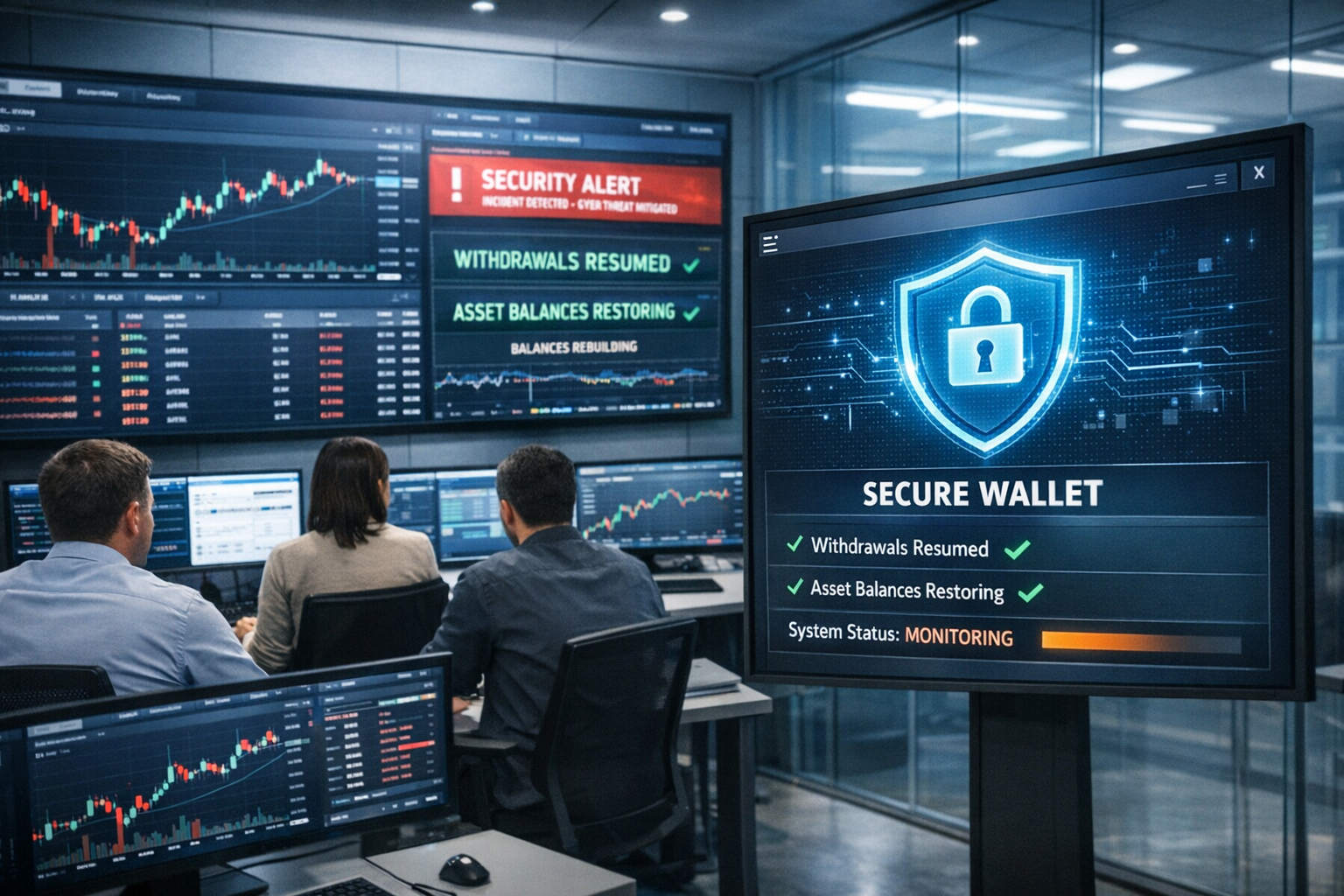
A record crypto theft shifts from shock to reckoning
Binance, the world’s largest cryptocurrency exchange, said it has replenished 98 percent of the assets affected in last week’s $6.34 billion theft, as the industry’s attention turns from the immediate damage to the deeper vulnerabilities the attack exposed.
The exchange has reopened withdrawals and moved to reassure customers that its balance sheet can absorb the loss. But as new details emerge about how the hackers gained access — and how quickly they exploited it — the breach is increasingly being viewed as more than a one-company crisis. It has become a test of the architecture underpinning global crypto markets.
In a security report released Tuesday, Binance said the attackers spent months inside its systems before carrying out the heist on Oct. 29. According to the company, the intrusion began with fake job interviews that led employees to install malware on their devices. From there, the hackers allegedly leveraged an internal artificial intelligence tool and gained access tied to wallet-signing processes, enabling rapid unauthorized withdrawals from hot wallets.
The Federal Bureau of Investigation has attributed the attack to TraderTraitor, a North Korean state-sponsored hacking group also widely known as Lazarus.
How the hackers operated
The attack’s method has drawn particular alarm because it appears to have combined old-fashioned social engineering with newer internal technology risks. Fake recruiting approaches have become a favored tactic among sophisticated cybercriminal groups, especially those linked to North Korea, which has repeatedly targeted crypto firms, developers and infrastructure providers through fraudulent outreach on professional networking sites and messaging platforms.
Binance’s account suggests the hackers did not simply break through a technical perimeter. They moved through human and operational weak points: employee devices, internal workflows and the systems involved in authorizing transfers.
That combination has underscored a growing concern in the industry that the greatest vulnerabilities may lie not only in code on public blockchains, but in the centralized machinery that connects customers’ assets to those networks.
Hot wallets — internet-connected wallets used to facilitate customer withdrawals and trading activity — have long been recognized as a trade-off between speed and security. The Binance theft appears to have shown just how large that risk can become when operational access, signing authority and internal tooling are concentrated inside a single platform.
Recovery, but not full retrieval
Binance said roughly $2.85 billion to $3 billion of the stolen assets have been frozen or intercepted with help from token issuers and other platforms. That distinction matters.
Some digital assets, particularly certain stablecoins, can sometimes be frozen by their issuers after a theft. More decentralized assets, including Bitcoin, are generally much harder to stop once they have been moved through wallets, bridges, swap services or decentralized finance protocols. U.S. authorities have long said North Korean hacking groups are adept at laundering stolen crypto through exactly those channels.
So while Binance says it has now restored nearly all affected customer balances, it remains unclear how much of the missing crypto will actually be recovered, rather than replaced from the exchange’s own reserves. The remaining gap may also be harder to close if it includes thinner-traded or less liquid tokens.
The company had initially said it had covered about 90 percent of affected assets. The revised 98 percent figure suggests the immediate financial damage to customers has narrowed significantly, even as the longer recovery effort remains unresolved.
Why custody is now at the center
If the first phase of the story was about a spectacular theft, the second is about custody.
The breach has intensified a debate over whether crypto exchanges should continue to bundle trading, custody and settlement under one roof — a structure common in digital assets but far less accepted in traditional finance. Investors, analysts and infrastructure firms are increasingly asking whether the next phase of the industry will require more separation between where assets are traded and where they are held.
That question has become more urgent because Binance was not a marginal venue. It was the central hub for a large share of global crypto trading. A compromise of that scale has sharpened concerns about concentration risk: when one platform controls customer relationships, trading flows and custody infrastructure, a single internal failure can have systemwide consequences.
Binance’s ability to replenish most of the losses has so far limited broader market contagion. There has been no immediate equivalent of a run that destabilized major rivals or sent prices into a prolonged collapse. But several billion dollars in net outflows were reported after services resumed, a sign that customer trust may prove harder to restore than balances.
For institutional investors especially, the breach may strengthen the appeal of independent custodians, stricter asset segregation and more heavily regulated safekeeping models. What once looked like back-end plumbing is now emerging as a frontline competitive issue.
The North Korea pattern
The alleged role of TraderTraitor places the Binance theft in a familiar and increasingly consequential pattern.
North Korea-linked cybertheft has become a major source of revenue for the isolated state, according to U.S. officials and private blockchain analysts. Security researchers have for years described the country’s hacking apparatus as one of the most effective sanctions-evasion tools available to Pyongyang. Crypto theft, in particular, offers access to assets that can be moved across borders outside much of the conventional banking system.
That makes major exchanges and crypto service providers high-value targets. It also means the implications of such hacks now extend beyond investor losses or corporate security failures. They sit at the intersection of financial stability, cyberwarfare and sanctions enforcement.
The Binance breach, because of its scale, is likely to intensify pressure on the industry to adopt tougher controls around employee access, wallet architecture and internal authorization systems. It may also increase scrutiny of how firms use AI-enabled tools inside sensitive financial operations, especially where automation intersects with transfer approvals or security monitoring.
A stress test for crypto’s next phase
The immediate crisis at Binance appears to be easing. Customers can withdraw again. Most affected assets have been replenished. Some of the stolen funds have been frozen.
But the larger lesson may only be beginning to sink in.
For years, crypto companies sold convenience and speed by combining exchange, custody and settlement into integrated platforms. The Binance hack has exposed the fragility of that model at the highest possible scale. In doing so, it may accelerate a shift in how the industry defines safety: not only by whether an exchange can survive a breach, but by whether customer assets should have been so exposed to one in the first place.
The next contest in crypto may not be over token listings or trading fees, but over who can most credibly safeguard assets in an era when state-backed hackers, social engineering and internal system complexity have become inseparable threats.
Sources
Further reading and reporting used to add context:
- https://www.axios.com/2026/11/03/north-korea-job-interview-binance-heist
- https://apnews.com/article/036aa8b36ae8401f3c1b3bbb81e9b2ed
- https://apnews.com/article/39cda8ceb8095e036334a18549d3d20d
- https://www.techradar.com/pro/security/fbi-confirms-it-thinks-north-korean-hackers-hit-binance-in-record-cryptocurrency-heist
- https://theweek.com/tech/binance-hack-the-biggest-heist-in-history
- https://www.itpro.com/security/cyber-attacks/the-binance-hack-explained-how-much-cryptocurrency-was-stolen-whos-behind-the-attack-and-was-a-single-compromised-laptop-to-blame
- https://www.theatlantic.com/newsletters/2026/10/crypto-biggest-heist-ever-binance-polymarket/689241/?utm_source=openai
- https://www.theguardian.com/business/2026/nov/01/binance-losses-covered-hack-fbi-north-korea-cryptocurrency
- https://www.binance.bh/en/blog/community/3229153443759566763
- https://www.binance.com/en/square/post/383244799724069
- https://www.binance.com/en-GB/support/announcement/security-incident-recovery-update-3-90-of-stolen-assets-replenished-proof-of-reserves-snapshot-provided-2026-10-31-1fdf1f61559c401da0435895ffcccb62
- https://www.theblock.co/news/business/2026-11-03-binance-hack-incident-report-north-korea-fake-job-interview-ai-tool-432406
- https://www.binance.bh/en-GB/support/announcement/security-incident-recovery-update-5-october-31st-por-snapshot-now-fully-verifiable-by-users-as-zk-proof-generated-2026-11-02-185bd9a4717f44088b3be70287b8237f
- https://www.investing.com/news/economy-news/binance-says-hackers-used-fake-job-interview-to-compromise-computer-before-63-billion-attack-4995603
- https://www.washingtonpost.com/technology/2026/11/03/how-malware-bogus-job-interview-let-attackers-nab-63b-binance/
- https://www.coindesk.com/business/2026/11/03/binance-s-usd6-3-billion-hack-began-with-a-fake-job-interview-exchange-says
- https://www.bleepingcomputer.com/news/security/fbi-links-63-billion-binance-crypto-heist-to-north-korean-hackers/
- https://apnews.com/article/550e9b876550f71f07098494fe735beb
- https://www.investing.com/news/stock-market-news/crypto-exchanges-call-for-quick-moves-to-bolster-defenses-after-binance-heist-4990717
- https://www.investing.com/news/economy-news/analysts-react-as-binance-freezes-assets-after-63-billion-security-breach-4985760
- https://www.investing.com/news/stock-market-news/binance-sees-outflows-stabilising-as-exchange-returns-online-after-63-billionheist-4989802
- https://www.investing.com/news/economy-news/binance-seeks-to-shore-up-confidence-after-record-63-billion-heist-4990304
- https://www.investing.com/news/economy-news/binance-coceo-says-company-is-in-very-strong-financial-health-after-63-billion-heist-4993774
- https://live.euronext.com/en/financial-news/binance-hackers-used-fake-job-interview-63-billion-attack
- https://www.breakingviews.com/40925ca4af2b/columns/considered-view/binance-hack-plays-up-cryptos-trust-issues-2026-11-02/
- https://www.zenguardterminal.com/news/binance-breach-puts-custody-at-center-of-crypto-infrastructure-trade-2026-11-03-97d6bd
- https://upside.pandobit.com/en/news/2026/11/binance-breach-puts-custody-at-center-of-crypto-infrastructure-trade-1118947/
- https://www.marketscreener.com/news/crypto-exchanges-call-for-quick-moves-to-bolster-defenses-after-binance-heist-ce785fd8d98af620
- https://au.investing.com/news/stock-market-news/crypto-exchanges-call-for-quick-moves-to-bolster-defenses-after-binance-heist-4733333
- https://research.binance.com/static/pdf/institutional-custody-in-crypto–.pdf
- https://apnews.com/article/883f18140c1e21ce0c38781e72cbe315
- https://www.pcgamer.com/software/security/users-pull-usd3-6-bn-from-binance-as-it-reopens-following-usd6-3-billion-mega-hack-fbi-says-north-korean-hacking-group-tradertraitor-to-blame-north-korea-says-nuh-uh/
- https://www.tomshardware.com/tech-industry/cryptocurrency/binance-withdrawals-frozen-after-thieves-steal-usd5-6-billion-in-crypto-in-record-breaking-cryptocurrency-heist-firm-says-it-will-cover-losses-as-stablecoin-networks-move-to-freeze-usd2-4b-in-stolen-assets
- https://www.fbi.gov/investigate/cyber/alerts/2026/north-korea-responsible-for-6-billion-binance-attack/layout_view
- https://binancebreach.com/attribution
- https://binancebreach.com/guide
- https://www.ally.security/incidents/binance-virtual-asset-theft-2026
- https://www.pk-sharma.com/briefing/fbi-attributes-binance-6-billion-theft-to-north-korea-tradertraitor-laundering-addresses-published
- https://www.fbi.gov/news/press-releases/press-releases
- https://www.thestreet.com/crypto/markets/fbi-names-who-took-6b-from-binance
- https://www.binance.com/en/square/post/383620403278886
- https://www.justice.gov/sites/default/files/2026-09/usa_v._approximately_110270_usdt_seized_from_binance_account_uid_735653443_held_in_the_name_of_enrique_mora_morales_-_complaint.pdf
- https://zenguardterminal.com/news/binance-breach-puts-custody-at-center-of-crypto-infrastructure-trade-2026-11-03-97d6bd
- https://cybersuit.tech/article/binance-breach-puts-custody-at-center-of-crypto-infrastructure-trade
- https://deadstack.net/recent
- https://edgeservices.bing.com/news/search?FORM=HDRSC6&q=Top+stories&rdr=1&rdrig=D0C9C5245F7843F6BDDABF32E7367FDF
- https://kompromatmedia.com/site/category.php?c=corporate-accountability
- https://www.thedigitaltrack.com/news/binance-breach-puts-custody-at-center-of-crypto-infrastructure-trade-vea4m4
- https://aiweekly.my/items/42698/binance-breach-puts-custody-at-center-of-crypto-infrastructure-trade
- https://search.govibe.org/?a=crypto_market
- https://www.bing.com/news?FORM=BNFD&q=
- https://www.deadstack.net/cluster/31180
- https://news.free-list.org/?cityId=10581&country=United+States
- Initial Findings and Response Update | Binance Blog
- Binance breach puts custody at center of crypto infrastructure trade
- Binance seeks to shore up confidence after record $6.3 billion heist By Reuters