
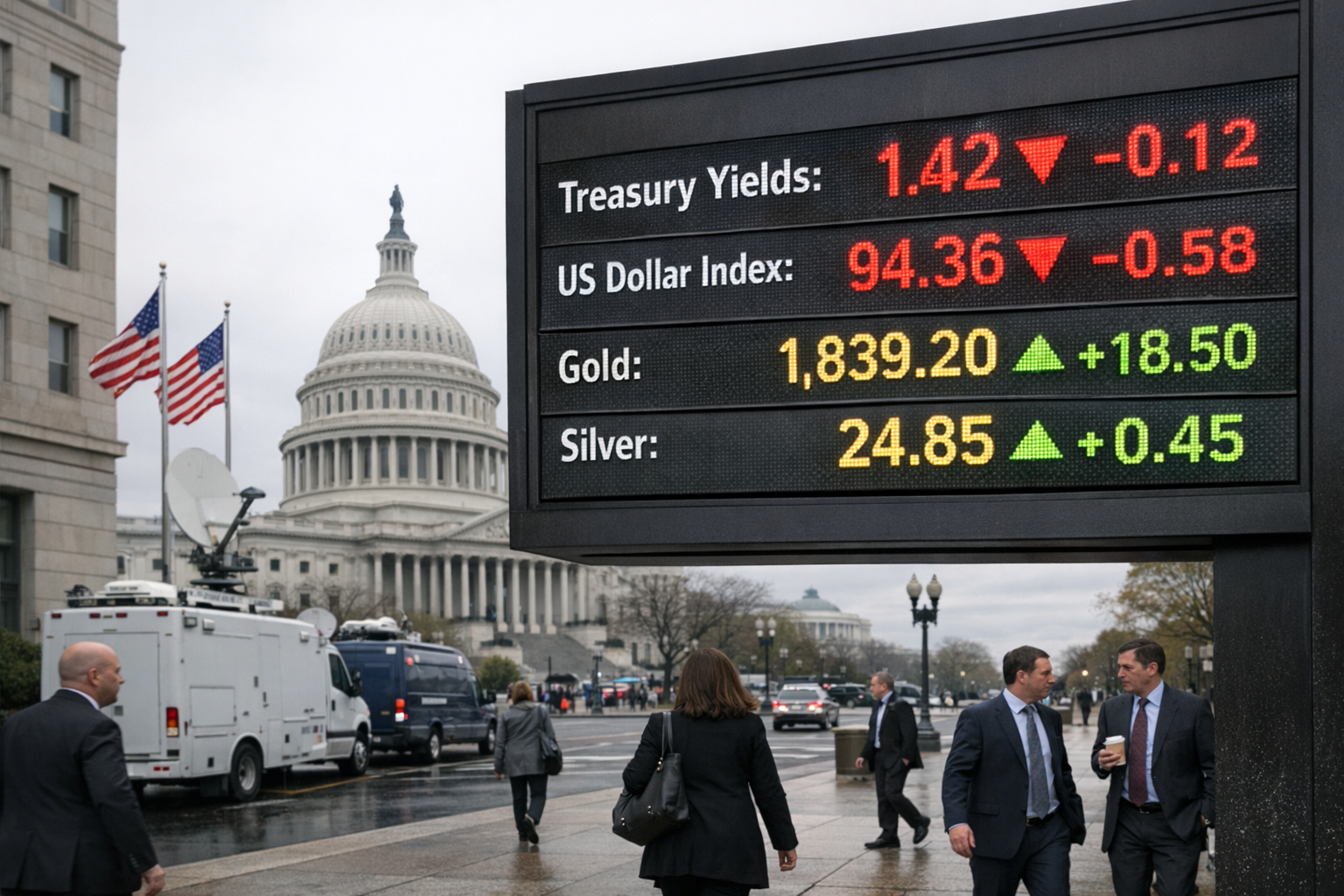
Markets on Wednesday delivered an immediate verdict on the new balance of power in Washington: less fiscal exuberance now, and a higher risk of political brinkmanship later.
After Democrats won control of both the House and the Senate in the midterm elections, investors pushed Treasury yields lower, sent the dollar down and rushed into gold and silver, reflecting a broad reassessment of how much room President Trump will have to pursue policies that add to deficits. U.S. stocks also rose, suggesting that for now Wall Street sees a Democratic Congress less as a source of paralysis than as a brake on further fiscal expansion.
The moves amounted to a classic repricing for divided government. The yield on the benchmark 10-year Treasury note fell to about 4.92 percent to 4.93 percent, a notable retreat as traders pared back expectations for new tax cuts or spending measures that could have put fresh upward pressure on borrowing costs. Gold climbed more than 2 percent, while silver rose roughly 4 percent, as a softer dollar and a search for political hedges buoyed precious metals.
A Relief Rally, With Caveats
The immediate logic behind the market response is straightforward. A Congress controlled by Democrats is likely to make it harder for Mr. Trump to enact additional deficit-financed legislation. That has eased, at least temporarily, one of the bond market’s central worries: that Washington would keep adding to already heavy borrowing needs at a moment when interest rates remain elevated.
The Treasury Department underscored the scale of those needs just before and after the election. On Nov. 2, it said it expected to borrow $618 billion in the October-through-December quarter and $800 billion in the first quarter of 2027. Then, in its quarterly refunding announcement on Wednesday, it kept nominal coupon and floating-rate note auction sizes broadly unchanged for the coming quarters, a sign of supply discipline for now even as financing demands remain large.
That combination — less prospect of fresh fiscal expansion, but no immediate increase in auction sizes — helped support the bond rally.
For stock investors, the result appeared to be reassuring in a different way. If Washington is less able to produce sweeping new legislation, it may also be less able to deliver measures that reignite inflation or push yields sharply higher. Lower long-term yields can support valuations, especially after a period in which rising rates have pressured both stocks and bonds.
The Debt Ceiling Lurks
But the same election result that soothed markets on Wednesday could become a source of turbulence in the months ahead.
With the White House and Congress now split, major fiscal disputes are more likely to be forced into deadline-driven confrontations, beginning with government funding later this year and extending to the debt-ceiling fight expected in late 2027. Investors have seen that script before, and they generally do not like it. Even when an outright default is widely viewed as unlikely, the mere possibility of delayed payments or a last-minute standoff can unsettle Treasury markets, raise short-term funding costs and inject fresh volatility across asset classes.
This time, the political dynamics may be unusually complicated. Republicans have traditionally been more willing to use the debt ceiling as leverage over Democratic presidents. Now Democrats may face pressure from their own base to use fiscal deadlines to extract concessions from Mr. Trump on spending, tariffs or other priorities. That reversal could leave markets confronting a familiar hazard from an unfamiliar direction.
The stakes are not abstract. U.S. federal debt has climbed past $40 trillion, and the government’s financing needs remain immense. Wednesday’s drop in yields offered relief, but it did not erase the deeper fiscal overhang hanging over the Treasury market.
Safe Havens and Political Hedges
The move into precious metals captured another dimension of investor thinking: this was not simply a celebration of gridlock. Gold often benefits when the dollar weakens and when traders seek protection against political instability. Wednesday brought both conditions.
The dollar slipped as investors recalibrated expectations for growth, borrowing and policy under a divided government. Gold and silver, in turn, gained as a hedge against the possibility that Washington’s newfound restraint could give way to confrontation. In that sense, the rise in metals was less a vote of confidence than a signal that some investors are preparing for a messier political phase.
That caution may prove well founded. If Mr. Trump, boxed in legislatively, turns more aggressively to executive action or foreign policy, markets could quickly shift their focus. Escalation on trade, particularly through tariffs, or tensions involving Iran and other geopolitical flashpoints could upend the election’s initial bond-friendly message.
Why This Matters Now
For now, investors are treating the election as a check on policies that might have driven deficits and yields even higher. But markets are also trying to distinguish between what has changed immediately and what has merely been postponed.
The immediate change is that Washington appears less capable of producing large new fiscal packages. The postponed risk is that the hardest fights may now come through must-pass deadlines, when the political incentives for confrontation are often strongest and the room for error is smallest.
That tension — relief today, anxiety tomorrow — explains why stocks could rise at the same time Treasurys rallied and gold surged. Investors are embracing the idea of restraint, while bracing for the possibility that restraint in Washington rarely arrives cleanly.
The market’s first response to the blue wave, in other words, was not just about who won Congress. It was about what kind of fiscal politics comes next — and whether the price of divided government will be paid in lower yields, or later in renewed brinkmanship.
Sources
Further reading and reporting used to add context:
- https://apnews.com/article/b1d26390b7ed7968435089be6d3bf612
- https://apnews.com/article/9c5c4c5283f58b1ae0786e2f410c21a0
- https://www.axios.com/2026/11/04/democrats-election-health-care-agenda-divisions
- US stocks rally, and the Dow soars more than 1,000 points | AP News
- https://www.theatlantic.com/politics/2026/11/trump-jeffries-democrats-midterms/689266/?utm_source=openai
- https://www.axios.com/newsletters/axios-am-3873025c-c9a4-43f6-b870-db7be0fe9438
- https://apnews.com/article/d66c92d2c171cf4dc434078c64cf2cd1
- https://www.theatlantic.com/ideas/2026/10/bubble-bailout-trump-authority/689190/?utm_source=openai
- https://www.kiplinger.com/investing/live/fed-meeting-updates-and-commentary-october-2026
- https://www.fidelity.com/news/article/international/202611040238RTRSNEWSCOMBINED_L2N46L0AS_1
- https://capitalswire.com/2026/11/04/gold-silver-and-precious-metals-prices-jump-dollar-dips-as-democrats-take-control-of-congress/
- https://allmind.ai/news/1015f48c4095cd2d519574bc6cbbe483b857c5556c7bf2624d05e26758837981
- https://www.aa.com.tr/en/economy/gold-silver-prices-surge-as-us-dollar-drops-after-midterm-elections/4111106
- https://www.fxstreet.com/analysis/republican-sweep-is-the-real-tail-risk-for-markets-202610161104
- https://ca.marketscreener.com/news/treasury-yields-decline-after-democrats-take-congress-eurozone-yields-edge-up-update-ce785fdfd98ff620
- https://www.axios.com/2026/11/04/midterm-elections-markets-stocks
- https://apnews.com/article/1022eb323f63cf9b78ae56d3868601ca
- https://www.axios.com/newsletters/axios-future-of-health-care-e793ffe0-d7d8-11f1-9b2f-9bd01a35ca05
- https://www.thedailybeast.com/veteran-election-guru-makes-disastrous-prediction-for-trump
- https://www.thedailybeast.com/odds-of-disaster-for-trump-surge-to-all-time-high-on-election-day
- https://www.investing.com/news/economic-indicators/the-midterm-election-outcomes-that-could-shape-trumps-final-two-years-4990725
- https://www.investing.com/news/economic-indicators/the-midterm-election-outcomes-that-could-shape-trumps-final-two-years-4956847
- https://www.marketscreener.com/news/the-midterm-election-outcomes-that-could-shape-trump-s-final-two-years-ce785cdbd88bf520
- https://www.investing.com/news/economy-news/analysisus-fiscal-deterioration-main-headache-for-investors-as-midterms-loom-4986509
- https://www.investing.com/news/economy-news/analysisinvestors-gaming-out-congress-control-for-spending-ai-outlook-4990603
- Treasury Announces Marketable Borrowing Estimates
- Democratic sweep adds new twist to markets’ Iran, AI, and debt worries By Reuters
- https://www.fidelity.com/news/article/us-markets/202611040405RTRSNEWSCOMBINED_L6N46L0L1_1
- https://www.investing.com/news/politics-news/trump-white-house-maps-path-to-govern-without-congress-if-democrats-win-4989653
- https://home.treasury.gov/news/press-releases/sb0678
- https://home.treasury.gov/policy-issues/financing-the-government/quarterly-refunding/most-recent-quarterly-refunding-documents/
- https://home.treasury.gov/news/press-releases/
- https://www.dejavu.org/cgi-bin/get.cgi?url=https%3A%2F%2Fhome.treasury.gov%2F%2Fpolicy-issues%2Ffinancing-the-government%2Fquarterly-refunding%2Fmost-recent-quarterly-refunding-documents%2F&ver=95
- https://content.govdelivery.com/accounts/USTREAS/bulletins/425aba1?reqfrom=share
- https://directspeech.news/en/news/quarterly-refunding-statement-of-assistant-secretary-for-financial-markets-hunter-mcmaster
- https://www.publicnow.com/view/D1A78949A7D656C87C250AB683BB53FF0E04E8A6
- https://www.pubt.io/view/A3056CBC4BB1A2FAECEE510486DAD55AC838386A
- https://t.co/jILijSCbBa
- https://home.treasury.gov/news/press-releases/sb0590?trk=public_post_comment-text
- https://home.treasury.gov/policy-issues/financing-the-government/quarterly-refunding/treasury-quarterly-refunding-process/
- https://media.marketnews.com/MNI_US_Deep_Dive_Issuance_2026_01_ca7816c3d7.pdf
- https://www.fiscal.treasury.gov/files/reports-statements/treasury-bulletin/2025/b2025-1.pdf
- https://www.treasurydirect.gov/instit/annceresult/press/preanre/2025/R_20251110_2.pdf
- https://www.treasurydirect.gov/instit/annceresult/press/preanre/2025/SPL_20250624_1.pdf
- https://www.treasury.gov/resource-center/data-chart-center/quarterly-refunding/Documents/auctions.pdf
- https://www.emeraldhost.net/files/LPL/Research/weekly-market-commentary-02-02-26.pdf
- https://www.reddit.com/r/stocks/comments/1vsmhf5/treasury_announces_increased_sizes_of_nominal/
- https://www.reddit.com/r/stocks/comments/1vsliip/us_treasury_increasing_size_of_liquidity_support/
- https://www.reddit.com/r/StockMarket/comments/1vsll4i/us_treasury_increasing_size_of_liquidity_support/
- https://en.wikipedia.org/wiki/History_of_Federal_Open_Market_Committee_actions
- https://www.reddit.com/r/bonds/comments/1x02lbo/treasury_auction_10y_53_high_yield_good_auction/
- https://www.reddit.com/r/fidelityinvestments/comments/1c5tmh7
- https://www.reddit.com/r/investing/comments/1vsttup/the_treasury_just_doubled_bond_buybacks_to_hold/
- The Latest: Voters give Democrats control of Congress in rebuke to Trump