
China is drawing a sharper line around its artificial intelligence industry at the very moment it is pushing the technology out of the cloud and into the physical world.
Beijing’s order this week requiring the withdrawal of Meta’s acquisition of Manus, a Singapore-based A.I. startup with Chinese roots, was more than a rebuke to one deal. It signaled an increasingly muscular view inside China that A.I. assets — not only chips and large models, but also talent, data, intellectual property and application know-how — are matters of national strategic importance.
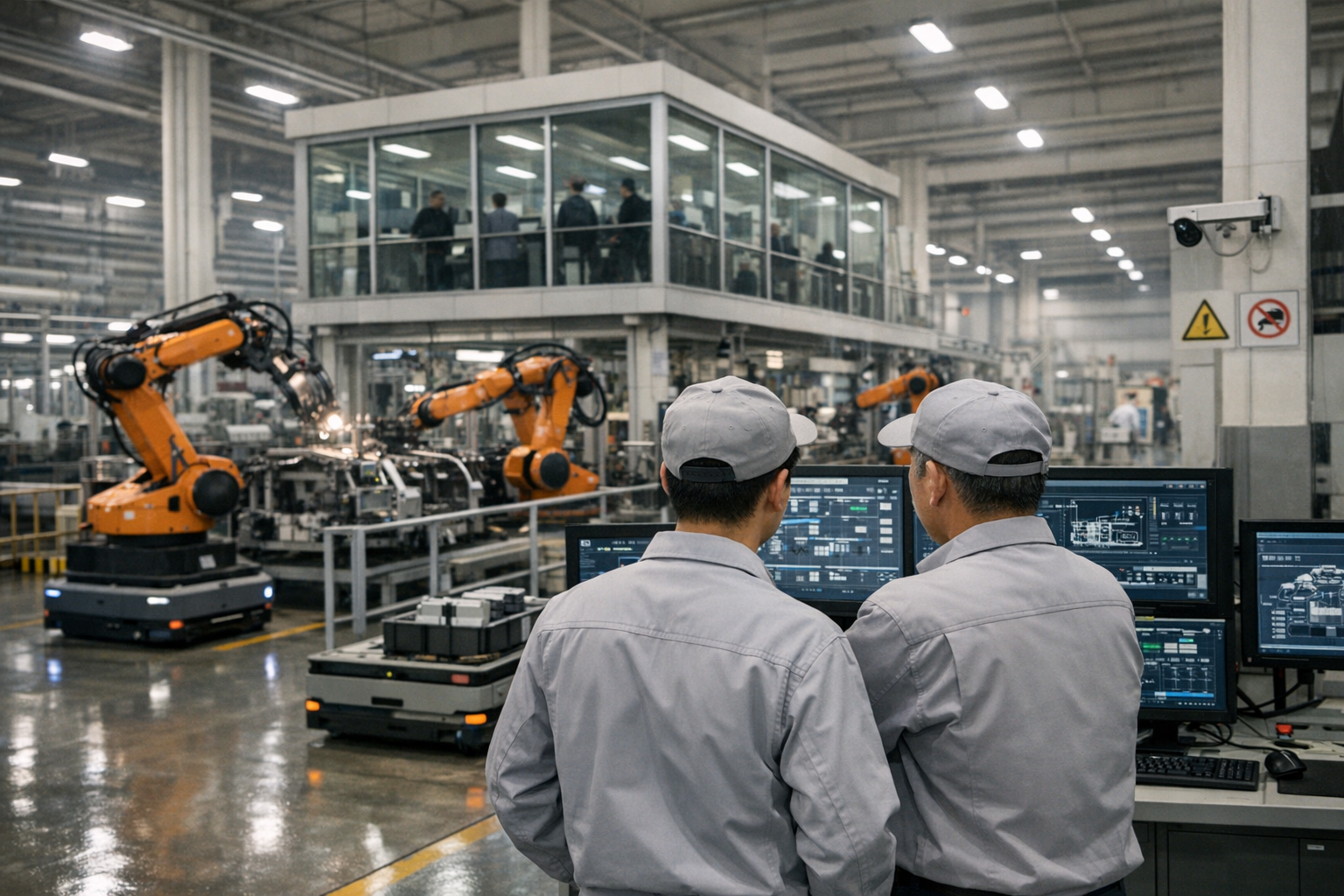
That message is arriving as Chinese companies and policymakers accelerate a second, equally consequential shift: embedding A.I. into robots, vehicles, factory systems and consumer devices. Together, the moves suggest that China’s next phase in the global A.I. contest may be defined less by chatbots alone than by control over the technologies that animate machines in the real economy.
A tougher line on cross-border A.I.
China’s top economic planning agency on April 27 ordered the Meta-Manus transaction unwound through the country’s foreign-investment security review process, according to people familiar with the matter and Chinese media reports. The decision has reverberated across China’s technology sector, where founders and investors have long used offshore structures, overseas listings and foreign acquisitions to raise capital and expand globally.
In this case, the government’s intervention appeared to send a clear warning: relocating Chinese-linked A.I. capabilities abroad, even through a company based in Singapore, will face far heavier scrutiny than in the past.
The implications go beyond one startup. For years, much of the debate over U.S.-China technological rivalry centered on semiconductors, export controls and access to the most advanced computing hardware. But the Manus decision suggests that Beijing now sees the application layer of A.I. as strategic terrain too — especially when it includes valuable engineering teams, proprietary data or systems that could be deployed in industry.
For Chinese entrepreneurs, that raises difficult questions. Offshore incorporation has often been treated as a pragmatic way to attract foreign investment or prepare for a global exit. Now, at least in A.I., such arrangements may increasingly be viewed through the lens of national security.
Whether the decision becomes a broad precedent remains unclear. Officials have not publicly detailed how expansively they intend to apply the standard to future mergers, overseas listings or corporate restructurings involving Chinese-linked A.I. firms. But the message to the market was unmistakable: the state intends to decide which A.I. assets can leave, and which cannot.
From software to machines
At the same time, Chinese industry is rapidly moving A.I. into what executives increasingly call the physical economy.
Rather than limiting A.I. to cloud services or office productivity tools, manufacturers, automakers and robotics companies are building it into devices that can sense, move and act: factory robots, smart vehicles, warehouse systems and humanoid machines. In China, that push is being reinforced by an industrial base that can produce hardware at scale — a longstanding advantage that policymakers hope can compensate, at least in part, for restrictions on access to top-tier American technology.
The strategy has become more explicit this year. In February, central state-owned enterprises launched an “embodied intelligence” consortium aimed at coordinating work on systems that combine A.I. software with physical machines. In March, China released its first national standard framework for humanoid robotics and embodied A.I., covering data, deployment, safety and ethics. And the government’s 2026 work agenda called for expanding the “AI Plus” initiative and accelerating the commercialization of A.I. agents, embodied A.I. and intelligent devices.
Those policy moves are landing in an industrial ecosystem already unmatched in scale. According to the International Federation of Robotics, China accounted for 54 percent of global new industrial-robot installations in 2024, and its total robot stock exceeded two million units.
That installed base matters. It gives Chinese companies a large testing ground in factories, logistics networks and automotive production lines — places where improvements in machine vision, control systems and generative A.I. can be turned into measurable gains in speed, cost and labor productivity.
In effect, Beijing appears to be betting that the future of A.I. will not be won solely by whoever builds the most advanced model, but also by whoever can most effectively deploy intelligence in physical systems at scale.
A broader Asian shift
The trend is not confined to China. Across Asia, labor shortages, rising service demand and advances in robotics are creating new incentives to automate work that once seemed too variable or delicate for machines.
In Japan, Japan Airlines is set to begin a trial at Tokyo’s Haneda Airport using humanoid robots as baggage handlers starting in May, part of a broader effort to cope with worsening labor shortages and a surge in inbound tourism. The trial is modest, but symbolically important: it points to how quickly robotics is moving from demonstration videos and trade shows into ordinary, labor-intensive operations.
The Japanese experiment also highlights the practical test facing the wider robotics boom. It is one thing for a robot to perform well in a controlled setting. It is another for it to operate reliably, safely and economically in crowded, unpredictable environments like airports, warehouses and transport hubs.
That challenge applies equally to China’s ambitions. Despite rapid progress, many “physical A.I.” systems remain early in commercialization. Their success will depend not just on smarter models, but on sensors, batteries, software integration, maintenance and clear safety rules.
Why this matters now
The combination of stricter state control and faster embodied deployment marks a notable turn in China’s A.I. strategy.
For much of the past two years, attention centered on whether Chinese companies could keep pace with American rivals in large language models while navigating export controls on advanced chips. China still faces those constraints. But it is increasingly pursuing an area where it may hold a different set of advantages: manufacturing depth, supply-chain density and a huge domestic market for industrial automation, electric vehicles and intelligent devices.
If Beijing can keep key A.I. talent and intellectual property from flowing abroad while channeling domestic industry toward robotics, autonomous systems and smart hardware, it could strengthen its position in what some executives call “physical A.I.” — the use of artificial intelligence to power machines that work in the real world.
That does not mean the strategy is without risk. More intrusive state oversight could deter foreign capital, limit partnerships and complicate exit paths for startups. Entrepreneurs may become more cautious about offshore structures or global dealmaking if they fear intervention after the fact. And in robotics, progress from pilot projects to dependable mass adoption is rarely smooth.
Still, the direction of travel is becoming clearer. China is not only trying to compete in A.I.; it is trying to decide where that competition will be fought. And increasingly, it appears to believe the most consequential battlefield may be less on screens than on factory floors, in vehicles, in warehouses and anywhere else software can be given a body.
Sources
Further reading and reporting used to add context:
- https://www.axios.com/2026/04/27/china-blocks-metas-acquisition-of-manus-ai
- https://apnews.com/article/5f8012791f86f719a24a3ebac06d9b0a
- https://www.theguardian.com/world/2026/apr/28/humanoid-robots-baggage-handlers-japan-airports
- https://arstechnica.com/ai/2026/04/japan-airlines-tests-having-robots-instead-of-humans-handle-travelers-luggage/
- https://www.forbes.com/sites/siladityaray/2026/04/27/china-blocks-metas-2-billion-acquisition-of-ai-startup-manus//
- https://www.cnbc.com/2025/06/04/cnbcs-the-china-connection-newsletter-china-supply-chains-ai-edge.html
- https://www.straitstimes.com/asia/beijing-blocks-us2-billion-sale-of-singapore-based-manus-to-meta
- https://en.wikipedia.org/wiki/Manus_%28AI_agent%29
- https://awesomeagents.ai/news/china-blocks-meta-manus-acquisition/
- https://elpais.com/economia/2026-04-27/pekin-bloquea-la-compra-por-meta-de-manus-una-start-up-china-de-ia.html
- https://happymag.tv/japan-trial-ai-humanoid-baggage-handler-robots-tokyo-airport/
- https://www.washingtonpost.com/world/2026/04/21/china-ai-competition-manus-meta//
- https://www.infobae.com/tecno/2026/04/28/asi-seran-los-robots-que-llevaran-tu-equipaje-y-te-acompanaran-en-el-aeropuerto/
- https://aviationweek.com/air-transport/airports-networks/japan-airlines-trials-humanoid-robots-ground-handling
- https://www.globenewswire.com/news-release/2026/04/16/3275135/28124/en/physical-artificial-intellligence-ai-research-report-2026-a-3-25-trillion-market-by-2040-from-383-billion-in-2026-with-untapped-potential-across-healthcare-smart-infrastructure-and.html
- https://www.techradar.com/pro/metas-usd2b-manus-acquisition-sparks-concerns-from-chinese-regulators
- https://www.tbsnews.net/tech/china-quietly-winning-physical-ai-race-1395301
- https://omniekonomi.se/kina-blockerar-metas-miljardkop-av-manus-ai/a/m0M33q
- https://www.reddit.com/r/AI_Agents/comments/1sx8402/metas_acquisition_of_the_ai_startup_manus_was/
- https://www.reddit.com/r/openclaw/comments/1sx86p4/metas_acquisition_of_the_ai_startup_manus_was/
- https://www.cnbc.com/2025/04/30/cnbcs-the-china-connection-newsletter-a-tech-boom-is-underway.html
- https://www.cnbc.com/2025/07/02/cnbc-china-connection-newsletter-a-slowing-economy-meets-a-fast-future-ai.html
- https://www.cnbc.com/2025/05/26/tencent-baidu-reveal-how-theyre-dealing-with-us-ai-chip-curbs.html
- https://www.cnbc.com/2025/06/11/cnbcs-the-china-connection-newsletter-ai-hits-an-already-weak-jobs-market.html
- https://www.cnbc.com/2025/07/14/meta-zuckerberg-ai.html
- https://www.cnbc.com/2025/01/23/scale-ai-ceo-says-china-has-quickly-caught-the-us-with-deepseek.html
- https://www.cnbc.com/2025/06/10/zuckerberg-makes-metas-biggest-bet-on-ai-14-billion-scale-ai-deal.html
- https://www.cnbc.com/2025/02/12/china-tech-giant-baidu-to-release-next-generation-ai-model-this-year-as-deepseek-shakes-up-market.html
- https://www.cnbc.com/2025/04/28/metas-ai-spending-comes-into-focus-amid-trumps-tariff-policies.html
- https://www.cnbc.com/2025/08/18/openai-altman-china-ai.html
- https://www.cnbc.com/2025/09/03/cnbcs-the-china-connection-newsletter-tech-exports-amid-us-ai-race.html
- https://fm.cnbc.com/applications/cnbc.com/resources/editorialfiles/2026/04/23/Toplines_260142_CNBC_AAES_Q1_2026_Topline.pdf
- https://zfxxgk.ndrc.gov.cn/upload/images/202511/2025112413101161.pdf
- https://fm.cnbc.com/applications/cnbc.com/resources/editorialfiles/2025/11/10/202511_-_Trump_Administration_-_AI_Data_Center_Energy_Prices.pdf
- https://zfxxgk.ndrc.gov.cn/upload/images/20260/202602311354699.pdf
- https://en.ndrc.gov.cn/policies/202105/P020210527780237298276.pdf
- https://www.statista.com/chart/31337/new-installations-of-industrial-robots-by-country/
- https://ifr.org/ifr-press-releases/news/global-robot-demand-in-factories-doubles-over-10-years%20%20%20
- https://humanoidintel.ai/news/china-humanoid-robots-factory-deployment-2026/
- https://www.intellinews.com/china-installs-more-industrial-robots-than-rest-of-world-combined-ifr-403694/?source=asia
- https://english.news.cn/20250926/0e0d8b4348b64c36951cc1c000498d38/c.html
- https://www.heise.de/en/news/China-will-install-more-than-half-of-all-industrial-robots-worldwide-in-2024-10684198.html
- https://ifr.org/downloads/press_docs/2025-09-25-IFR_press_release_China_in_English.pdf
- https://itif.org/publications/2024/03/11/how-innovative-is-china-in-the-robotics-industry/
- https://www.foundrymag.com/issues-and-ideas/article/55166369/robot-installations-dropped-in-latest-summary-international-federation-of-robotics
- https://www.scmp.com/tech/tech-trends/article/3300872/future-made-china-ubtech-robotics-deploys-first-humanoid-team-car-factory
- https://english.news.cn/20250322/ba24987c841b47ebad8ed3929e8bef7c/c.html
- https://www.wipo.int/ja/web/global-innovation-index/w/blogs/2024/robotics-industry
- https://en.wikipedia.org/wiki/Industrial_robot
- https://www.lemonde.fr/en/economy/article/2025/08/16/china-s-robotics-industry-surges-amid-promise-of-a-5-trillion-market_6744434_19.html
- https://www.techradar.com/vehicle-tech/hybrid-electric-vehicles/i-was-stuck-on-the-overpass-with-dump-trucks-all-around-me-a-mass-baidu-robotaxi-outage-just-caused-traffic-mayhem-in-china
- https://www.techradar.com/tech/bigger-than-the-super-bowl-futuristic-humanoid-robots-dominate-chinas-most-watched-tv-show-and-leap-ahead-of-the-tesla-optimus
- https://hai.stanford.edu/assets/files/hai_ai-index-report-2024_chapter4.pdf
- https://en.wikipedia.org/wiki/AgiBot
- https://theweek.com/tech/china-and-the-rise-of-the-humanoid-robots
- https://www.livescience.com/technology/robotics/china-launches-worlds-first-robot-that-can-run-by-itself-24-7-watch-it-change-its-own-batteries-in-unsettling-new-footage
- https://en.sasac.gov.cn/2026/02/13/c_20439.htm
- https://english.scio.gov.cn/chinavoices/2026-03/02/content_118354738.html
- https://english.news.cn/20260422/71e6e5eee389441395d6956fe6e42598/c.html
- https://english.scio.gov.cn/chinavoices/2026-02/13/content_118332450.html
- https://english.news.cn/20260414/875be29bc56c45558650ed4139a66361/c.html
- https://english.news.cn/europe/20260422/226db2153c23443690d531fd09b9a81e/c.html
- https://english.news.cn/20260419/b729d971f23e4d969cbc88d55a8519f2/c.html
- https://english.www.gov.cn/2026special/2026npcandcpcc/202603/05/content_WS69a92040c6d00ca5f9a09916.html
- https://english.scio.gov.cn/m/pressroom/2026-01/26/content_118301853_5.html
- https://english.news.cn/20260320/302cac49c8ae42bc9483fa656348e93e/c.html
- https://english.news.cn/20251106/c8672a1542834c66ab7f2ed16bd2e526/c.html
- https://english.news.cn/20260413/5c2ca2699bb84e63bc2c4625fc770ae9/c.html
- https://ie.china-embassy.gov.cn/zagx/kjjl/202603/P020260316803254210174.pdf
- https://pt.china-embassy.gov.cn/chn/kjjl/202502/P020250215039925014218.pdf
- https://pt.china-embassy.gov.cn/pot/kjjl/202504/P020250416666147440343.pdf
- https://pt.china-embassy.gov.cn/chn/kjjl/202509/P020250924643409665024.pdf
- https://www.beijing.gov.cn/fuwu/lqfw/gggs/202505/P020250508613471148826.pdf
- https://eu.china-mission.gov.cn/eng/zywj/CSTNENG/202601/P020260107058022236099.pdf
- China blocks Meta from acquiring startup Manus as global AI rivalry deepens
- China's Central SOEs Launch Embodied Intelligence Consortium