
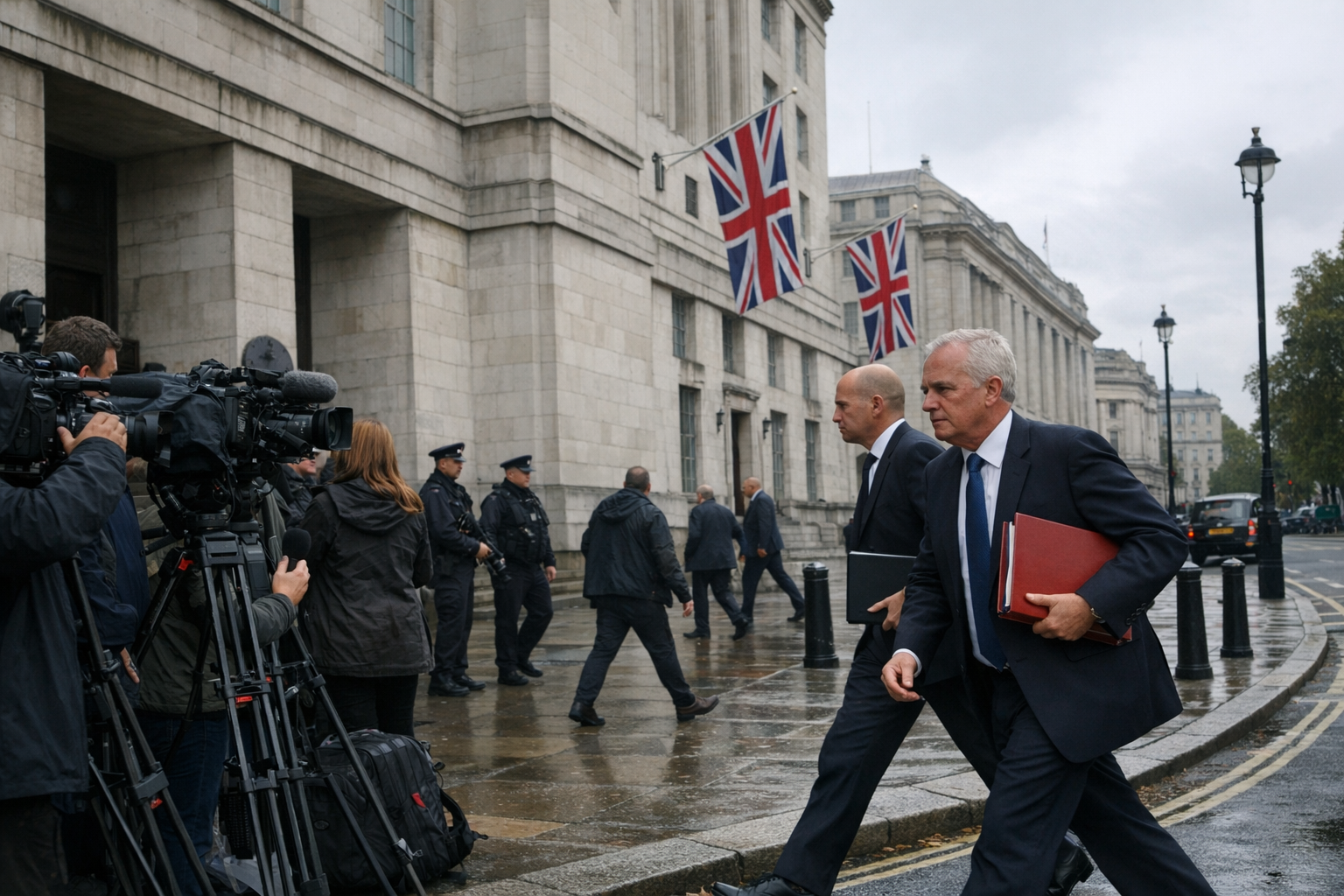
A Defence Revolt at a Fraught Moment
Britain’s long-simmering argument over how much to spend on the military — and what, exactly, to buy with it — erupted into a full political crisis this week after the resignations of two senior defence figures laid bare a widening split at the top of government.
John Healey stepped down as defence secretary on June 11, saying the government’s planned Defence Investment Plan did not come close to meeting the scale of the threat facing Britain. Within hours, Al Carns, the armed forces minister and a rising figure in Labour, followed him out the door, but with an even sharper warning: the problem was not only that the plan was underfunded, but that it was preparing Britain for the wrong kind of war.
Their departures leave Prime Minister Keir Starmer trying to steady his government just weeks before a NATO summit in Ankara, where allies are expected to present evidence of higher spending and faster military-industrial mobilization. They also come as tensions in the Middle East have sharpened concerns about how quickly Britain and its allies could sustain another crisis.
The government moved quickly to install Dan Jarvis as Healey’s replacement. But the speed of the reshuffle did little to conceal the seriousness of the rupture. What had for months been an internal dispute over budgets and procurement has now become a public challenge to Starmer’s authority, his fiscal strategy and his broader claim that Labour can restore competence to government.
More Than a Budget Row
At the center of the confrontation is the still-unpublished Defence Investment Plan, a document intended to translate Britain’s Strategic Defence Review into a funded long-term program. Ministers have repeatedly said they are overseeing the biggest sustained rise in defence spending since the Cold War, with a target of reaching 2.6 percent of gross domestic product from 2027.
But Healey and Carns made clear that they believed the numbers, and the assumptions behind them, were not enough.
Healey’s complaint was fundamentally about scale: that after months of delay, the Treasury’s offer to the Ministry of Defence was too small to finance major projects credibly. Carns widened the indictment. In his resignation letter, he argued that British procurement remained too slow and too rooted in old habits, even as battlefields from Ukraine to the Middle East have shown how rapidly cheaper autonomous systems, software and data can reshape war.
He said Britain was still buying capabilities suited to “the last war” while adversaries were arming for the next one, and called for a much larger emphasis on drones, artificial intelligence, data systems and more adaptable forms of military power. His criticism echoed a debate now running through Western defence establishments: whether expensive legacy platforms still deserve priority when they can be threatened by much cheaper systems in mass.
That argument is no longer abstract. Russia’s war in Ukraine has underscored the decisive role of drones, electronic warfare, munitions stockpiles and industrial depth. The conflict has also exposed how slowly many European governments replenish weapons and how cumbersome their procurement systems remain. Carns’s assertion that decisions take months when they should take days touched on a frustration shared well beyond Britain.
Pressure Before NATO
The timing could hardly be worse for Downing Street.
At next month’s NATO summit, leaders will be under pressure not merely to repeat spending pledges but to show that they can convert money into usable capability. Across the alliance, the debate has shifted from headline percentages to readiness, production and resilience: how many munitions can be made, how quickly forces can deploy, and whether procurement systems can respond to a more dangerous era.
For Britain, which has long sought to present itself as one of Europe’s leading military powers, the optics are damaging. A public revolt by a defence secretary and an armed forces minister invites doubts not only about the adequacy of the budget but also about whether London has a coherent plan at all.
That matters especially because Britain has positioned itself as a key European pillar of NATO at a time when the alliance remains preoccupied by Russia, uncertainty over future American commitments and a broadening set of threats stretching from cyberwarfare to instability in the Middle East. If London arrives in Ankara still arguing over the fundamentals, it risks appearing less like a leader than a government trapped by its own internal contradictions.
A Broader Warning About Government
Carns’s resignation also carried a message that went beyond defence. He described a state apparatus too slow for current dangers and a political culture that, in his view, too often rewarded performance over candor. That language gave his departure the feel of something larger than a policy dispute. It was a criticism of how Britain is governed at a moment when security challenges are moving faster than Whitehall’s habits.
Such warnings have become increasingly resonant in Britain, where years of pressure on public finances have collided with demands for military modernization, industrial renewal and stronger national resilience. Defence planners have been forced to confront not only the cost of new technologies but also the need to replenish ammunition, repair readiness gaps and strengthen supply chains after decades in which procurement often favored long-term prestige projects.
The question now is whether Starmer chooses to absorb the criticism and revise the plan, or to press ahead and argue that fiscal restraint remains unavoidable. Either course carries political risk. A rewrite could look like an admission that his government lost control of one of its most sensitive portfolios. Holding the line could deepen Labour’s internal divisions and reinforce the charge that Britain is failing to match rhetoric with strategy.
What Comes Next
Much remains unclear, including the size of the actual funding gap and whether Jarvis will defend the existing investment plan or substantially recast it. Also unresolved is the central strategic choice exposed by the resignations: whether Britain should keep prioritizing traditional, expensive platforms, or shift more sharply toward autonomous systems, data networks, stockpiles and faster procurement.
That debate will shape more than one spending round. It will help determine what kind of military Britain believes it needs for the next decade, and whether it can adapt quickly enough to a security landscape in which speed, scale and software increasingly matter as much as ships, aircraft and armor.
For Starmer, the immediate problem is political survival and credibility. For Britain, the deeper issue is whether a country that still sees itself as a major military actor is prepared to fund — and rethink — the means required to remain one.
Sources
Further reading and reporting used to add context:
- https://apnews.com/article/533cb2637192f045ca6247ab5a402bac
- https://www.chathamhouse.org/2026/06/defence-investment-paralysis-why-defence-minister-quit-what-means-independent-thinking-podcast
- https://labourlist.org/2026/06/al-carns-resigns-armed-forces-minister/
- https://www.euronews.com/my-europe/2026/06/11/uk-defence-secretary-resigns-with-stinging-attack-on-keir-starmers-military-spending-plans
- https://www.aa.com.tr/en/europe/uk-armed-forces-minister-resigns-hours-after-defense-secretary-quits-over-spending-dispute/3964640
- https://www.itv.com/news/2026-06-11/starmers-authority-shaken-by-defence-secretarys-exit-over-military-funding
- https://www.gov.uk/government/news/ministerial-appointment-11-june-2026
- https://www.presstv.ir/Detail/2026/06/12/770285/UK-defense-crisis-deepens–Second-top-official-resigns-in-less-than-24-hours
- https://www.chathamhouse.org/2026/06/john-healeys-resignation-highlights-profound-strategic-failure-uk-governments-approach
- https://www.theguardian.com/politics/2026/jun/11/john-healey-resigns-defence-secretary-military-spending
- https://www.enca.com/news/two-uk-ministers-quit-defence-spending-row-piling-pressure-pm
- https://www.cbsnews.com/news/united-kingdom-defense-chief-john-healey-resigns-military-funding-nato/?intcid=CNR-01-0623
- https://www.lemonde.fr/en/international/article/2026/06/12/uk-defense-minister-resigns-as-keir-starmer-fails-to-define-military-investment-plan_6754377_4.html
- https://newsonair.gov.in/uk-armed-forces-minister-al-carns-resigns-over-defence-funding-dispute/
- https://elpais.com/internacional/2026-06-11/el-ministro-de-defensa-de-reino-unido-john-healey-dimite-por-desacuerdos-sobre-gasto-militar.html
- https://cadenaser.com/nacional/2026/06/11/dimite-el-ministro-de-defensa-del-reino-unido-por-sus-diferencias-con-starmer-sobre-el-gasto-militar-esta-nueva-era-requeria-mas-inversiones-cadena-ser/
- https://www.gov.scot/binaries/content/documents/govscot/publications/foi-eir-release/2026/02-e/foi-202500497216/documents/foi-202500497216—information-released—annex/foi-202500497216—information-released—annex/govscot%3Adocument/FOI%2B202500497216%2B-%2BInformation%2BReleased%2B-%2BAnnex.pdf
- https://en.wikipedia.org/wiki/2025_The_Hague_NATO_summit
- https://en.wikipedia.org/wiki/Agreement_on_5%25_NATO_defence_spending_by_2035
- https://en.wikipedia.org/wiki/Al_Carns
- https://www.gov.uk/government/news/uk-spends-over-400-million-on-long-range-weapons-as-cooperation-scales-up-with-european-allies
- https://www.gov.uk/government/news/student-skills-investment-to-boost-uk-defence-industry
- https://www.gov.uk/government/news/half-a-a-billion-investment-to-upgrade-raf-typhoons-and-secure-1500-british-jobs
- https://www.gov.uk/government/news/50-million-boost-for-defence-businesses-in-plymouth-and-the-south-west-with-new-defence-growth-deal
- https://www.gov.uk/government/news/unlocking-private-investment-to-drive-uk-defence-as-an-engine-for-growth
- https://www.gov.uk/government/news/50-million-boost-to-defence-innovation-in-south-yorkshire-with-new-defence-growth-deal
- https://www.gov.uk/government/news/northern-ireland-start-up-boost-with-new-50-million-defence-growth-deal
- https://www.gov.uk/government/news/scotland-set-for-skills-and-innovation-boost-as-50-million-defence-growth-deal-unveiled
- https://www.gov.uk/government/news/armed-forces-personnel-receive-third-consecutive-above-inflation-pay-rise
- https://www.gov.uk/government/news/uk-accelerates-200-million-of-funding-for-deployment-to-ukraine-as-air-defence-support-stepped-up
- https://www.gov.uk/government/news/government-spends-record-levels-to-support-our-veterans
- https://www.gov.uk/government/news/prime-minister-sets-out-biggest-sustained-increase-in-defence-spending-since-the-cold-war-protecting-british-people-in-new-era-for-national-security
- https://assets.publishing.service.gov.uk/media/68f5fcd7f5d433238a14c7ba/UK_Defence_Footprint_-_Making_Defence_an_Engine_for_Growth.pdf
- https://assets.publishing.service.gov.uk/media/68bea3fc223d92d088f01d69/Defence_Industrial_Strategy_2025_-_Making_Defence_an_Engine_for_Growth.pdf
- https://assets.publishing.service.gov.uk/media/683d89f181deb72cce2680a5/The_Strategic_Defence_Review_2025_-_Making_Britain_Safer_-_secure_at_home__strong_abroad.pdf
- https://www.axios.com/2026/06/11/trump-cancel-iran-strikes-deal-strait
- https://www.axios.com/2026/06/11/trump-iran-strikes-kharg-island-oil
- https://apnews.com/article/47f9fecd934706362104cd92514122fe
- https://www.axios.com/2026/06/07/trump-israel-iran-missile-attack
- https://apnews.com/article/df859624fb659cb28cec798200cc85d4
- https://www.nato.int/cps/en/natohq/topics_50115.htm
- https://www.nato.int/en/news-and-events/articles/news/2025/08/20/turkiye-to-host-2026-nato-summit-in-ankara
- https://www.nato.int/en/what-we-do/introduction-to-nato/nato-summits
- https://www.nato.int/en/news-and-events/events/media-advisories/2026/04/22/nato-summit-media-advisory
- https://www.nato.int/en/news-and-events/articles/news/2026/01/15/natos-largest-military-exercise-of-2026-steadfast-dart-is-underway
- https://en.wikipedia.org/wiki/2026_Ankara_NATO_summit
- https://www.nato.int/en/news-and-events/articles/news/2026/06/10/nato-secretary-general-highlights-the-importance-of-nato-eu-cooperation
- https://www.nato.int/en/news-and-events/articles/news/2026/05/28/nato-secretary-general-meets-with-prime-minister-magyar-of-hungary
- https://www.nato.int/en/what-we-do/introduction-to-nato/nato-summits?selectedLocale=ru
- https://www.nato.int/en/news-and-events/articles/news/2026/05/22/nato-foreign-ministers-wrap-up-preparations-for-ankara-summit-in-helsingborg
- https://www.nato.int/fr/what-we-do/introduction-to-nato/nato-summits
- https://www.nato.int/en/news-and-events/articles/news/2026/05/28/nato-military-committee-visits-jfc-brunssum
- https://www.aa.com.tr/en/world/turkiye-chalks-out-high-level-security-plan-for-nato-summit-in-ankara/3965039
- https://www.lemonde.fr/en/international/article/2026/06/08/israel-iran-missile-exchanges-raise-fears-of-fresh-regional-escalation_6754248_4.html
- https://en.wikipedia.org/wiki/2026_United_States_military_buildup_in_the_Middle_East
- https://en.wikipedia.org/wiki/NATO_summit
- https://en.wikipedia.org/wiki/2026_Kharg_Island_attack
- https://en.wikipedia.org/wiki/2026_Iran_war
- https://www.nato.int/content/dam/nato/webready/documents/events/2026/20260112-DMM-Media-programme.pdf
- https://monch.com/wp-content/uploads/2026/04/NNPP-NATO-Summit-2026-Flyer-HighRes.pdf
- https://www.reddit.com/r/TrumpGlobalWar/comments/1u3aioa/us_political_briefing_june_11_2026_trump_cancels/
- UK defense secretary resigns, saying the government isn't willing to spend enough on the military
- Starmer’s authority shaken by defence secretary’s exit over military funding | ITV News
- Strategic
Defence
Review
Making Britain Safer: