
American warplanes struck targets in Iran for a ninth consecutive night on Monday, even as oil prices swung sharply and fresh signs emerged that both Washington and Tehran may still be searching for a way to keep the conflict from widening further.
The latest attacks came after the American military disclosed another service member’s death, this time in Iraq during what officials described as the controlled detonation of a downed Iranian drone. That announcement followed the deaths of U.S. troops in Jordan over the weekend, underscoring how a confrontation that only weeks ago was still framed around a collapsed cease-fire has hardened into a sustained war with mounting American casualties and growing consequences for global energy markets.
U.S. Central Command said the latest strikes hit Iranian coastal surveillance systems, air defenses and other military facilities tied to Tehran’s ability to threaten vessels moving through the Strait of Hormuz, the narrow waterway between Iran and the Arabian Peninsula that carries roughly a fifth of the world’s traded oil and gas.
The Trump administration has increasingly cast the campaign in those terms: not only as retaliation for attacks on American personnel, but as an effort to keep one of the world’s most important energy chokepoints open.
A war increasingly centered on Hormuz
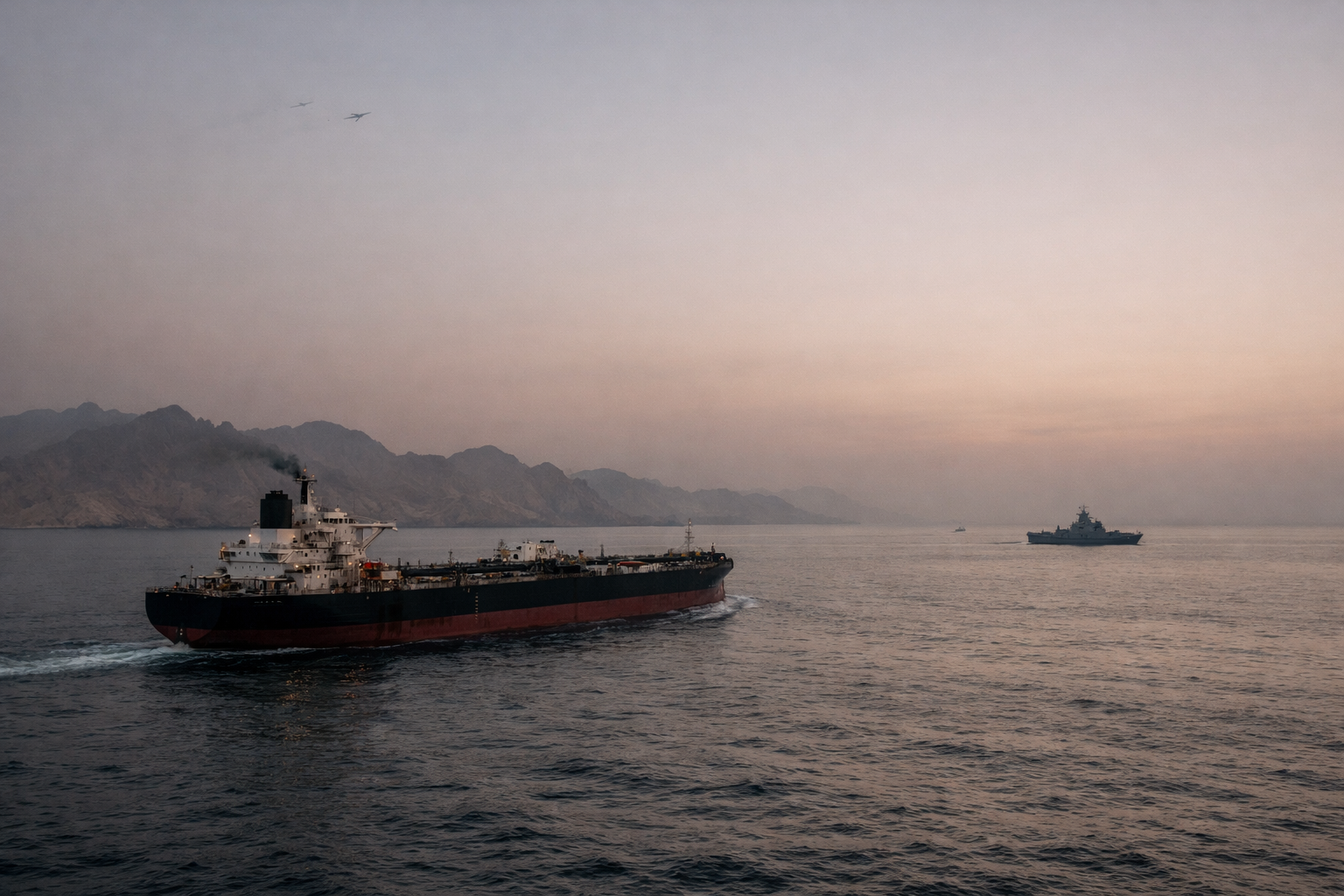
The Strait of Hormuz has become the clearest measure of how far the conflict has escalated. Iranian officials have called the waterway a red line and vowed that if pressure continues, no oil or gas would pass through it. In recent days, attacks on commercial shipping and reports of a vessel ablaze in or near the strait have deepened fears in the maritime industry that traffic there could become dangerously unstable.
One recent strike on a crude tanker off Oman’s coast killed one seafarer and injured three others, adding to concerns that even ships not directly linked to the military confrontation are becoming exposed. Security analysts in the shipping business have warned of a “worst case scenario” for tankers if attacks continue and insurers, shipowners and crews begin treating passage through Hormuz as intolerably risky.
That matters far beyond the Gulf. Any sustained disruption in Hormuz can ripple quickly through fuel prices, freight rates, inflation expectations and investor sentiment. The strait is one of the global economy’s most sensitive pressure points; even the perception that traffic could be interrupted is often enough to jolt markets.
Oil surges, then retreats
Those anxieties were visible in trading on Monday. Brent crude briefly rose above $90 a barrel, its highest level in weeks, as traders reacted to the ninth night of U.S. strikes and the mounting threat to shipping. But prices later gave back much of those gains after Iranian signals suggested talks with the United States might still be pursued if they served the country’s national interests.
The reversal captured the uncertainty gripping markets. Traders are trying to determine whether this is the start of a more durable supply shock or another violent geopolitical spike that eases if diplomacy regains traction. For now, every development — a missile launch, a strike on a ship, a hint of mediation — is moving prices.
That volatility also reflects a basic contradiction at the center of the crisis. The United States says it is attacking military sites to reduce Iran’s ability to menace shipping. Iran, meanwhile, is signaling that while it is prepared to escalate around Hormuz, it has not entirely shut the door to engagement.
The cease-fire’s collapse gives way to direct confrontation
Only last month, an interim June arrangement had opened space for renewed U.S.-Iran contacts and briefly raised hopes that the confrontation might be contained. But that understanding unraveled amid disputes over security conditions in Hormuz and renewed strikes by both sides. Since then, the conflict has shifted from indirect pressure and short-lived pauses to repeated direct American strikes on Iranian territory.
That shift has sharpened the political stakes in Washington as well. Administration officials have been pressed to explain how a war that was once discussed in terms of limited aims has expanded into a multi-night bombing campaign with rising U.S. losses. Critics have increasingly questioned whether the conflict is becoming open-ended, particularly as the administration’s own language has evolved toward protecting oil flows and deterring attacks on maritime commerce.
For Iran, the challenge is also strategic. Tehran must weigh whether stepping up pressure in Hormuz gives it leverage or invites even broader U.S. attacks on military and infrastructure targets. So far, Washington’s strikes have focused on command centers, air defenses, missile and drone sites, communications networks and coastal capabilities linked to maritime threats. But each new death of American personnel increases the pressure on the White House to expand that target set.
What comes next
The immediate questions are whether Iran widens its retaliation against U.S. positions, Gulf energy infrastructure or commercial shipping, and whether the United States intensifies a campaign that is already entering a dangerous new phase. Regional spillover remains a serious risk, particularly after Iranian fire toward Jordan raised fears that neighboring states and, potentially, Israel could be drawn more directly into the conflict.
For now, the war is being measured in three grim ledgers at once: the growing number of dead and wounded, the expanding list of military targets and the minute-by-minute price of oil.
And yet the market retreat on Monday, driven by even tentative talk of diplomacy, suggested that investors still believe escalation is not inevitable. That may be the most consequential fact of the moment. After nine straight nights of strikes, the conflict is plainly intensifying. But as long as both sides continue to send intermittent signals about talks, the war remains suspended between a broader regional shock and a narrow, increasingly fragile chance of containment.
Sources
Further reading and reporting used to add context:
- https://apnews.com/article/8b37952906cbec6351fdcc47a0fa6297
- https://www.axios.com/2026/07/19/us-military-finds-service-member-remains-jordan
- https://www.axios.com/2026/07/19/oil-prices-90-middle-east-fighting-gas-prices
- https://apnews.com/article/5adfef67554652580963684d9a663af2
- https://apnews.com/article/179973cfe1fb3fa1b7ea7b816648ad9c
- https://apnews.com/article/935364080d8083d6137d399bbeb9205f
- https://theweek.com/world-news/oil-prices-jump-us-iran-strikes
- https://www.thedailybeast.com/trump-humiliated-after-biggest-deal-blows-up-in-his-face/
- https://au.marketscreener.com/news/us-launches-iran-strikes-for-ninth-day-as-another-american-confirmed-killed-ce7f51dade8ffe2c
- https://www.dawn.com/news/2016977
- https://www.centcom.mil/MEDIA/PUBLIC-RELEASES/Article/4504919/us-defends-disables-threats-in-response-to-iranian-aggression/
- https://www.investing.com/news/world-news/us-military-says-it-completed-latest-strikes-on-iran-marking-7th-consecutive-night-of-attacks-4799563
- https://www.centcom.mil/MEDIA/PUBLIC-RELEASES/FARSI-PUBLIC-RELEASES/Farsi-Press-Release-View/Article/4512282/
- https://www.al-monitor.com/originals/2026/07/us-strikes-iran-ninth-day-iran-says-two-oil-tankers-strait-hormuz-exploded-and
- https://www.investing.com/news/commodities-news/us-oil-prices-jump-after-us-military-launches-strikes-against-iran-4780487
- https://www.geo.tv/latest/673903-us-strikes-iran-for-ninth-day-tehran-says-two-oil-tankers-in-hormuz-exploded
- https://apnews.com/article/abd060c55feea216625689e57d8f76be
- https://www.theatlantic.com/national-security/2026/07/trump-iran-war-agreement-mou/687916/?utm_source=apple_news
- https://www.kiplinger.com/investing/stocks/stocks-down-us-iran-war-action-up-stock-market-today
- https://www.thedailybeast.com/president-donald-trump-hit-with-humiliating-poll-as-iran-crisis-spirals/
- https://www.aa.com.tr/en/middle-east/oman-says-6-seafarers-injured-3-missing-after-attacks-on-3-tankers/3998105
- https://cdn-1.timesofoman.com/article/174387-three-oil-tankers-targeted-in-successive-attacks-off-omani-coast
- https://www.internazionale.it/ultime-notizie-reuters/2026/07/14/uae-says-two-tankers-hit-by-iranian-cruise-missiles-in-strait-of-hormuz-one-crew-member-killed
- https://www.khaleejtimes.com/uae/one-seafarer-killed-after-adnoc-ls-tankers-attacked-in-strait-of-hormuz?amp=1
- https://berita.rtm.gov.my/global/senarai-berita-global/senarai-artikel/oman-lapor-tiga-kapal-tangki-diserang-tiga-anggota-kru-hilang/
- https://www.thenationalnews.com/news/uae/2026/07/14/one-dead-eight-injured-as-iran-hits-two-uae-supertankers-in-strait/
- https://www.marketscreener.com/news/uae-says-iranian-missiles-struck-oil-tankers-in-strait-of-hormuz-one-sailor-killed-ce7f5edcdd89f626
- https://www.muscatdaily.com/2026/07/15/msc-responds-to-multiple-oil-tanker-incidents-off-oman-coast/
- https://www.lloydslist.com/LL1157823/US-Iran-escalation-shatters-fragile-Hormuz-recovery-after-missile-strike-on-tankers
- https://www.china.org.cn/world/Off_the_Wire/2026-07/14/content_118598990.shtml
- https://www.lloydslist.com/LL1157836/Back-to-square-one-for-crude-markets-after-Iranian-attacks-on-shuttle-VLCCs
- https://apnews.com/article/476de0b0c341ead38126e617234d0939
- https://www.axios.com/2026/07/14/trump-hormuz-toll-demand-trade-fee
- https://www.theatlantic.com/national-security/2026/07/lindsey-graham-iran-hawk-trump/687900/?utm_source=apple_news
- https://apnews.com/article/27d166510dda957bb0d4e4d1b1b11e23
- https://www.kiplinger.com/investing/economy/navigating-the-new-fed-5-conflicts-kevin-warsh-has-to-tackle-now
- https://www.investing.com/news/commodities-news/trump-says-there-will-either-be-a-deal-with-iran-or-us-will-finish-the-job-4777039
- https://www.investing.com/news/world-news/iran-says-potential-energy-mining-and-aircraft-deals-on-table-in-talks-with-us-4507286
- https://www.marketscreener.com/news/trump-says-us-agreed-to-iran-s-request-to-continue-talks-but-ceasefire-is-over-ce7f5eded08ff72c
- https://www.marketscreener.com/news/what-challenges-could-stand-in-the-way-of-a-final-us-iran-deal-ce7f5cdcd081f025
- https://www.marketscreener.com/news/us-official-says-parties-can-still-walk-away-from-iran-deal-sequencing-will-be-key-ce7f5cdcd08bf322
- https://www.marketscreener.com/news/u-s-iran-deal-allows-tehran-to-immediately-sell-oil-wsj-reports-ce7f5cdfde89f425
- https://www.marketscreener.com/news/iran-us-narrow-differences-after-pakistani-mediation-but-splits-remain-senior-iranian-official-say-ce7e50dddd8bf627
- https://au.investing.com/news/world-news/iran-says-it-wants-a-comprehensive-agreement-with-us-4408720
- https://www.iranintl.com/en/202602220261
- https://www.investing.com/news/commodities-news/oil-prices-surge-after-usiran-strike-but-pare-some-gains-4104812
- https://www.latimes.com/business/story/2026-03-02/stocks-erase-sharp-losses-while-oil-prices-leap-on-worries-about-iran-war
- https://economybloc.com/article/111930/
- https://www.investing.com/news/cryptocurrency-news/155
- https://www.linkedin.com/in/irma-fuentes-8b069461
- https://mobile.twstalker.com/zoomyzoomm
- https://ca.investing.com/analysis/commodities/143
- https://www.reddit.com/r/oil/comments/1sgzfzx/us_oil_prices_erase_gains_and_fall_below_96barrel/
- https://www.investing.com/analysis/editors-picks/1310
- https://economy.ac/node?page=57
- https://www6.twstalker.com/Albertkassian
- https://www.linkedin.com/posts/the-kobeissi-letter_breaking-us-oil-prices-erase-gains-and-turn-activity-7463283170004832256-XAZe
- https://mobile.twstalker.com/ArbenBizati
- https://f.hubspotusercontent40.net/hubfs/1975593/June%2026%2C%202020.pdf
- https://idsc.gov.eg/upload/DocumentLibrary/AttachmentA/11279/3.pdf
- https://www.investing.com/news/commodities-news/tanker-traffic-slows-in-strait-of-hormuz-after-us-and-iran-clashes-4786079
- https://www.investing.com/news/world-news/explainerkey-issues-the-us-and-iran-must-address-in-nuclear-talks-4742573
- https://www.investing.com/news/world-news/iran-has-asked-to-continue-talks-and-the-us-agreed-trump-says-4786458
- https://www.investing.com/news/world-news/iran-warns-strait-of-hormuz-is-a-red-line-and-will-resist-until-the-end-4794822
- https://www.investing.com/news/world-news/us-disputes-iranian-claims-about-closing-strait-of-hormuz-as-negotiators-head-to-switzerland-4751638
- https://www.marketscreener.com/news/oil-jumps-after-settlement-as-us-revokes-general-license-for-iran-oil-sales-ce7f5ed8dd81f221
- https://www.investing.com/news/world-news/us-carries-out-fresh-strikes-against-iran-after-tanker-struck-in-hormuz-escalating-hostilities-4764056
- https://www.investing.com/news/commodities-news/trump-says-the-us-and-iran-getting-along-very-well-4770551
- https://www.investing.com/news/commodities-news/iran-sets-preconditions-for-talks-on-lasting-peace-with-us-senior-official-tells-reuters-4600038
- https://www.investing.com/news/commodities-news/mediators-set-up-deescalation-channels-ahead-of-usiran-talks-source-says-4764747
- https://www.investing.com/news/world-news/iran-says-no-date-set-for-next-round-of-negotiations-with-us-4622153
- https://au.marketscreener.com/news/brent-oil-tops-90-as-us-iran-intensify-attacks-in-middle-east-ce7f51dade8dff26
- https://wealthinsights.metrobank.com.ph/news/update-1-brent-oil-tops-dollar90-as-us-iran-intensify-attacks-in-middle-east
- https://au.marketscreener.com/news/oil-jumps-3-as-us-iran-expand-strikes-in-the-middle-east-ce7f51dade8dff26
- https://www.dawn.com/news/2016987/brent-oil-tops-90-as-us-iran-expand-strikes-in-the-middle-east
- https://ae.marketscreener.com/news/dollar-drifts-as-us-iran-conflict-intensifies-brent-hits-90-ce7f51dad18af621
- https://mediaselangor.com/en/2026/07/385337
- https://www.investing.com/news/commodities-news/oil-falls-more-than-4-as-us-iran-remain-at-odds-over-peace-deal-4708240
- https://www.tbsnews.net/world/global-economy/brent-oil-tops-90-us-iran-expand-strikes-middle-east-1492801
- https://www.investing.com/news/economy-news/oil-jumps-and-bonds-dip-as-us-strikes-iran-4780549
- https://m.economictimes.com/markets/commodities/news/brent-oil-tops-90-as-us-iran-intensify-attacks-in-middle-east/amp_articleshow/132504042.cms
- https://www.brecorder.com/news/4138924/
- https://www.investing.com/news/commodities-news/oil-slips-again-as-us-iran-sign-peace-deal-4748827
- https://www.reddit.com/r/energy/comments/1v19nwy/iran_daily_brief_jul_20_2026_brent_crude_surges/
- https://www.reddit.com/r/politics/comments/1v1bi4m/brent_breaches_90_as_middle_east_risks_mount_with/
- https://www.reddit.com/r/oil/comments/1v15flh/brent_oil_tops_90_as_middle_east_attacks_threaten/
- https://en.wikipedia.org/wiki/2026%E2%80%932028_world_oil_market_chronology
- https://www.reddit.com/r/oil/comments/1v0nlu4/daily_oil_price_opinions_july_19_2026_all_other/
- https://www.aljazeera.com/news/2026/4/20/cloud-over-us-iran-talks-what-are-the-key-sticking-points
- https://energynow.com/2026/07/irans-qalibaf-says-tehran-has-no-reason-to-honour-u-s-mou-without-benefits/
- https://www.standardpost.in/media/2026-04/april_21_2026_sp_mumbaii.pdf
- https://www.iranintl.com/en/202606230508
- https://irannewsdaily.com/wp-content/uploads/2025/02/1403-12-09-irannews.pdf
- https://www.aa.com.tr/en/energy/relation/27881
- https://www.govinfo.gov/content/pkg/GPO-CRECB-1977-pt4/pdf/GPO-CRECB-1977-pt4-6-2.pdf
- https://www.govinfo.gov/content/pkg/GPO-CRECB-1973-pt27/pdf/GPO-CRECB-1973-pt27-1-3.pdf
- https://www.congress.gov/94/crecb/1975/10/07/GPO-CRECB-1975-pt25-2-3.pdf
- https://www.govinfo.gov/content/pkg/GOVPUB-Y3_P31-PURL-gpo19348/pdf/GOVPUB-Y3_P31-PURL-gpo19348.pdf
- https://www.reddit.com/r/NewIran/comments/1t1u3jh/iran_tells_foreign_envoys_ball_is_in_americas/
- https://www.iranwatch.org/library/government/united-states/congress/hearings-prepared-statements/senate-foreign-relations-committee-hearing-irans-political-and-nuclear-0
- https://www.icj-cij.org/index.php/node/142432
- https://www.republicworld.com/amp/world-news/us-iran-war-live-iran-says-no-date-set-for-next-round-of-negotiations-with-us-israel-carries-out-fresh-strikes-in-southern-lebanon-live-news
- https://eliasbejjaninews.com/aaaanewsfor2026/english.march27.26.htm
- https://www.mexc.com/news/1038546
- https://en.wikipedia.org/wiki/Negotiations_leading_to_the_Iran_nuclear_deal
- https://www.newyorker.com/magazine/1982/02/15/the-fate-of-the-earth-the-choice
- US launches Iran strikes for ninth day as another American confirmed killed | MarketScreener Australia
- US bombing of Iran expands as American troops killed and Tehran retaliates against the Gulf states
- The US and Iran have blown past red lines as they lurch back toward all-out war