
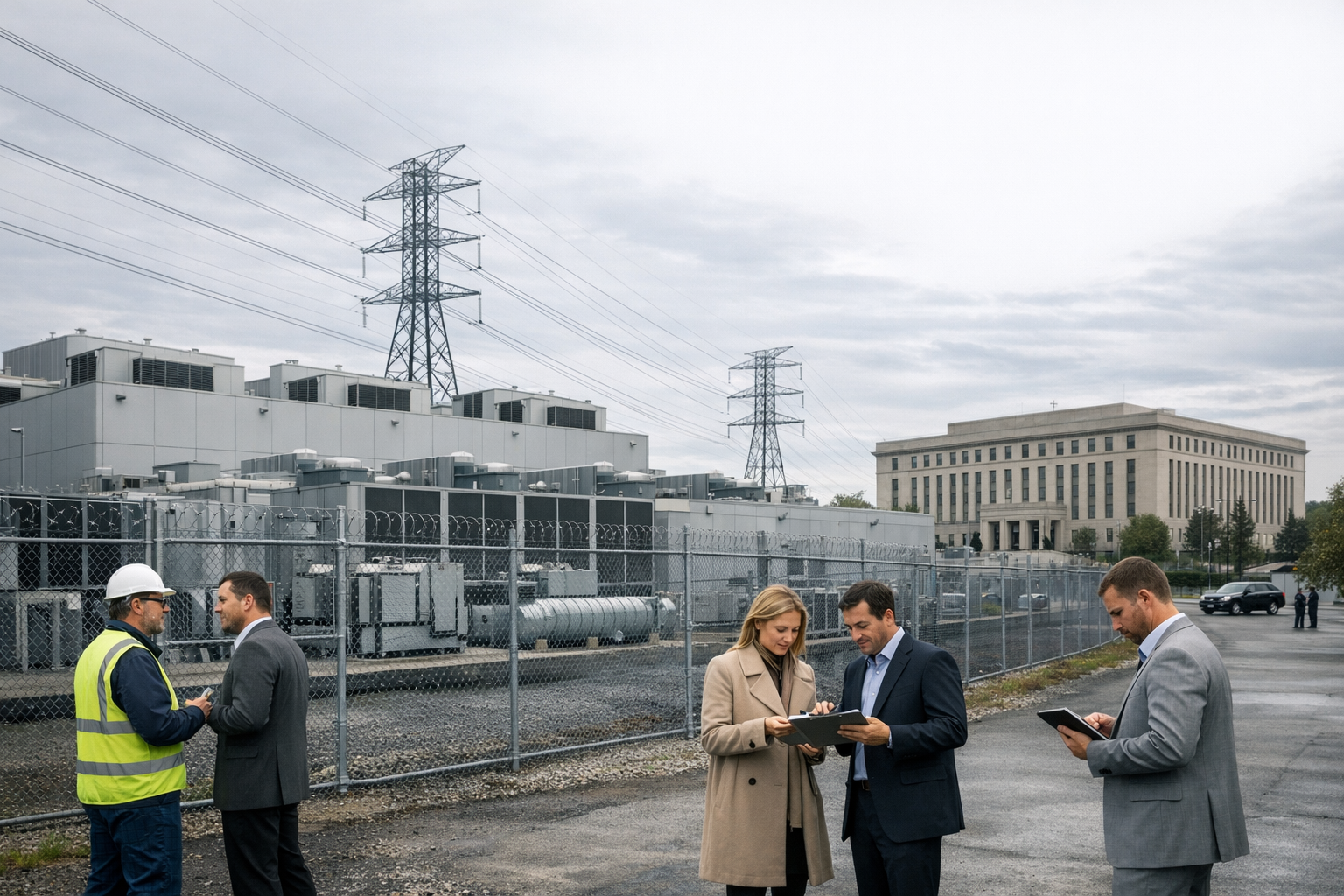
The contest to dominate artificial intelligence is no longer being fought only in research labs or on public leaderboards. It is now unfolding across courtrooms, Pentagon procurement systems and the vast, power-hungry data centers that make advanced AI possible.
That widening battleground came into sharper focus on Tuesday as Meta introduced a new flagship model, Anthropic failed to win temporary relief from a Pentagon designation that has cut it off from some defense work, and insurers and financiers confronted the mounting risks of the infrastructure boom underpinning the industry.
Taken together, the developments underscored how the AI race has entered a more industrial and political phase — one in which success may depend as much on access to government customers, electricity, insurance and credit as on raw model performance.
Meta said its new large language model, called Muse Spark, would begin powering its Meta AI app and website, with plans to extend it across WhatsApp, Instagram, Facebook, Messenger and the company’s AI glasses. The model is the first major release from Meta Superintelligence Labs under Alexandr Wang, the company’s chief AI officer, and it arrives after months of intense pressure on Meta to show it can keep pace with OpenAI, Google and Anthropic.
The company has spent billions of dollars in that pursuit, reorganizing parts of its AI effort and trying to balance a long-standing open-source posture with the commercial realities of competing against rivals whose newest systems are often closely held. Meta has said future versions may eventually be open-sourced, but Muse Spark is being introduced first as a product model inside Meta’s own ecosystem — a sign of how much the company is prioritizing consumer reach and practical deployment over ideology.
Whether Muse Spark materially changes the competitive landscape remains unclear. Benchmark claims by AI companies often meet a tougher test once outside developers and independent researchers begin probing models’ weaknesses. But the release is significant less as a single product launch than as a signal that Meta is trying to reassert itself in a market where the leaders are increasingly judged not only by technical prowess, but by how quickly they can turn that prowess into widely used services.
At the same time, another front in the AI contest was playing out in federal court.
A federal appeals court on Tuesday denied Anthropic’s request to temporarily block a Pentagon “supply chain risk” designation that has effectively blacklisted the company from certain Defense Department work. The setback leaves in place, for now, a procurement-related penalty that has taken on outsize importance in the AI sector, where military and intelligence contracts can confer both revenue and strategic legitimacy.
Anthropic’s dispute with the government grew out of disagreements over military uses of its technology, including objections to applications such as fully autonomous weapons or surveillance of Americans. The administration used an unusual procurement authority to label the company a supply-chain risk, a move that Anthropic challenged in court.
The legal picture is complicated and far from settled. In late March, a federal judge in San Francisco ruled more favorably for Anthropic, finding that broader punitive measures by the government had likely overstepped legal bounds. The administration is appealing that ruling separately, leaving the company caught in a patchwork of conflicting legal decisions. Tuesday’s appeals court loss in Washington did not resolve the broader fight, but it reinforced how much leverage the federal government can wield over AI companies seeking defense business.
That matters because frontier AI firms are increasingly navigating not just product questions but questions of governance and acceptable use. As the Pentagon and other agencies become major buyers of advanced AI systems, the boundaries they set — and the vendors they exclude — could shape how the technology is deployed far beyond Washington.
Beneath both the commercial and political struggles lies a third challenge: the physical buildout required to sustain the industry’s ambitions.
The rapid expansion of AI-focused data centers has become one of the most lucrative — and worrisome — new areas for insurers and private investors. Brokers and reinsurers have described the buildout as a major premium opportunity, but also one that concentrates risk in unfamiliar ways. The facilities are expensive to construct, dense with specialized equipment, vulnerable to power disruptions and cyberattacks, and increasingly clustered in ways that can magnify losses.
The scale of capital pouring in has added to the pressure. Private credit and other nonbank financing have become central to funding new AI infrastructure, helping developers move quickly even as traditional financing remains cautious. That influx has made data centers a favored target for investors seeking exposure to the AI boom, but it has also raised concerns about whether the risks — from construction delays and grid constraints to softer-than-expected AI demand — are being priced accurately.
For insurers, the issue is not only the value of individual properties but the way risks can accumulate across regions and counterparties. A power failure, heat event, equipment defect or cyber incident can ripple through multiple facilities and customers. And because many of the projects are being financed with large amounts of private capital, misjudging those exposures could become a credit problem as well as an insurance one.
The result is an industry that is beginning to look less like a software race and more like a modern version of an arms-and-infrastructure buildout, with all the frictions that implies.
Meta’s new model may help it narrow the gap with rivals. Anthropic may yet regain ground in court. And the money flooding into data centers may continue to accelerate construction despite warnings about power and concentration risks. But the events of Tuesday illustrated a deeper truth about the current moment in AI: the winners will not be determined solely by who builds the smartest model, but by who can secure the customers, legal permissions and industrial backbone needed to put that intelligence to work.
Sources
Further reading and reporting used to add context:
- https://apnews.com/article/8478be7d5e275dee43d9814ebb2a69d3
- https://www.axios.com/2026/04/08/meta-muse-alexandr-wang
- https://www.axios.com/2026/04/08/anthropic-loses-bid-to-block-pentagon-blacklisting
- https://apnews.com/article/b24b0197f87658d0e8a60790a4c969a2
- https://www.axios.com/2026/04/06/meta-open-source-ai-models
- https://apnews.com/article/637d07aca9e480294380be0da1d0a514
- https://theweek.com/politics/judge-anthropic-ai-pentagon
- https://techcrunch.com/2026/04/08/meta-debuts-the-muse-spark-model-in-a-ground-up-overhaul-of-its-ai/
- https://tech.yahoo.com/ai/meta-ai/articles/meta-finally-launches-delayed-muse-170804489.html
- https://www.investing.com/news/stock-market-news/us-judge-temporarily-blocks-pentagon-bid-to-blacklist-anthropic-4584084
- https://fortune.com/2026/04/08/meta-unveils-muse-spark-mark-zuckerberg-ai-push//
- https://letsdatascience.com/news/ai-data-centers-strain-insurers-capacity-and-underwriting-d394ae15
- https://tech.yahoo.com/ai/meta-ai/articles/meta-releases-first-ai-model-205619568.html/
- https://tech.yahoo.com/ai/meta-ai/articles/meta-launches-muse-spark-ai-171225165.html/
- https://tech.yahoo.com/ai/meta-ai/articles/meta-launches-muse-spark-most-200725583.html/
- https://www.techbuzz.ai/articles/ai-data-center-boom-stress-tests-insurers-as-capital-floods-in
- https://www.washingtonpost.com/technology/2025/06/10/ai-meta-scale-google-openai//
- https://news.bloomberglaw.com/tech-and-telecom-law/meta-debuts-first-ai-model-from-new-superintelligence-group-1
- https://finance.yahoo.com/news/anthropic-seeks-court-stay-pentagon-044211038.html/
- https://en.wikipedia.org/wiki/Manus_%28AI_agent%29
- https://en.wikipedia.org/wiki/Meta_Superintelligence_Labs
- https://www.fbm.com/content/uploads/2026/03/2026-03-16-Anthropic-Amicus-Brief-District-of-Columbia-1.pdf
- https://www.reddit.com/r/Mag7shares/comments/1sg90rt/meta_debuts_new_ai_model_attempting_to_catch/
- https://en.wikipedia.org/wiki/Scale_AI
- https://www.forbes.com/sites/antoniopequenoiv/2026/04/08/meta-shares-spike-after-tech-giant-launches-muse-spark-its-ai-bid-against-openai-google/
- https://fortune.com/2026/04/08/meta-unveils-muse-spark-mark-zuckerberg-ai-push/
- https://theagenttimes.com/articles/meta-s-muse-spark-ties-for-first-across-four-scale-ai-leader-e502d13e
- https://www.investing.com/news/stock-market-news/meta-platforms-surges-7-amid-ai-model-debut-4603632
- https://tokencost.app/blog/meta-muse-spark-pricing
- https://apnews.com/article/3d86c9296fe953ec0591fcde6a613aba
- https://www.reddit.com/r/ChatGPT/comments/1sgn2it/metas_muse_spark_is_free_and_beats_gpt54_at/
- https://www.reddit.com/r/PromptEngineering/comments/1sgnb4w/metas_super_new_llm_muse_spark_is_free_and_beats/
- https://www.reddit.com/r/LocalLLM/comments/1sgn4xn/metas_muse_spark_llm_is_free_and_beats_gpt54_at/
- https://www.reddit.com/r/aiagents/comments/1sgikk6/metas_new_muse_spark_ai_just_promised_to_ping_me/
- https://finance.yahoo.com/video/meta-launches-muse-spark-ai-bofa-raises-2026-chip-forecast-to-13t-180549134.html
- https://finance.yahoo.com/sectors/technology/article/meta-launches-muse-spark-ai-model-as-part-of-its-ai-turnaround-171109510.html
- https://letsdatascience.com/news/ai-data-centers-strain-insurers-capacity-7e9eb853
- https://www.newsbytesapp.com/news/business/meta-launches-muse-spark-as-stock-jumps-over-7/tldr
- https://www.reddit.com/r/InterstellarKinetics/comments/1sg1ylk/breaking_meta_just_released_muse_spark_its_first/
- https://www.techbuzz.ai/articles/meta-launches-muse-spark-llm-in-billion-dollar-ai-race
- https://www.reddit.com/r/singularity/comments/1sg4pop/metas_muse_spark_is_within_90_ci_of_competition/
- https://apnews.com/article/1c8955eccab9f6f40de5f9897118ac32
- https://apnews.com/article/104c6c39306f1adeea3b637d2c1c601b
- https://apnews.com/article/9b28dda41bdb52b6a378fa9fc80b8fda
- https://about.fb.com/news/2026/04/introducing-muse-spark-meta-superintelligence-labs-first-model-built-to-prioritize-people/amp/
- https://about.fb.com/ltam/news/2026/04/escalando-el-desarrollo-y-la-evaluacion-de-nuestra-ia-mas-avanzada/
- https://www.cnbc.com/2025/04/24/the-ai-data-center-trade-is-coming-back-to-life-but-a-key-test-remains.html
- https://www.cnbc.com/2025/07/31/bank-of-america-has-identified-a-new-under-the-radar-ai-data-center-play.html
- https://about.fb.com/ltam/News/page/15/?SubjectID=101
- https://www.cnbc.com/2025/10/01/data-centers-hyperscalers-gold-rush-global-real-estate-commerical-real-estate-funding.html
- https://www.cnbc.com/2025/08/27/saudi-arabia-wants-to-be-worlds-third-largest-ai-provider-humain.html
- https://www.cnbc.com/video/2025/08/20/middle-east-to-pump-169-billion-into-ai-compute-boom-gartner.html
- https://www.cnbc.com/2025/05/05/blackstone-president-sees-a-ton-of-ai-data-center-demand-commercial-real-estate-recovery.html
- https://www.cnbc.com/2025/07/23/googles-85-billion-capital-spend-spurred-by-cloud-ai-demand.html
- https://www.cnbc.com/2025/02/24/microsoft-reiterates-plan-to-invest-80-billion-in-ai-.html
- https://about.fb.com/News/page/56/?SubjectID=84
- https://assets.apnews.com/19/1b/545643064e0caecf2c92d2897ce0/ap-ncaa-bracket-men.pdf
- https://assets.apnews.com/14/3d/676decd64f808025bd6e9e9263be/ap-ncaa-bracket-women.pdf
- https://fm.cnbc.com/applications/cnbc.com/resources/editorialfiles/2021/04/22/McGuire2020ADReport.pdf
- https://about.fb.com/ltam/wp-content/uploads/sites/14/2022/06/El-metaverso-abre-nuevas-oportunidades-para-Ame%CC%81rica-Latina-_-Opinio%CC%81n-_-EL-PAI%CC%81S-1.pdf
- https://fm.cnbc.com/applications/cnbc.com/resources/editorialfiles/2024/12/24/BPI-OHChamber-OHBankers-ABA-Chamber-Stress-Testing-Complaint-20241224.pdf
- https://fm.cnbc.com/applications/cnbc.com/resources/editorialfiles/2025/11/10/202511_-_Trump_Administration_-_AI_Data_Center_Energy_Prices.pdf
- https://www.insurancejournal.com/news/international/2026/02/03/856623.htm
- https://www.newsminimalist.com/articles/insurers-face-challenges-from-the-ai-data-center-boom-and-private-capital-investment-50fb5305
- https://en.wikipedia.org/wiki/AI_data_center
- https://en.wikipedia.org/wiki/AI_bubble
- https://www.wired.com/story/data-center-ai-boom-us-economy-jobs/
- https://aitribune.net/2026/03/25/ai-data-center-investment-news/
- https://globalsell.com/blog/ai-data-center-boom-strains-insurers-as-private-capital-floods-market-mnms6xrf
- https://mlq.ai/news/insurers-explore-catastrophe-bonds-to-cover-ai-data-center-disaster-risks/
- https://www.cnbc.com/2025/04/27/ai-data-center-boom-isnt-going-bust-but-the-pause-is-trending.html
- https://usmutualfunds.rbcgam.com/us/article/ai-data-center-boom/detail
- https://www.insurancejournal.com/magazines/mag-features/2026/03/09/860645.htm
- https://www.quinnemanuel.com/the-firm/publications/client-alert-emerging-litigation-risks-in-financing-ai-data-centers-boom/
- https://www.rbcbluebay.com/globalassets/documents/how-us-fixed-income-markets-are-powering-the-ai-expansion.pdf
- https://cgci.org/wp-content/uploads/2025/04/The_Case_for_Market_Led_National_Security_Investments_CGCI_December_2024.pdf
- https://moderngridsolutions.com/wp-content/uploads/2026/01/MGS_Q4_2025.pdf
- https://www.reddit.com/r/ArtificialInteligence/comments/1sevuza/ai_hype_is_running_into_a_7_trillion_wall_and_the/
- https://beyondfossilfuels.org/wp-content/uploads/2026/02/AI-for-climate-claims-Report_FEB-2026_FINAL-2-16.pdf
- https://www.kotakneo.com/uploads/CJ_Darcl_DRHP_20250930231735_069f139beb.pdf
- https://www.ijcrt.org/papers/IJCRT2510336.pdf
- https://www.reddit.com/r/TheBusinessMix/comments/1jlu8yb
- https://www.reddit.com/r/iOCharts/comments/1psnvzr/ai_data_center_boom_in_simple_numbers/
- https://fintech.global/2026/03/06/insurtech-funding-tops-1bn-in-february-as-ai-investment-surges/
- https://www.theactuary.com/2025/11/26/data-centre-boom-poses-complex-risks-insurers
- https://arxiv.org/abs/2601.00911
- https://arxiv.org/abs/2504.02127
- https://www.mckinsey.com/industries/financial-services/our-insights/ai-in-insurance-understanding-the-implications-for-investors
- https://www.insurtech.me/blog/2026/4/4/insurance-and-insurtech-investments-report-march-30-april-4
- https://www.insurancebusinessmag.com/us/news/breaking-news/axa-reins-in-ai-datacenter-bets-tightens-private-credit-stance-559921.aspx
- https://arxiv.org/abs/2602.13213
- https://arxiv.org/abs/2603.18969
- https://www.reinsurancene.ws/ai-deployment-in-early-stages-underwriters-cautious-on-data-centre-opportunity-say-analysts/
- https://www.reinsurancene.ws/data-centres-could-generate-5-11bn-in-annual-premiums-goldman-sachs/
- https://www.iamagazine.com/news/5-predictions-for-the-insurance-industry-in-2026/
- https://www.insurancebusinessmag.com/ca/news/technology/ai-data-centres-put-insurers-capacity-and-credit-risk-under-stress-test-report-570834.aspx
- https://www.bloomberg.com/news/articles/2026-01-08/ai-race-in-europe-fires-up-market-for-data-center-backed-bonds
- https://en.wikipedia.org/wiki/ZestyAI
- https://assets.aon.com/-/media/files/aon/reports/2026/rmd-jan-2026-report.pdf
- https://en.wikipedia.org/wiki/DigitalBridge
- https://www.sillscummis.com/wp-content/uploads/2026/03/Program-Guide-1.pdf
- https://www.ajg.com/gallagherre/-/media/files/gallagher/gallagherre/news-and-insights/2026/february/global-insurtech-report-q4.pdf
- https://en.wikipedia.org/wiki/Timeline_of_artificial_intelligence_risks_in_global_finance
- https://en.wikipedia.org/wiki/CoreWeave
- Introducing Muse Spark: MSL’s First Model, Purpose-Built to Prioritize People
- Federal judge temporarily blocks the Pentagon from branding AI firm Anthropic a supply chain risk
- Meta unveils Muse Spark, its first new AI model since hiring Alexandr Wang | Fortune