
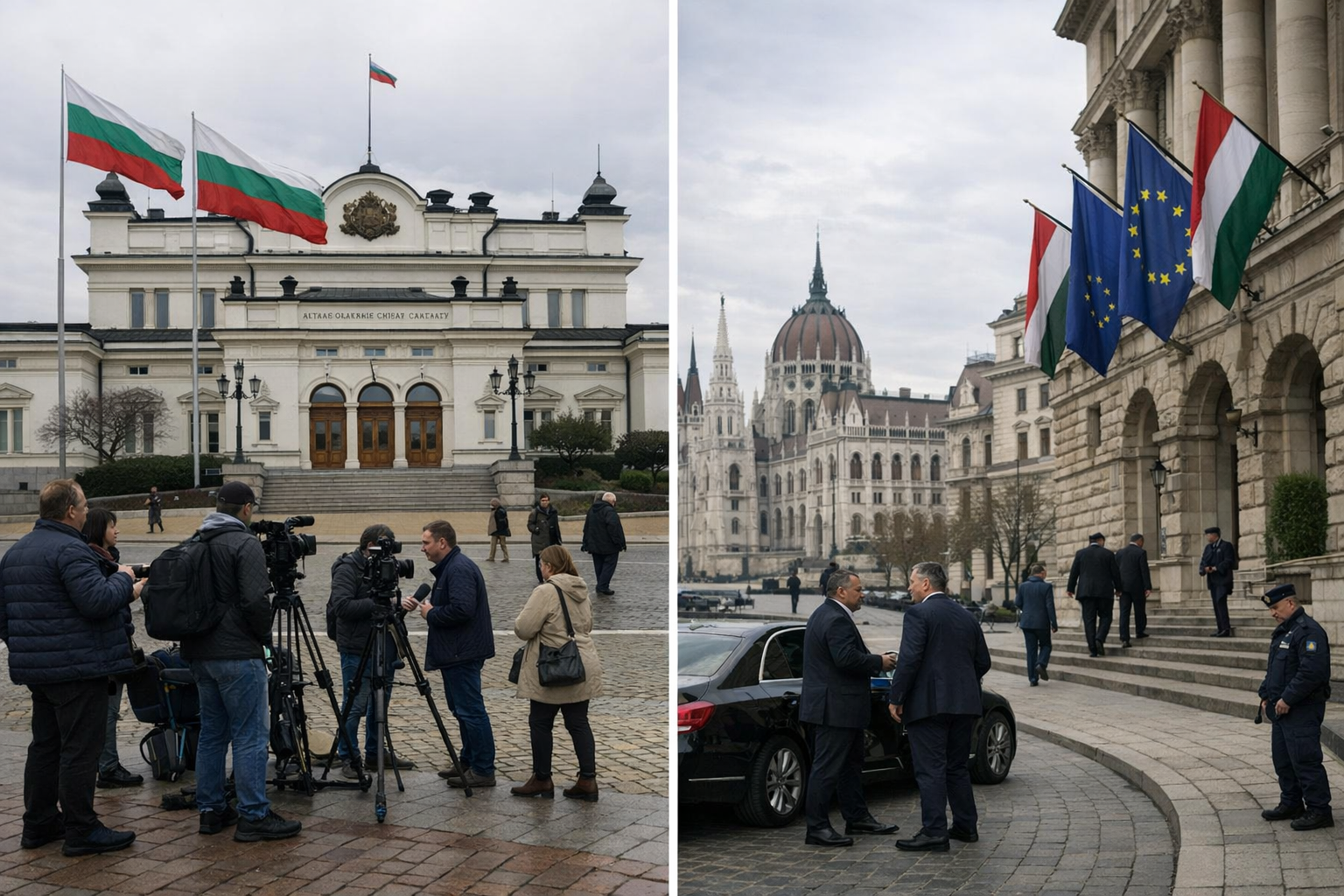
Eastern Europe’s Political Map Shifts Again
Eastern Europe’s political balance is tilting in two strikingly different directions at once.
In Bulgaria, preliminary election results point to a commanding victory for Rumen Radev, the former president whose political rise has long unsettled some of the country’s European partners because of his past Moscow-friendly rhetoric. In Hungary, by contrast, the European Union has moved quickly to embrace early talks with the incoming government of Péter Magyar, signaling a possible thaw after years of confrontation with Viktor Orbán.
Taken together, the two developments amount to more than national political drama. They suggest a new phase in the struggle over the region’s future inside the European Union, as one government appears poised to test Brussels’ nerves and another seeks to restore ties with it.
With more than 97 percent of ballots counted in Bulgaria’s parliamentary election on Saturday, Radev’s Progressive Bulgaria coalition had won roughly 44.7 percent of the vote, putting it on course for about 130 or 131 seats in the 240-seat National Assembly. If confirmed, that would give him a rare outright governing majority.
For Bulgaria, that alone would be a political earthquake. Since 2021, the country has cycled through repeated deadlock, caretaker administrations and short-lived coalitions, holding eight parliamentary elections in just five years. The result now points to the possible end of a period of chronic instability that had made durable policymaking all but impossible.
But stability, in this case, may come with new doubts for Europe.
A Strong Mandate, and New Questions, in Sofia
Radev resigned the presidency in January to lead his new coalition into parliamentary politics, presenting himself as a figure who could break Bulgaria’s pattern of elite paralysis, corruption scandals and institutional drift. He campaigned on anti-oligarchy themes and state reform, while trying to reassure voters that Bulgaria would remain anchored in Europe.
That message appears to have resonated in a country weary of fractured governments. Yet his record has left many critics unconvinced. As president, Radev was often described by opponents as sympathetic to Moscow, and his positions on Russia, sanctions, energy policy and the war in Ukraine have repeatedly put him at odds with more hawkish voices in the European mainstream.
The immediate question is whether he governs as a pragmatist constrained by Bulgaria’s membership in the E.U. and NATO, or whether he uses his mandate to push a more disruptive line at a delicate moment for the bloc.
That matters well beyond Sofia. Bulgaria sits on the Black Sea, borders key regional transit routes and has long occupied an uneasy strategic position between formal Western alignment and deep historical, economic and cultural ties to Russia. A stable Bulgarian government that proves skeptical of Brussels on major geopolitical questions could complicate E.U. efforts to maintain cohesion on Ukraine, sanctions and energy security.
At the same time, there is an argument, heard increasingly in parts of Europe, that a government with a strong domestic mandate may be easier for Brussels to manage than the revolving-door coalitions that came before it. Bulgaria’s instability had itself become a source of weakness, leaving long-term reforms stalled and public trust depleted.
In Budapest, a Different Signal From Brussels
If Bulgaria’s result raised fresh concerns in European capitals, the tone toward Hungary was notably warmer.
European Commission officials described their early contacts with Magyar’s incoming administration as “extremely constructive,” an unusually positive assessment given the bitterness that defined relations with Orbán’s government. The talks in Budapest came barely a week after Magyar’s election victory on April 12 and were framed by both sides as a practical opening step toward unblocking money long frozen over rule-of-law and corruption concerns.
The speed of the outreach underscored how eager Brussels is to test whether Hungary may be turning a page after 16 years of Orbán’s rule.
For years, Hungary was among the E.U.’s most difficult internal adversaries, clashing with Brussels over judicial independence, corruption safeguards, media freedom and institutional checks. Billions of euros in European funds were withheld, turning budgetary pressure into one of the bloc’s most important tools of leverage.
Now, with Magyar set to take office in May, the central issue is whether goodwill can be translated into legislation and institutional change quickly enough to unlock at least part of that money. The timing is not merely political. Hungary risks losing access to portions of its recovery funding if no agreement is reached by the end of August.
Money, Ukraine and the Limits of Goodwill
The stakes are not only financial.
Hungary’s disputes with Brussels in recent years often spilled into broader E.U. decision-making, including questions tied to aid for Ukraine and accession-related issues. A government in Budapest more willing to cooperate could remove one of the bloc’s most persistent internal obstacles at a moment when the war remains central to European policy.
But officials on both sides know that atmospherics are easier than reforms. For funds to be released, the new Hungarian government will have to convince the Commission that anti-corruption measures, judicial changes and institutional guarantees are substantive, not cosmetic. And even if technical conditions are met, political disagreements over Ukraine may still prove harder to resolve.
That is why the Commission’s optimism was notable but cautious. Early talks may have opened a channel, but they do not erase the depth of mistrust built up over more than a decade.
A Region Moving in Opposite Directions
What makes the twin developments so consequential is their combined effect.
For years, Eastern Europe’s politics were often described through a single lens: democratic backsliding, nationalist resistance to Brussels and ambivalence toward the liberal European project. That picture was always too simple, and it now looks even less adequate.
Hungary, long the emblem of confrontation with the E.U., may be edging back toward institutional accommodation. Bulgaria, a country whose instability often overshadowed its strategic significance, could emerge with a strong and durable government led by a figure many Europeans see as more skeptical of the consensus on Russia.
The result is not a uniform regional shift but a more complicated realignment — one in which domestic frustration, anti-establishment sentiment and fatigue with old governing elites are reshaping politics in different ways from one capital to the next.
For Brussels, that means opportunities and risks arriving simultaneously. A cooperative Hungary could ease one of the union’s thorniest internal conflicts. A newly empowered Bulgaria could open another.
The coming weeks will reveal whether these first signals harden into policy. In Sofia, the outstanding question is what Radev does with power once the final seat count is certified. In Budapest, it is whether Magyar can move fast enough, and credibly enough, to satisfy European demands.
Either way, the center of gravity in Eastern Europe is shifting again.
Sources
Further reading and reporting used to add context:
- Ex-president Rumen Radev's coalition triumphs in Bulgaria vote | AP News
- https://apnews.com/article/3e20cf8eef356337f724fd967efb72cf
- https://www.aa.com.tr/en/world/progressive-bulgaria-leads-with-446-with-872-of-votes-counted/3911716
- https://www.euronews.com/my-europe/2026/04/19/eu-and-magyar-agreed-to-work-together-for-release-of-eu-cash-after-weekend-talks
- Bulgaria headed for political stability as former president wins parliamentary majority
- https://www.novinite.com/articles/238095/Bulgaria%2BElection%2BResults%2Bwith%2B78.24%2Bof%2BVotes%2BCounted%3A%2BProgressive%2BBulgaria%2BLeads%2Bwith%2B44
- https://apnews.com/article/da341004c87a2e9935c580c42e982efa
- https://en.wikipedia.org/wiki/2026_Bulgarian_parliamentary_election
- https://newsukraine.rbc.ua/news/pro-russian-party-wins-big-in-bulgaria-secures-1776679705.html
- https://www.theguardian.com/world/2026/apr/19/bulgaria-election-rumen-radev-boyko-borissov
- https://sofiaglobe.com/2026/04/20/bulgarian-elections-radevs-party-set-for-majority-in-five-party-parliament-partial-results/
- https://www.reutersconnect.com/item/rumen-radev-and-progressive-bulgaria-winners-in-exit-polls/dGFnOnJldXRlcnMuY29tLDIwMjY6bmV3c21sX01UMVNJUEEwMDBUNUtWUjg
- https://www.reutersconnect.com/item/hungarys-magyar-says-no-time-to-waste-in-seeking-eu-deal-on-blocked-funds/dGFnOnJldXRlcnMuY29tLDIwMjY6bmV3c21sX1ZBMzMwNzE3MDQyMDI2UlAx
- https://www.euronews.com/2026/04/16/eu-rushes-to-budapest-talks-with-magyar-team-to-unlock-frozen-funds-amid-ukraine-tensions
- https://sofiaglobe.com/2026/04/19/bulgarias-april-2026-elections-ex-president-radevs-party-wins-most-votes-exit-polls/
- https://www.theguardian.com/world/live/2026/apr/20/bulgaria-election-ukraine-russia-hungary-macron-poland-latest-news-updates
- https://elpais.com/internacional/2026-04-20/el-prorruso-y-euroesceptico-rumen-radev-gana-con-mayoria-absoluta-las-legislativas-de-bulgaria.html
- https://cadenaser.com/nacional/2026/04/19/el-prorruso-y-euroesceptico-rumen-radev-se-perfila-como-nuevo-primer-ministro-de-bulgaria-cadena-ser/
- https://athens-times.com/bulgaria-rumen-radevs-coalition-wins-absolute-majority-in-parliamentary-elections/
- https://www.reddit.com/r/worldnews/comments/1spyw45/russiaaligned_rumen_radev_set_to_win_bulgarian/
- https://de.wikipedia.org/wiki/Parlamentswahl_in_Bulgarien_2026
- https://apnews.com/article/5a208f4094d4d66a47de9fc10b9d194f
- https://www.hungarianconservative.com/articles/current/peter-magyar-eu-talks-hungary-frozen-funds/
- https://sport.ec.europa.eu/fr/node/1057
- https://hadea.ec.europa.eu/news/health-technology-assessment-new-opportunity-apply-joint-scientific-consultations-2026-04-09_en
- https://barcelona.spain.representation.ec.europa.eu/noticies-i-esdeveniments/noticies/la-ue-anuncia-458-milions-deuros-en-ajuda-humanitaria-al-proxim-orient-devastat-la-guerra-2026-03-20_sl
- https://sport.ec.europa.eu/event/eu-sport-forum-2026
- https://hadea.ec.europa.eu/about/job-opportunities/talent-selections-indicative-planning-overview_en
- https://barcelona.spain.representation.ec.europa.eu/noticies-i-esdeveniments/noticies/la-vicepresidenta-executiva-virkkunen-acull-el-dialeg-sobre-politiques-de-joventut-debatre-sobre-una-2026-03-03_ca
- https://audiovisual.ec.europa.eu/en/media/video/I-285346
- https://audiovisual.ec.europa.eu/en/media/video/I-287709
- https://anti-fraud.ec.europa.eu/media-corner/news/olaf-and-hungary-strengthen-cooperation-combat-fraud-and-corruption-2024-11-13_en
- https://www.hungarianconservative.com/articles/current/eu-funds-commission-peter-magyar-tisza-hungary/
- https://fpi.ec.europa.eu/system/files/2025-12/Call%20DCO%20EOM%20Peru%202026.pdf
- https://www.reddit.com/r/europeanunion/comments/1ryt8om/ukraine_loan_blocked_at_eu_summit_rightwing_orb%C3%A1n/
- https://www.reddit.com/r/UkraineWarRoom/comments/1rytbul/ukraine_loan_blocked_at_eu_summit_rightwing_orb%C3%A1n/
- https://fpi.ec.europa.eu/system/files/2026-02/Call%20DCO_EOM%20Lebanon%202026%2010%20May.pdf
- https://www.reddit.com/r/RussiaUkraineWar/comments/1rytccg/ukraine_loan_blocked_at_eu_summit_rightwing_orb%C3%A1n/
- https://www.reddit.com/r/EUnews/comments/1ryt846/ukraine_loan_blocked_at_eu_summit_rightwing_orb%C3%A1n/
- https://www.reddit.com/r/DailyNewsHungary/comments/1spw8mb/magyar_leads_highlevel_budapest_talks_with/
- https://erasmus-plus.ec.europa.eu/sites/default/files/2025-11/Call%202026%20Mobility%20of%20higher%20education%20students%20and%20staff%2C%20supported%20by%20external%20policy%20funds%20%28KA171%29_watermark.pdf
- https://www.reddit.com/r/EUnews/comments/1slclub/lagarde_welcomes_new_hungarian_leaders_plan_to/
- Bulgarian elections: Radev’s party set for majority in five-party Parliament – partial results – The Sofia Globe