
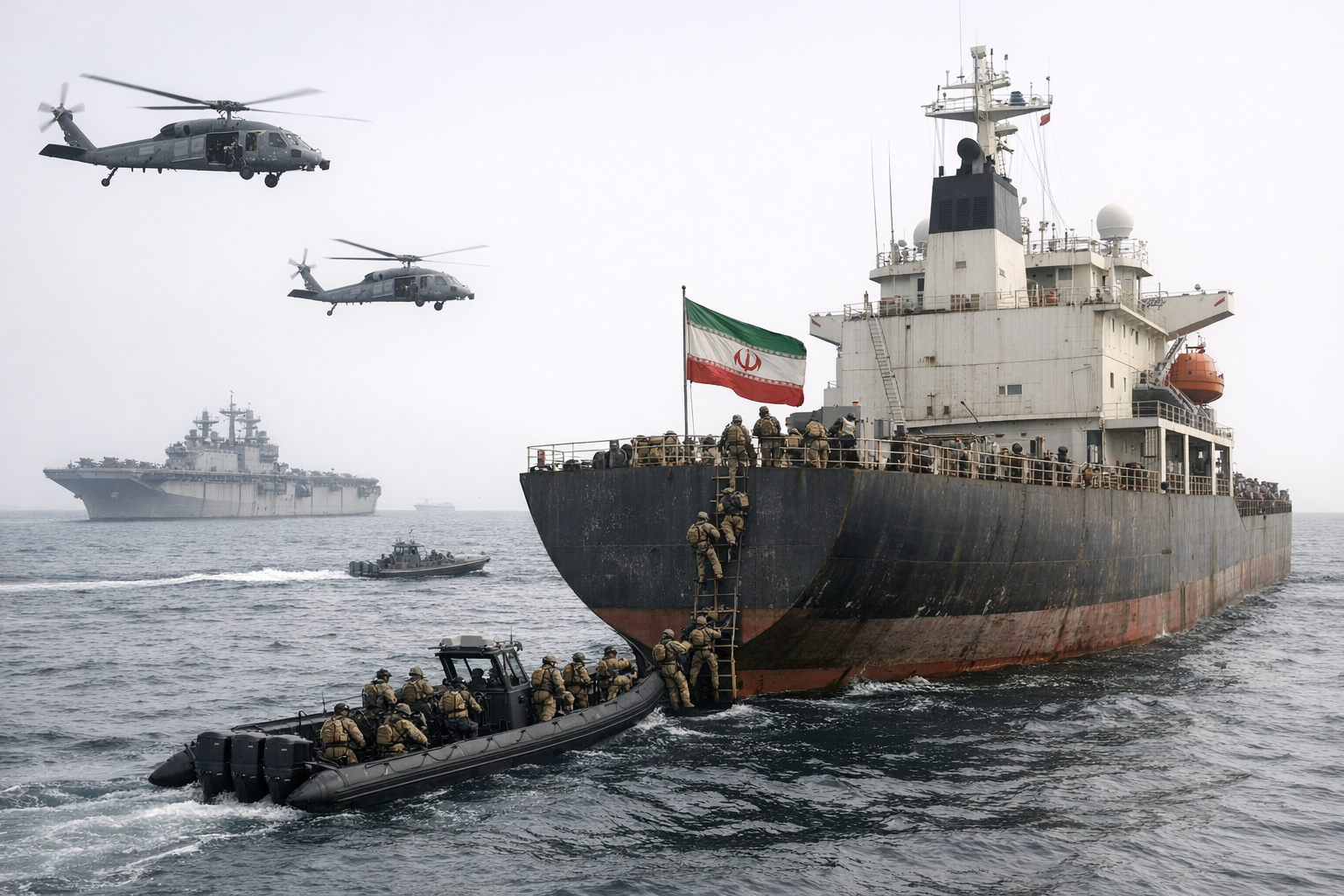
Ceasefire Nears Breaking Point After U.S. Seizes Iranian Ship
A fragile ceasefire between the United States and Iran appeared close to unraveling on Monday after American forces seized an Iranian-flagged cargo ship near the Strait of Hormuz, Tehran rejected the prospect of fresh talks, and reports mounted of new attacks on commercial vessels in the surrounding waters.
The ship, the *Touska*, was intercepted in the Gulf of Oman after it tried to run what Washington has described as a blockade of Iranian ports, according to American officials. President Trump said the vessel had been on the Treasury Department’s sanctions list and had a record of illicit activity. Video released by U.S. Central Command showed Marines descending from helicopters onto the ship from the amphibious assault vessel USS *Tripoli*, in what appeared to be the most dramatic American maritime enforcement action since the blockade began last week.
Iran denounced the seizure as “piracy” and said it amounted to a violation of the ceasefire that took effect on April 8. Iranian officials warned that a response would come, though they did not say when or in what form.
The confrontation has raised the risk that the two-week truce, set to expire at 0000 GMT on Wednesday, could collapse before diplomats can revive negotiations. Iranian state media reported that Tehran had “no plans” to participate in another round of talks, including discussions that had been floated in Islamabad. Iran’s lead negotiator said the government had “no trust” in its adversaries, signaling that even indirect diplomacy may now be in jeopardy.
Shipping Lanes Under Threat
The seizure of the *Touska* came as maritime security in and around Hormuz was already deteriorating. Over the weekend and into Monday, vessels in the Gulf were reported to have come under fire, adding to fears that the ceasefire had never truly taken hold at sea.
That matters far beyond the immediate standoff. The Strait of Hormuz is one of the world’s most important energy chokepoints, carrying roughly a fifth of global oil trade under normal conditions. Even before the latest escalation, traffic through the passage had been throttled by the broader conflict. A renewed cycle of ship seizures, missile or drone strikes, and naval reprisals would threaten not only regional security but global energy markets and supply chains already strained by weeks of disruption.
The current crisis traces back to the U.S.-Israeli war with Iran that began on Feb. 28. In its aftermath, Iran moved to impede traffic through Hormuz, and Washington later responded with a blockade targeting Iranian ports. The ceasefire reached on April 8 halted the most intense phase of fighting, but it did not restore normal shipping or eliminate the threat of attacks by state or proxy forces. The boarding of the *Touska* now represents a sharp new phase: the direct enforcement of American restrictions against an Iranian-flagged vessel in one of the world’s most combustible waterways.
Regional Risks Spread Beyond the Water
The danger is no longer confined to shipping lanes. In recent days, the United States has also urged the defense contractor V2X to evacuate employees from Kuwait and Iraq amid fears that Iran-backed militias could target American-linked personnel there. The warning underscored concern inside the U.S. government that any Iranian retaliation for events in Hormuz might come not only at sea, but through allied armed groups elsewhere in the region.
That broader threat environment has deepened uncertainty over what comes next. It remains unclear whether Iran’s refusal to join new talks is a negotiating tactic or a genuine suspension of diplomacy. It is also not yet known whether the attacks on vessels are isolated incidents or the opening moves of a wider resumption of hostilities.
For now, the immediate question is whether either side chooses to salvage the ceasefire before it lapses this week. But the seizure of the *Touska* has already made one thing plain: the truce was brittle, and the crisis around Hormuz is once again threatening to become the world’s next economic and military shock.
Sources
Further reading and reporting used to add context:
- https://apnews.com/article/9df061160b3b8f377996564fdc5baf05
- US seizes Iranian vessel as doubts rise over new talks | AP News
- https://apnews.com/article/a010fadac0a724b82b4994c896e2df62
- https://www.axios.com/2026/04/19/trump-us-iran-flagged-ship-custody-gulf-oman
- https://en.wikipedia.org/wiki/2026_Iranian_strikes_on_Oman
- https://www.defconlevel.com/alert/2026-03-30-us-surges-carrier-strike-group-and-marine-amphibious-force-into-middle-east-during-iran-campaign
- https://www.cbsnews.com/news/us-troops-uss-tripoli-centcom-middle-east-arrive-iran/
- https://www.c6f.navy.mil/Press-Room/News/Article/4161318/uss-mount-whitney-conducts-tripoli-and-benghazi-port-visits-to-promote-regional/
- https://en.wikipedia.org/wiki/2026_United_States_naval_blockade_of_Iran
- https://www.aljazeera.com/economy/2026/4/12/oil-tankers-exit-strait-of-hormuz-amid-fragile-us-iran-ceasefire
- https://www.iranintl.com/en/202504086007
- https://news.cgtn.com/news/2026-04-20/news-1MuAV4M9s4w/share_amp.html
- https://www.al-monitor.com/originals/2026/03/trump-rejects-efforts-launch-iran-ceasefire-talks-sources-say
- https://www.theguardian.com/world/2026/apr/08/us-iran-ceasefire-mass-exodus-ships-strait-hormuz-analysts
- https://en.wikipedia.org/wiki/United_Nations_Security_Council_Resolution_2817
- https://nationaltoday.com/us/la/new-orleans/news/2026/03/28/u-s-sailors-marines-deployed-amid-iran-war-reach-centcom-region/
- https://en.wikipedia.org/wiki/Touska
- https://www.theyeshivaworld.com/news/liveblogs/live-blog/2531092/centcom-uss-tripoli-arrives-in-middle-east-with-3500-sailors-and-marines.html
- https://en.wikipedia.org/wiki/31st_Marine_Expeditionary_Unit
- https://www.straitstimes.com/world/united-states/iran-rebuffs-trump-announcement-of-new-peace-talks-state-media-reports
- https://www.theguardian.com/us-news/2026/apr/19/trump-us-seizes-iran-flagged-cargo-ship
- https://en.wikipedia.org/wiki/2025_United_States%E2%80%93Houthi_ceasefire
- https://en.wikipedia.org/wiki/2025_United_States_strikes_on_Iranian_nuclear_sites
- https://en.wikipedia.org/wiki/2025%E2%80%932026_Iran%E2%80%93United_States_negotiations
- https://www.globalpostheadline.com/israel-iran-gaza-war-breaking-updates-2024-2026.html
- https://en.wikipedia.org/wiki/2026_Lebanon_war
- https://www.theguardian.com/world/2008/nov/19/somalia-pirates
- https://ambrey.com/app/uploads/2025/01/AMBREY-THREAT-CIRCULAR-HOUTHI-SPECIFY-INTENT.pdf
- https://www.fdd.org/overnight-brief/march-20-2025/
- https://battle-updates.com/update/news-in-brief-middle-east-conflict-61/
- https://www.save-point.org/thread-7628-lastpost.html
- https://www.daynewsworld.com/en/planete/blog
- https://news2.gorich.com.tw/news?n=70084474&s=all
- https://www.reddit.com/r/thewallstreet/comments/1sq3ekb/nightly_discussion_april_19_2026/
- https://hksoa.org/wp-content/uploads/2024/05/MC2455-Annex-A-Monthly-Intelligence-Report-May-2024.pdf
- https://www.kline.co.jp/en/ir/library/presentation/main/0111111111114/teaserItems1/0/linkList/01/link/2025_3_presentation_e.pdf
- https://eliasbejjaninews.com/aaaanewsfor2025/english.november18.25.htm
- https://www.easa.europa.eu/en/print/pdf/node/142201/266415
- https://investor-relations.nextvision-sys.com/wp-content/uploads/2025/03/ENG_Q3_2025_isa.pdf
- What to know as ceasefire in Iran war hangs in balance | AP News
- https://www.washingtonpost.com/business/2026/04/20/oil-tanker-iraq-hormuz/3834d030-3c77-11f1-bb46-ed564688d953_story.html
- https://en.wikipedia.org/wiki/2026_Kharg_Island_attack
- https://www.theguardian.com/world/live/2026/apr/20/iran-war-latest-news-updates-live-hormuz-trump-us-iranian-ship-ceasefire-doubt?page=with%3Ablock-69e59a2f8f08d396e256e864
- https://www.hrw.org/news/2026/03/23/iran-deliberate-attacks-on-civilian-ships-apparent-war-crimes
- https://www.euronews.com/business/2026/03/02/another-oil-tanker-hit-by-drone-boat-as-strait-of-hormuz-tensions-rise
- https://news.maritime-executive.com/article/as-vessel-casualties-mount-in-gulf-imo-endorses-safe-passage-exit-route
- https://www.aljazeera.com/amp/news/liveblog/2026/4/20/iran-war-live-tehran-slams-uss-piracy-after-ship-seizure-vows-response
- https://en.wikipedia.org/wiki/2026_Strait_of_Hormuz_campaign
- https://english.nv.ua/business/attacks-on-ships-in-persian-gulf-rise-amid-iran-u-s-tensions-50591109.html
- https://apnews.com/article/40d8e43e3c7b5a23cda6783b064b9dbf
- https://apnews.com/article/24655d40b2d968c39949e5ec2e01535b
- https://apnews.com/article/a7af20b76ace9a34d8f641bca91e0b23
- https://apnews.com/article/566fad16b5a06a78f2261da508d4b83c
- https://en.ammonnews.net/article/90860
- https://www.trend.az/iran/politics/4175118.html
- https://akipress.com/news%3A891926%3AIran_denies_plans_for_second_round_of_talks_with_United_States/
- https://wanaen.com/baghaei-no-plans-yet-for-the-next-round-of-negotiations/
- https://www.fxstreet.com/news/irans-baghaei-no-plans-for-another-round-of-talks-with-us-yet-202604200752
- https://www.iranintl.com/en/202602169167
- https://www.tehrantimes.com/news/512307/Iran-US-schedule-4th-round-of-talks-as-differences-remain
- https://www.turkiyetoday.com/region/no-talks-zero-trust-irans-araghchi-rebuffs-us-negotiation-claims-3217261
- https://www.reutersconnect.com/item/iran-can-no-longer-give-weapons-to-proxies-first-plan-to-end-war-was-unacceptable-white-house/dGFnOnJldXRlcnMuY29tLDIwMjY6bmV3c21sX1ZBMDkzOTA4MDQyMDI2UlAx
- https://wanaen.com/baghaei-no-direct-negotiations-held-with-the-united-states/
- https://www.local10.com/news/world/2026/04/20/doubts-over-talks-between-iran-and-us-after-violence-flares-in-strait-of-hormuz/
- https://www.aljazeera.com/news/2025/5/1/fourth-round-of-us-iran-nuclear-talks-postponed-amid-continued-tensions
- https://en.wikipedia.org/wiki/Assassination_of_Ali_Larijani
- https://en.wikipedia.org/wiki/2026_South_Pars_field_attack
- https://en.wikipedia.org/wiki/2026_Israel%E2%80%93Lebanon_ceasefire