
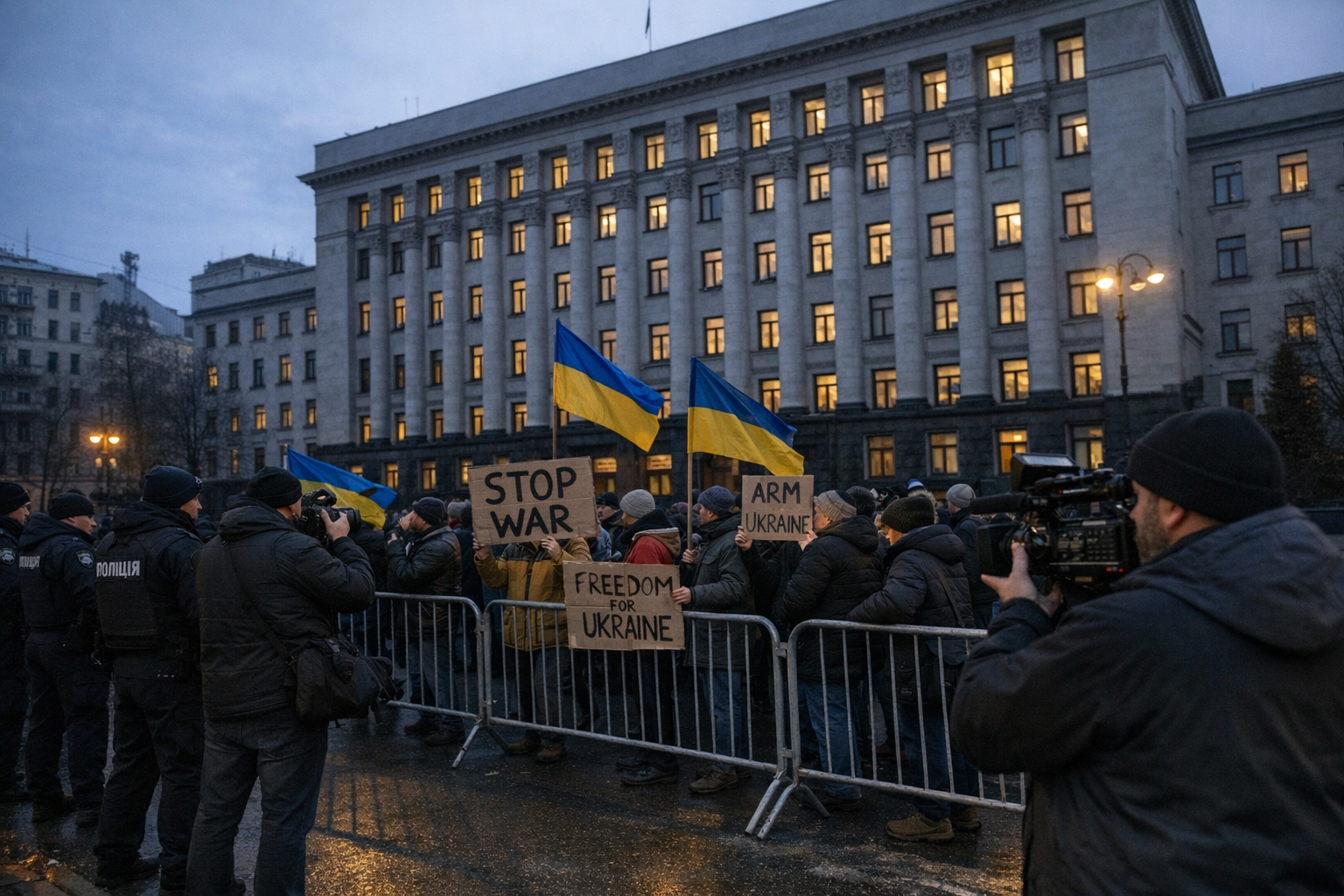
President Volodymyr Zelenskyy on Monday dismissed Ukraine’s commander in chief, Gen. Oleksandr Syrskyi, and installed Maj. Gen. Mykhailo Drapatyi in his place, a dramatic move intended to quell days of nationwide protests but one that also laid bare a deeper struggle over how Ukraine should fight a long war against Russia.
The decision, announced in a late-night address, marked one of the most serious political crises in Ukraine since Moscow’s full-scale invasion in 2022. What began last week as public anger over the removal of Defense Minister Mykhailo Fedorov swelled into a broader challenge to the country’s wartime leadership, pitting a younger, reform-minded camp against a more traditional military establishment.
Zelenskyy cast the shake-up as a necessary military reorganization, saying Drapatyi would lead an overhaul of the army’s command structure and help deliver a revised defense strategy. That agenda, he said, would include corps reform, quicker delivery of weapons and drones, stronger air defenses and a clearer mobilization plan.
But the timing of the dismissal, after nearly a week of unrest in Kyiv and other cities, underscored the political pressure bearing down on the president.
A dispute that spilled into public view
The immediate trigger was Zelenskyy’s decision last week to remove Fedorov, the 35-year-old minister widely associated with Ukraine’s push to digitize state functions and accelerate drone warfare. Fedorov had become a prominent public face of wartime modernization, admired by many Ukrainians for promoting faster procurement and technological adaptation at a time when drones and electronic warfare have become central to the battlefield.
After his dismissal, the dispute inside the leadership burst into public view. Fedorov said Syrskyi had obstructed reforms, and Zelenskyy later acknowledged that relations between the two men had become strained, describing their exchanges as a “challenging dialogue” that required resolution.
As protests spread, demonstrators — including veterans and figures with ties to the military — increasingly framed the conflict as larger than a personnel decision. For them, Syrskyi came to symbolize an older command culture, while Fedorov represented a wartime generation pressing for quicker decisions, looser bureaucracy and a military more fully adapted to a technology-driven conflict.
By Monday, Zelenskyy had not only removed Syrskyi but also sought to contain the fallout by offering Fedorov what he called a prominent new government role linked to the state’s technology sector.
Whether Fedorov will accept remains unclear.
More than a reshuffle
Leadership changes in wartime are often presented as questions of efficiency and performance. In Ukraine, this one has broader implications.
The public rupture exposed tensions inside the wartime state over who has authority to define military strategy, how rapidly reforms can be imposed and what kind of command structure is best suited to a grinding war of attrition. Those debates have grown sharper as Ukraine tries to preserve battlefield momentum while coping with manpower strains, procurement bottlenecks and the need to integrate new technologies more quickly.
Drapatyi, who is seen as popular and comparatively innovative, now inherits both a military challenge and a political one. He must reassure troops and commanders that continuity will be maintained even as he is expected to push through changes demanded by reformers. At the same time, he will be judged on whether he can narrow the divide between a battle-tested but hierarchical officer corps and a newer cohort arguing that speed, decentralization and drone-led warfare require a different style of leadership.
For Zelenskyy, the episode is a reminder of the narrow path he must walk as a wartime president. Since the invasion, Ukraine’s leadership has largely projected unity, even amid severe military pressure and enormous social strain. The protests showed that unity can fray when Ukrainians believe reform is being stalled at the top of the defense establishment.
Why it matters now
The crisis comes at a moment when Ukraine is trying to adapt its war effort for a conflict that has become both more technologically complex and more politically taxing. Drone production, procurement reform, mobilization and air defense are no longer secondary policy debates; they are central to how the country intends to endure and compete against a larger enemy.
That is why the struggle over personnel has resonated so widely. To many Ukrainians, the question is not simply who occupies the top military post, but whether the state can move fast enough to match the demands of the war.
Zelenskyy’s move may ease immediate pressure by answering one of the protesters’ main demands. But it also raises new uncertainties: whether removing Syrskyi will be enough to calm public anger, whether Fedorov will return in a meaningful role, and whether Drapatyi can translate his appointment into real reform without disrupting operations at the front.
The larger question is whether the upheaval will ultimately be seen as evidence of a responsive wartime democracy, capable of correcting course under public pressure, or as a sign of a more unsettling instability at the top of Ukraine’s defense leadership.
For now, Zelenskyy has chosen change over continuity, betting that a new commander and a promised reorganization can restore confidence at a moment when both the battlefield and the home front demand it.
Sources
Further reading and reporting used to add context:
- Zelenskyy gives Ukraine a new top general to fight Russia | AP News
- Ukraine's Zelenskyy fires military chief Syrskyi, names a replacement | AP News
- https://apnews.com/article/54db297e2097edc5beb04e13def2b9f9
- An old guard general beats out a young tech innovator in Ukraine's political crisis | AP News
- https://apnews.com/article/88083e4381b1690f5048088d75954d3a
- https://apnews.com/article/966aa6f66b81df96310531af1f11fba5
- https://www.theguardian.com/world/2026/jul/17/zelenskyy-defends-sacking-ukraine-defence-minister-mykhailo-fedorov
- https://www.theguardian.com/world/live/2026/jul/21/ukraine-russia-zelenskyy-greece-italy-spain-france-social-media-latest-news-updates?page=with%3Ablock-6a5f2a748f08ed007109e901
- https://wtop.com/russia-ukraine-war-news/2026/07/protesters-rally-in-kyiv-as-zelenskyy-moves-to-oust-ukraines-defense-minister/
- https://www.local10.com/news/world/2026/07/16/ukrainians-protest-zelenskyys-ouster-of-his-popular-defense-minister/
- https://www.gpb.org/news/2026/07/21/ukraines-zelenskyy-fires-his-military-chief-after-protests-and-names-new-one
- https://www.reutersconnect.com/item/ukrainians-protest-in-kyiv-over-dismissal-of-defense-minister-mykhailo-fedorov/dGFnOnJldXRlcnMuY29tLDIwMjY6bmV3c21sX09XRUZWQzU1MDIwOTU2MDkyMDAx
- https://www.rferl.org/a/ukraine-defense-minister-fedorov-sacked-zelenskyy-cabinet-shuffle/33804467.html
- https://www.president.gov.ua/en/news/last?date-from=21-07-2025&date-to=21-07-2026&page=1
- https://www.euronews.com/my-europe/2026/07/21/zelenskyy-replaces-oleksandr-syrskyi-with-mykhailo-drapatyi-as-ukraines-commander-in-chief
- https://www.wsls.com/business/2026/07/16/protesters-rally-in-kyiv-as-zelenskyy-moves-to-oust-ukraines-defense-minister/
- https://wtop.com/russia-ukraine-war-news/2026/07/ukraines-zelenskyy-fires-military-chief-after-protests-and-names-a-replacement/
- https://www.reutersconnect.com/item/ukraines-ex-defence-minister-fedorov-declines-offer-to-become-zelenskiy-adviser/dGFnOnJldXRlcnMuY29tLDIwMjY6bmV3c21sX1ZBODQzNTE2MDcyMDI2UlAx
- https://www.pravda.com.ua/eng/news/2026/07/21/8045240/
- https://www.pravda.com.ua/eng/news/2026/07/21/8045240/index.amp
- https://en.interfax.com.ua/news/general/1187028.html
- https://wtop.com/russia-ukraine-war-news/2026/07/two-very-different-men-are-at-the-heart-of-ukraines-political-crisis/
- https://en.interfax.com.ua/news/general/1185479.html
- https://www.theguardian.com/world/2026/jul/17/dismissal-ukraine-defence-minister-mykhailo-fedorov-volodomyr-zelenskyy
- https://abc17news.com/news/national-world/cnn-world/2026/07/21/zelensky-sacks-ukraines-military-chief-following-widespread-protests/
- https://www.investing.com/news/world-news/dismissal-of-ukraines-defence-chief-sparks-political-crisis-4795513
- https://www.investing.com/news/world-news/ukraine-reshuffle-puts-defence-minister-in-focus-as-war-grinds-on-4792878
- https://www.pravda.com.ua/eng/news/2026/07/21/8045244/index.amp
- https://www.investing.com/news/world-news/zelenskiy-shakes-up-national-security-post-as-protesters-rally-for-second-day-4798520
- https://www.reddit.com/r/ukraine/comments/1v2x4lm/zelenskyy_offers_former_defence_minister_fedorov/
- https://www.reddit.com/r/UkraineWarVideoReport/comments/1v2uhrb/fedorovs_post_about_the_appointment_of_new/
- https://www.reddit.com/r/ukraine/comments/1uxlkm0/fedorov_on_telegram_it_was_a_great_honor_to_serve/
- https://en.wikipedia.org/wiki/Mykhailo_Fedorov
- https://www.reddit.com/r/worldnews/comments/1v2t2m8/removed/
- https://apnews.com/article/f42baa61109fcb43b7efabf5334c4f50
- https://www.latimes.com/world-nation/story/2026-07-16/ukrainians-protest-zelenskys-ouster-of-his-popular-defense-minister
- https://www.modernghana.com/amp/videonews/683353
- https://meduza.io/en/news/2026/07/18/ft-and-meduza-zelensky-weighs-firing-top-general-oleksandr-syrsky-amid-protests-over-ousted-defense-minister
- https://www.modernghana.com/amp/videonews/683605
- https://lb.ua/news/2026/07/18/752876_ft_zelenskiy_rozglyadaie.html
- https://www.corriere.it/esteri/26_luglio_22/zelensky-rimuove-syrsky-capo-esercito-drapatyi-fedorov-3908421b-a50d-48dc-b01e-ac901850axlk_amp.shtml
- https://www.investing.com/news/stock-market-news/ukraines-zelenskiy-meets-commanders-as-street-protests-mount-4801475
- https://www.opovo.com.br/agencia/bbc/2026/07/21/a-crise-na-ucrania-que-fez-zelensky-demitir-ministro-da-defesa-e-comandante-do-exercito-em-plena-guerra-com-a-russia.html
- https://www.ansa.it/europa/notizie/rubriche/altrenews/2026/07/18/ft-zelensky-valuta-la-rimozione-del-capo-delle-forze-armate-syrsky_65552046-bba6-42a8-8e79-07581beebfdf.html
- https://www.washingtonpost.com/business/2026/07/16/russia-ukraine-war-defense-minister-reshuffle-fedorov/d48bd0b6-80ef-11f1-8a16-393bd03340b0_story.html
- https://www.pravda.com.ua/eng/news/2026/07/21/8045231/
- https://www.reddit.com/r/worldnews/comments/1uxz69o/protests_in_ukraines_cities_against_zelenskys/
- https://www.reddit.com/r/UkraineWarVideoReport/comments/1v05du0/following_massive_protests_across_ukraine_over/
- https://www.reddit.com/r/pics/comments/1v1zk0u/protests_in_kyiv_over_the_dismissal_of_minister/
- Ukraine overhauls its military top brass for the fight against Russia