
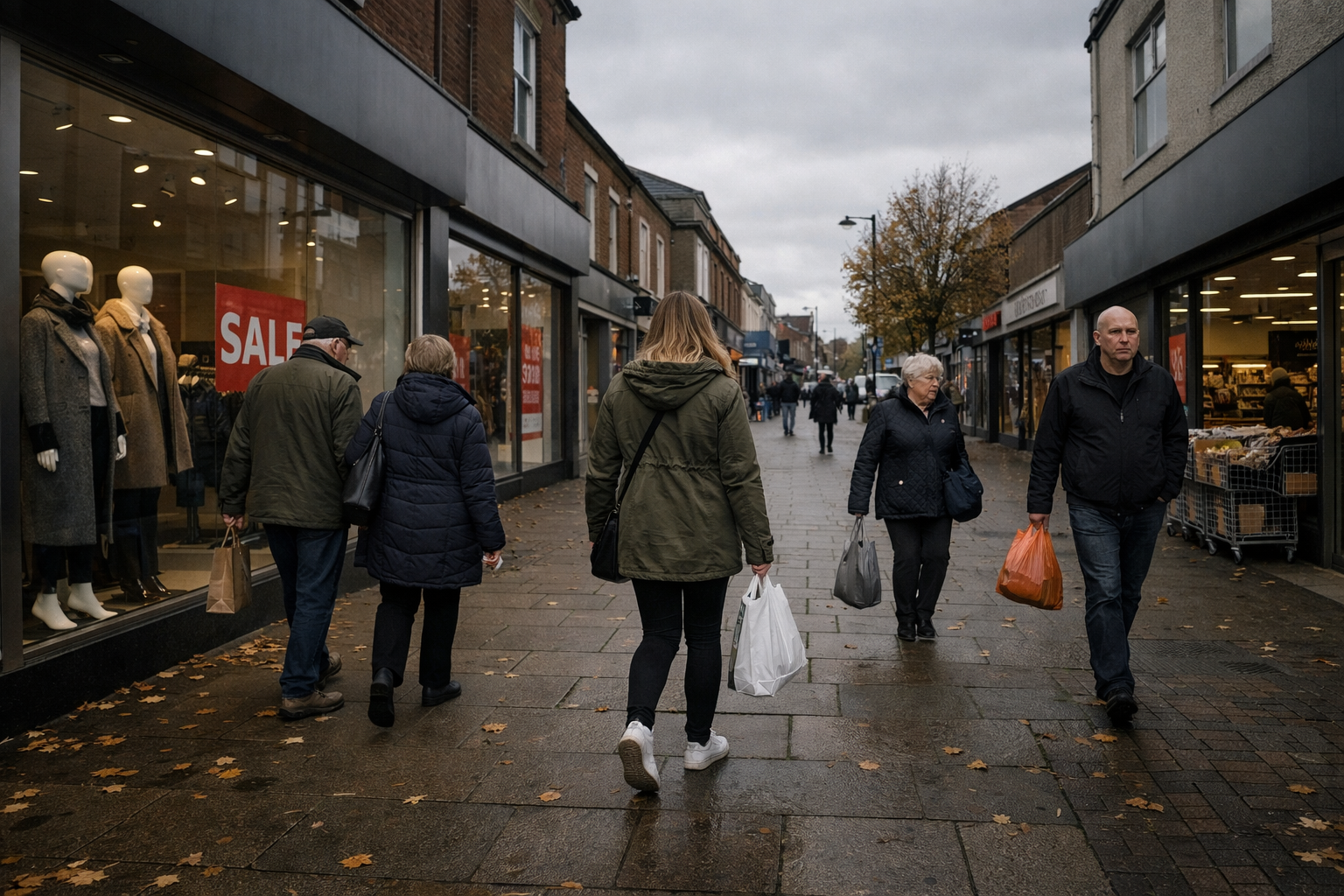
British households grow more cautious as retail sales slip before budget
British consumers pulled back sharply in September and turned markedly gloomier in October, according to fresh data released days before the government’s Autumn Budget, adding to pressure on ministers as they prepare to set out their plans for an economy still struggling with the cost of living.
Retail sales volumes in Great Britain fell 0.4 percent in September from the previous month, the Office for National Statistics said on Friday, a steeper decline than economists had expected and a reversal from August’s 0.7 percent rise. In a separate reading, the closely watched GfK consumer confidence index dropped 11 points in October to minus 24, its steepest fall of that scale since the aftermath of the 2016 Brexit vote, excluding the pandemic shock.
Together, the figures paint a picture of households growing more wary just as Chancellor John Healey heads into his first budget next Wednesday.
The timing is awkward for the government. Consumer spending is a crucial driver of Britain’s economy, and weakening confidence can quickly translate into postponed purchases, weaker holiday spending and slower growth. The latest data also arrive as inflation has moved higher again, with consumer prices rising 3.5 percent in the year to September, well above the Bank of England’s 2 percent target.
Signs of strain on the high street
The decline in September retail sales was broad-based. The statistics agency said supermarkets, non-store retailers and clothing sellers all reported weaker trade. Some online clothing retailers pointed to unusually warm weather, which reduced demand for autumn and winter lines, while other stores said lower footfall and tighter household budgets had weighed on spending.
Monthly retail figures can be volatile, and the broader picture was not uniformly weak. Over the third quarter as a whole, retail sales volumes were still up 0.7 percent compared with the previous three months, helped by stronger fuel and food sales earlier in the period.
Still, the September setback suggests consumers are becoming more selective. After years of elevated food, energy and borrowing costs, even modest new price pressures can alter spending habits quickly, particularly among lower- and middle-income households.
Confidence deteriorates at Brexit-era pace
If the retail numbers offered one warning sign, the confidence data delivered another. GfK said the sharpest falls in October came in expectations for the wider economy and in consumers’ willingness to make major purchases, an indication that the improvement in sentiment seen over the summer may have been fragile.
That matters because confidence often shapes behavior before it appears in official spending data. A household that feels less secure about the economy may delay replacing a car, renovating a home or beginning Christmas shopping early. For retailers, that can make the final months of the year more uncertain.
The latest drop in sentiment has also been linked to a worsening global backdrop, including the economic spillovers from the war in the Middle East, which have added to concerns over energy costs and inflation.
A harder backdrop for the budget
The figures leave Healey facing a more difficult balancing act in the budget on Oct. 28. Any effort to support households more aggressively risks complicating the fight against inflation or stretching already pressured public finances. But a budget seen as too austere could deepen the sense among voters that living standards remain under strain.
The new numbers may also sharpen attention on the forecasts due from the Office for Budget Responsibility, which will offer a fuller view of whether weaker sentiment is likely to become a broader slowdown.
For now, the question is whether September’s retail decline proves to be a one-month wobble or the start of a more sustained retrenchment by consumers. With inflation still above target and confidence falling fast, the answer could shape not only the Christmas trading season, but the political reception to the government’s economic plans.
Sources
Further reading and reporting used to add context:
- https://apnews.com/article/f390b0105bf3cb9b35f6a42761e96233
- https://moneyweek.com/personal-finance/tax/budget-tax-rises
- https://moneyweek.com/economy/uk-economy/uk-inflation-consumer-price-index-release-dates
- https://moneyweek.com/personal-finance/state-pensions/state-pension-rise-how-much-could-you-get
- https://theweek.com/business/economy/andy-burnhams-everyday-fixes-blitz
- Retail sales, Great Britain – Office for National Statistics
- https://www.ons.gov.uk/businessindustryandtrade/retailindustry/datasets/retailsalessummarytables/current
- https://www.parliament.uk/about/how/role/check-and-approve-government-spending-and-taxation/the-budget-and-parliament/
- https://www.bankofengland.co.uk/agents-summary/2026/september-2026
- https://commonslibrary.parliament.uk/research-briefings/cbp-11005/
- https://www.parliament.uk/business/news/2026/october-2026/coming-up-in-the-commons-26-30-october/
- https://tnaqa.mirrorweb.com/ukgwa/20261008200830mp_/https%3A/www.gov.uk/government/news/budget-to-move-power-and-money-out-of-westminster-and-into-every-postcode-around-britain
- https://obr.uk/hero/october-2026-forecast-publication/
- https://www.bankofengland.co.uk/monetary-policy-report/2026/july-2026
- https://obr.uk/october-2026-forecast-timetable/
- https://commonslibrary.parliament.uk/research-briefings/sn02817/
- https://www.instituteforgovernment.org.uk/budget-2026
- https://www.reddit.com/r/u_ONS_UK/comments/1xd5zqk/retail_sales_rose_by_07_in_the_three_months_to/
- https://www.reddit.com/r/u_ONS_UK/comments/1wjhywa/retail_sales_are_estimated_to_have_risen_by_09_in/
- https://commonsbusiness.parliament.uk/Document/98743/Pdf?subType=Standard
- https://commonsbusiness.parliament.uk/Document/105328/Pdf?subType=Standard
- https://mtsinsights-assets.s3.amazonaws.com/media/summaries/att/gfk-uk-consumer-confidence/2026/03/27/5f5fbd72-d9d1-4997-b70c-ef4305ea3176.pdf?X-Amz-Algorithm=AWS4-HMAC-SHA256&X-Amz-Credential=AKIARB7EFOVKWBL5S67B%2F20260416%2Fus-east-2%2Fs3%2Faws4_request&X-Amz-Date=20260416T023927Z&X-Amz-Expires=3600&X-Amz-Signature=7db32c43aa6185bafff441d6e97aafd0f121a472bf36d29f386875be473b0a74&X-Amz-SignedHeaders=host&response-content-disposition=inline&response-content-type=application%2Fpdf
- https://en.wikipedia.org/wiki/2026_United_Kingdom_budget
- https://www.youtube.com/watch?v=-iXMOfUwL04
- https://www.gfk.com/hubfs/UK_2023/GfK_UK_Black-Friday-Tech-analysis-2023.pdf
- https://www.gfk.com/hubfs/Landing_Pages_Images/2020/Global/TEMAX/GfKs%20Helicopter%20View%20Report%202022%20Q3.pdf
- https://discover.gfk.com/story/keep-pace-with-consumer-confidence/page/2
- https://www.gfk.com/hubfs/GfK%20Consumer%20Confidence%20Barometer%20Charts%20October%202020.pdf
- https://discover.gfk.com/story/keep-pace-with-consumer-confidence/page/1
- https://www.gfk.com/fileadmin/user_upload/dyna_content/GB/documents/Press_Releases/GfK_Consumer_Confidence_Press_Release_August_2017.pdf
- https://www.gfk.com/fileadmin/user_upload/dyna_content/Global/documents/Press_Releases/2016/20161026_Consumer_Climate_Germany_Oct_efin.pdf
- https://www.gfk.com/webinar-on-demand-the-new-health-check-that-could-save-a-brands-life
- https://panelsculture.premium.gfk.com/
- https://panelsculture.gfk.com/
- https://account.gfk.com/gfkonepanel.onmicrosoft.com/oauth2/v2.0/authorize?client_id=c66bafcc-d826-4cf3-98f5-b8f848aa2d25&nonce=defaultNonce&p=B2C_1A_SUSI_OP&psk=AmxQsWDHBQKUmOHbPith56rvCi3RYhwgKVMBNbph&redirect_uri=https%3A%2F%2Fportal.we-evolv.com&response_type=code&scope=openid&signin=1&ui_locales=nl-nl
- https://router.gfk.com/
- https://audienciastv.gfk.com/politica-de-privacidade
- https://account.gfk.com/gfkonepanel.onmicrosoft.com/oauth2/v2.0/authorize?client_id=c66bafcc-d826-4cf3-98f5-b8f848aa2d25&nonce=defaultNonce&p=B2C_1A_SUSI_OP&psk=vcyrAjcByC4mxRxFQdYtLMZOJ7nUbYHWEjbtEguN&redirect_uri=https%3A%2F%2Fportal.we-evolv.com&response_type=code&scope=openid&signin=1&ui_locales=de-at
- https://insights.cps.gfk.com/story/the-shock-of-inflation-fmcg-strategies-to-master-shoppers-cuts-free/page/4
- https://insights.cps.gfk.com/story/green-ambitions-golden-opportunities-sustainability-in-times-of-instability/page/5
- https://startrack.mi.gfk.com/
- https://nielseniq.com/global/en/news-center/2026/consumer-confidence-plunges-11-points-to-24-in-october/
- https://nielseniq.com/global/en/news-center/2026/consumer-confidence-stay-at-23-in-june/
- https://nielseniq.com/global/en/news-center/2026/headline-score-up-three-points-to-14-in-august/
- https://nielseniq.com/global/en/news-center/2026/consumer-confidence-up-two-points-in-may-to-23/
- https://nielseniq.com/global/en/news-center/2025/uk-consumer-confidence-increases-two-points-in-october-to-17/
- https://nielseniq.com/global/en/news-center/financial-services/
- https://nielseniq.com/global/en/insights/analysis/2026/cider-sales-up-but-spirits-fall-in-steady-september/
- https://nielseniq.com/global/en/news-center/2026/consumer-confidence-score-down-four-points-in-april-to-25/
- https://nielseniq.com/global/en/news-center/2026/consumer-confidence-down-two-points-in-march/
- https://nielseniq.com/global/en/news-center/2026/consumer-confidence-up-six-points-to-17-in-july/
- https://nielseniq.com/global/en/insights/multimedia/2024/uk-consumer-confidence-slips-one-point-to-21-in-october/
- https://nielseniq.com/global/en/news-center/2025/consumer-confidence-drops-two-points-in-november-to-19/
- https://microsites.nielseniq.com/web-assets/wp-content/uploads/sites/7/2022/11/Cost-of-Living-Consumer-Reset-.pdf
- https://microsites.nielseniq.com/web-assets/wp-content/uploads/sites/7/2021/10/NielsenIQ-Lares-Brasileiros-e-latino-americanos.pdf
- https://microsites.nielseniq.com/web-assets/wp-content/uploads/sites/7/2023/09/NielsenIQ-l-Conjoncture-alternative-2023.pdf