
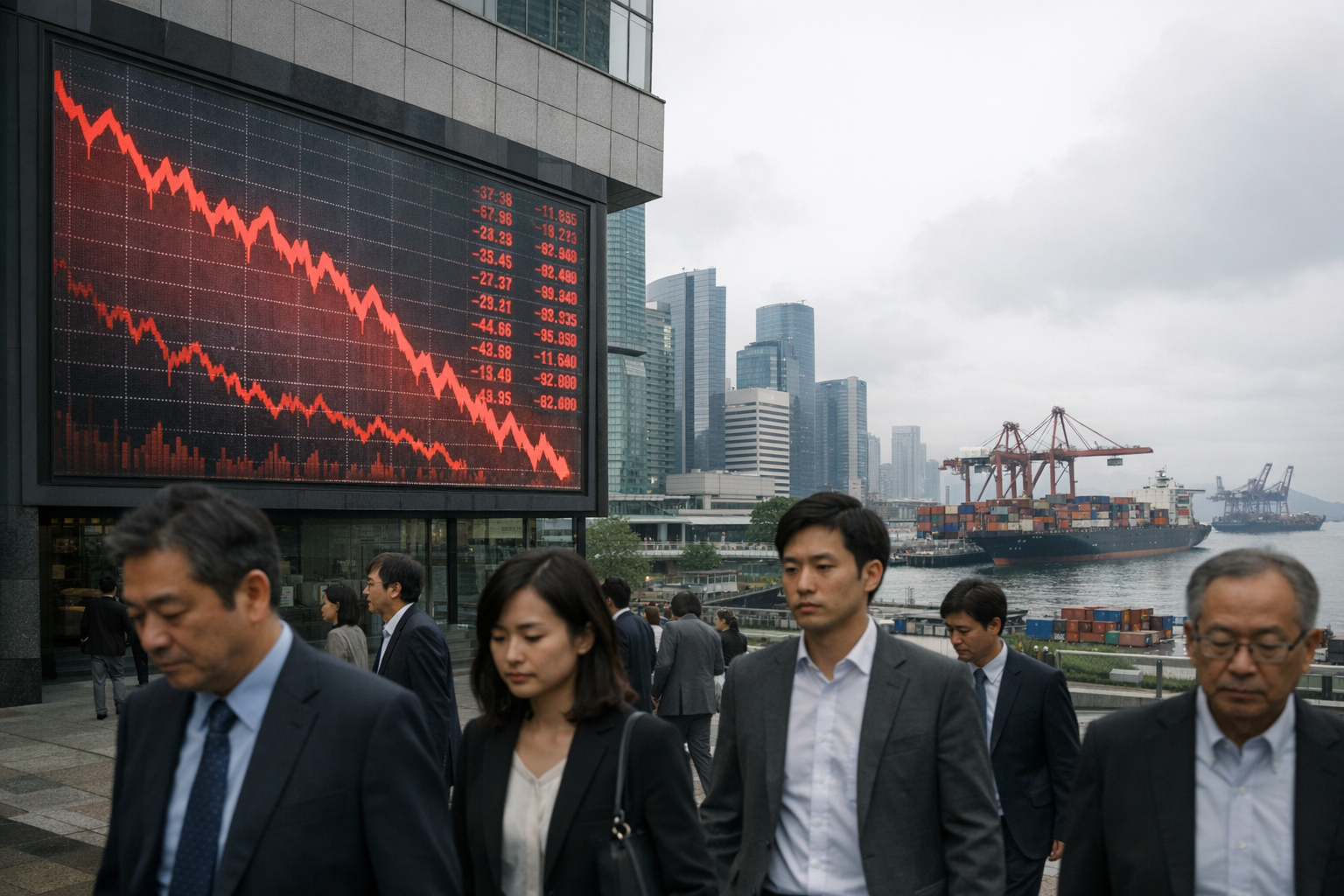
China’s April Slowdown Ripples Across Asia
China’s economy lost momentum sharply in April, according to official data released Monday, intensifying worries that the world’s second-largest economy is struggling to generate enough domestic demand to cushion itself — and the region — from mounting geopolitical and market pressures.
Industrial output rose 4.1 percent from a year earlier, down from 5.7 percent in March. Retail sales, a closely watched gauge of household spending, increased just 0.2 percent, the weakest pace in about 40 months. Fixed-asset investment for the first four months of the year contracted 1.6 percent, a reversal from the modest growth seen in the first quarter.
The figures missed expectations across the board and underscored a pattern that has become increasingly difficult for policymakers to dismiss: China’s recovery remains uneven, with consumers cautious, investment faltering and growth still heavily exposed to external shocks.
That matters far beyond China’s borders. For much of Asia, and for global commodity producers and exporters, China remains a crucial source of demand. When Chinese households spend less and factories slow, the effects are felt in export orders, raw-material prices and corporate earnings from Seoul to Sydney.
A Weak Consumer at the Center
The most striking part of April’s data was the slowdown in consumption. Retail sales not only barely grew from a year earlier; official figures also showed they fell from the previous month, suggesting that household demand weakened even as Beijing has tried to project economic stability.
The softness is especially troubling because Chinese officials have increasingly emphasized consumption as the engine needed to reduce the economy’s dependence on property, infrastructure and exports. But the latest numbers suggest households remain reluctant to spend, a sign of lingering anxiety over income, jobs and the broader outlook.
April’s results marked a clear loss of speed from March, when retail sales rose 1.7 percent and industrial output expanded 5.7 percent. Fixed-asset investment, which was still positive in the first quarter, also deteriorated. Taken together, the data point to an economy that is not collapsing but is struggling to build self-sustaining momentum.
Regional Markets Feel the Strain
The slowdown is feeding into a more fragile mood across Asian markets already unsettled by geopolitical tensions and surging energy concerns.
In South Korea, market volatility climbed near record levels after foreign investors sold roughly $13.2 billion in local equities last week, a sharp retreat that reflected not only country-specific profit-taking but also a broader reduction in risk exposure. South Korea, with its export-heavy economy and sensitivity to swings in global technology demand and energy prices, is particularly vulnerable when confidence in China weakens.
A softer Chinese economy tends to darken the outlook for South Korean exporters, manufacturers and shipping firms. And when that weakness coincides with higher oil prices and uncertainty tied to the conflict involving Iran, investors have more reason to pull back from regional markets seen as exposed to both trade and energy shocks.
Beijing has also become a center of diplomacy around those tensions, as global leaders weigh the economic and political consequences of instability in the Middle East. Any prolonged disruption that keeps oil prices elevated would add another burden for Asian economies, especially at a moment when China appears less able to absorb higher costs through stronger domestic growth.
Why This Matters Now
The timing of China’s weaker data is especially sensitive. Global investors had been looking for signs that Chinese demand could help stabilize growth in Asia and support a fragile world economy. Instead, April offered evidence that the opposite may be happening: domestic demand in China remains too soft to offset rising external risks.
That raises questions about whether Beijing will respond with more forceful stimulus, and if so, what kind. In recent years, Chinese policymakers have often leaned on investment and industrial support measures. But economists have increasingly argued that the more pressing need is direct support for households and consumer confidence.
Without that, weaker retail spending could continue to drag on imports, corporate sentiment and regional trade flows. For countries tightly linked to Chinese demand, the consequences could be immediate.
Investors are now watching two closely related questions: whether Chinese officials step up support for growth, and whether foreign selling in Asian equities — particularly in South Korea — stabilizes or spreads into a broader retreat from the region.
For now, April’s numbers have reinforced a sobering message. China’s economy is still growing, but not with the strength needed to reassure markets already on edge. And in an Asia increasingly buffeted by geopolitical risk, that loss of momentum is becoming harder to contain.
Sources
Further reading and reporting used to add context:
- https://apnews.com/article/48b0ca751712ce473ffcd207997928af
- https://m.investing.com/news/economy-news/chinas-april-industrial-output-retail-sales-growth-miss-expectations-4694603?ampMode=1
- https://invezz.com/in/news/2026/05/18/chinas-economy-stumbles-as-factory-output-and-retail-sales-miss/
- https://energynews.oedigital.com/energy-markets/2026/05/17/chinas-economy-slowed-in-april-as-retail-sales-and-output-fell-far-below-expectations
- https://ca.investing.com/news/economic-indicators/china-april-factory-output-retail-sales-miss-forecasts-amid-weak-domestic-demand-4644466
- https://www.marketscreener.com/news/china-s-economy-slows-in-april-as-output-retail-sales-disappoint-in-blow-to-outlook-ce7f5bd3d08af227
- https://www.chinadaily.com.cn/a/202605/18/WS6a0aa98aa310d6866eb49364.html
- https://english.www.gov.cn/archive/statistics/202604/16/content_WS69e04c35c6d00ca5f9a0a739.html
- https://www.investing.com/news/economy-news/chinas-factory-output-rises-57-in-march-retail-sales-growth-slips-to-17-4617009
- https://www.investing.com/news/economy-news/china-april-industrial-output-retail-sales-growth-slow-4051738
- https://www.aljazeera.com/news/2026/5/13/iran-war-day-75-trump-xi-talks-loom-in-beijing-as-tensions-rise-in-gulf
- https://english.sse.com.cn/news/newsrelease/voice/c/c_20250519_10779405.shtml
- https://www.straitstimes.com/business/economy/china-economy-slows-sharply-as-investment-returns-to-contraction/
- https://apnews.com/article/3bd8f26cbb815fc9b445046611f423f7
- https://www.reddit.com/r/NBCauto/comments/1tg82n7/world_cnbc_daily_open_trump_faces_grueling/
- https://en.wikipedia.org/wiki/2026_Iran_war
- https://en.wikipedia.org/wiki/2026_Strait_of_Hormuz_campaign
- https://www.koreatimes.co.kr/economy/20251109/kospi-experiences-record-foreign-sell-off-in-1st-week-of-november-amid-ai-bubble-woes
- https://biz.chosun.com/en/en-finance/2026/05/15/PI2VK6M2XNH75BPOHGDRY53GSY/?outputType=amp
- https://biz.chosun.com/en/en-policy/2026/03/12/7QCYUYNLGJELDIDJQZVIK6KWCA/?outputType=amp
- https://en.sedaily.com/news/2026/05/12/kospi-plunges-578-points-after-touching-7999-on-trump
- https://koreajoongangdaily.joins.com/news/2025-11-09/business/finance/Kospi-experiences-record-foreign-selloff-in-1st-week-of-November-amid-AI-bubble-woes/2440028
- https://www.koreatimes.co.kr/amp/economy/20260312/foreign-net-selling-of-s-korean-stocks-hits-record-high-in-february
- https://en.sedaily.com/news/2026/05/15/kospi-whipsaws-from-8000-to-7600-as-foreigners-dump-29b
- https://www.chosun.com/english/market-money-en/2026/03/04/MO7VGYIYCFBHVHEISX3XMIDA7A/
- https://www.brecorder.com/news/amp/40420812
- https://en.yna.co.kr/view/AEN20260312003400320?section=economy-finance%2Feconomy
- https://www.investing.com/news/economy-news/south-korean-retail-investors-panic-as-worldbeating-stock-gains-vanish-4540114
- https://rockstarmarkets.com/news/2026/05/15/asian-equity-rally-stalls-yen-intervention-risk
- https://www.lseg.com/content/dam/ftse-russell/en_us/documents/market-insights/apac/apac-financial-markets-spotlight-may-2025.pdf
- https://international.groupecreditagricole.com/en/international-support/south-korea/investing?convertir_en_pdf=ok
- https://www.investing.com/news/economy-news/chinas-april-industrial-output-retail-sales-growth-miss-expectations-4694603
- https://www.investing.com/news/economy-news/chinas-economy-slows-in-april-as-output-retail-sales-sharply-undershoot-forecasts-4694608
- https://www.brecorder.com/news/40421655/chinas-april-industrial-output-retail-sales-growth-miss-expectations
- https://www.stats.gov.cn/english/PressRelease/
- https://english.www.gov.cn/archive/statistics/202605/18/content_WS6a0a7676c6d00ca5f9a0b06f.html
- https://finance.yahoo.com/economy/articles/chinas-april-industrial-output-retail-020150348.html
- https://www.stats.gov.cn/english/PressRelease/index.html
- https://www.marketscreener.com/news/china-s-april-industrial-output-retail-sales-growth-miss-expectations-ce7f5bd3d08bf02d
- https://www.chinadailyasia.com/article/633602
- https://www.scmp.com/economy/china-economy/article/3353914/chinas-economy-shows-signs-strain-april-iran-war-headwinds-grow?module=top_story&pgtype=section
- https://927thevan.com/2026/05/17/chinas-april-industrial-output-retail-sales-growth-miss-expectations/
- https://assets.kpmg.com/content/dam/kpmgsites/cn/pdf/en/2026/02/china-economic-monitor-q1-2026.pdf.coredownload.inline.pdf
- https://www.reddit.com/r/RWATimes/comments/1tgguy8/chinas_economy_loses_momentum_as_industrial/
- https://www.hkbea.com/pdf/bea-economic-research/202603/2603-market-monitor-cn-en.pdf
- https://www.reddit.com/r/Economics/comments/1tg9x93/chinas_april_economic_data_underwhelms_with/
- https://en.wikipedia.org/wiki/KOSPI
- https://prasad.dyson.cornell.edu/doc/CNBC.18Jan26.pdf
- https://static.poder360.com.br/2026/04/nbs-1-tri-2026.pdf
- https://www.imf.org/-/media/files/publications/cr/2026/english/1chnea2026001-source-pdf.pdf
- https://www.hkbea.com/pdf/bea-economic-research/202406/2406-market-monitor-cn-en.pdf
- China’s economy slows in April as output, retail sales sharply undershoot forecasts By Reuters
- South Korean retail investors panic as world-beating stock gains vanish By Reuters
- China’s factory output rises 5.7% in March, retail sales growth slips to 1.7% By Reuters