
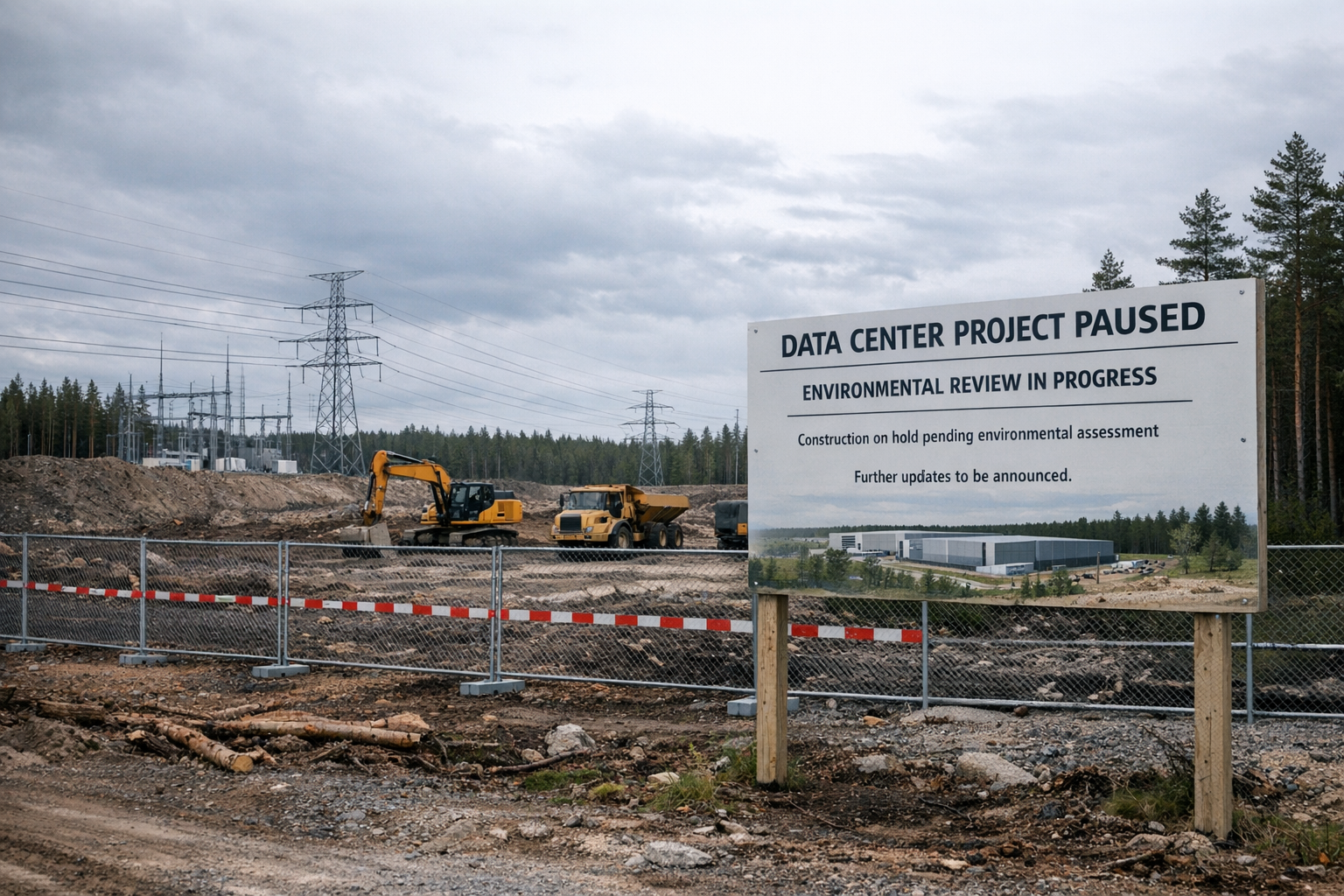
The global race to build the physical backbone of artificial intelligence is running into a new set of doubts — not over whether demand for AI is real, but whether the industry is building too much, too fast, and at too high a financial and political cost.
That tension sharpened this week in Finland, where authorities ordered Google’s local project company to halt environmentally significant preparatory work at two planned data-center sites in Muhos and Kajaani until a required environmental review is completed. The move comes only weeks after Google announced a €13 billion push into AI infrastructure in Finland for 2027 and 2028, describing it as its largest single investment in Europe.
The pause is narrow for now, focused on permitting and environmental process. But it arrives at a moment when investors, policymakers and even some longtime market bulls are beginning to ask whether the AI boom is entering a more fragile phase — one in which the enthusiasm surrounding chips, cloud computing and model development collides with the slower realities of land use, electricity grids, public opposition and the risk of overheated markets.
The AI build-out meets local limits
Finland has become one of Europe’s most attractive homes for data centers, offering a cool climate, comparatively abundant power and a policy environment long seen as supportive of digital infrastructure. For companies racing to secure computing capacity for AI, those advantages have made the country a strategic foothold.
But the same qualities that drew investment are now exposing the strains of rapid expansion. Large data centers require vast amounts of electricity, transmission access, land preparation and, increasingly, political consent. In Finland, scrutiny has grown around forest impacts, environmental permitting and whether power systems can absorb a wave of new demand from AI-related projects.
The order affecting Google’s planned sites may yet prove to be a procedural delay rather than a broader setback. Still, it underscores a crucial shift in the AI story: the bottleneck is no longer just advanced semiconductors. It is also permits, substations, transmission lines and local acceptance.
For Europe in particular, the episode raises the question of whether AI ambitions can proceed on the timetable promised by technology companies if environmental oversight becomes tougher or if communities and regulators begin to resist the scale of the build-out.
Investors start worrying about overreach
At the same time, concerns are spreading in financial markets that the AI trade — one of the dominant forces behind global equities over the past year — has become crowded and vulnerable.
At Temasek, Singapore’s state investment firm, its chief investment officer has described a potential unwinding of the AI trade as the biggest risk facing markets now. The warning stands out not because Temasek is hostile to AI, but because it has been among the large, long-term investors trying to position for technological change. The concern is less about the eventual importance of AI than about what happens when too much money chases the same theme, at the same valuations, in the same handful of companies.
That anxiety has grown more visible as AI-linked megacap stocks continue to help lift major indexes even while bond markets send a more cautious signal. Rising yields have reflected concern about inflation, debt and the path of interest rates, yet equity investors have largely looked through that pressure so long as AI growth appears intact.
The result is an unusual split-screen market: technology shares, especially those tied to AI infrastructure, keep powering benchmarks higher, while the bond market warns that financing conditions are becoming less forgiving.
If that gap closes suddenly, the pain could spread well beyond a narrow corner of tech. A reversal in AI enthusiasm would hit not only chipmakers and cloud companies, but also the broader indexes that have come to depend heavily on a small group of AI beneficiaries for momentum.
From productivity promise to debt and inflation risk
The unease is not confined to investors. Kristalina Georgieva, the managing director of the International Monetary Fund, has warned that AI is both a source of hope and a hazard for world leaders. The technology may lift productivity and growth over time, but it can also intensify inflationary pressure and push yields higher in an already debt-laden world.
That warning goes to the heart of the current moment. AI investment is often presented as unquestionably productive spending — the kind of capital outlay that modern economies need. But in the short run, it can look more like a surge in demand for scarce inputs: electricity, construction labor, specialized equipment, financing and land.
In a world where governments are already carrying elevated debt loads and interest costs have risen sharply, that matters. If AI capital spending feeds overheating rather than immediate productivity gains, policymakers may become less willing to treat the boom as benign.
The political stakes are high. Governments want the jobs, prestige and strategic benefits that come with hosting AI infrastructure. They also want growth. But they are increasingly being asked to weigh those benefits against environmental disruption, pressure on power systems and the possibility that today’s investment frenzy could leave behind stranded assets tomorrow.
A question of timing
Skeptics of the current build-out argue that the industry is racing ahead of proven demand. Among the more outspoken is Arthur Hayes, the former BitMEX chief executive, who has said that trillions of dollars are being wasted on AI infrastructure and that data-center spending is heading toward overbuild.
His view is more extreme than that of mainstream institutional investors, and it is tied to his own bet that any eventual bust and policy response could benefit crypto assets. But the core argument — that the industry may be laying down far more capacity than near-term profits can justify — is increasingly hard to dismiss outright.
That does not mean the AI boom is about to collapse. Many investors who worry about an eventual reckoning do not expect it immediately. Some see the bigger danger emerging later in the decade, perhaps around 2027, if revenue growth fails to keep pace with the enormous spending commitments now being made.
For now, the market’s faith rests on a simple proposition: that demand for AI services will grow quickly enough to justify the cost of chips, power contracts, campuses and transmission upgrades now underway across the world.
Why this moment matters
The significance of Finland’s intervention lies less in the specific projects than in what it symbolizes. It is an early reminder that AI is not weightless software. It is an industrial build-out, one that depends on concrete, steel, cooling systems, power lines and political permission.
That reality makes the next phase of the AI boom more complicated than the last one. The first chapter was dominated by excitement over breakthrough models and the companies selling the picks and shovels. The next may be shaped by harder questions: whether the grid can cope, whether regulators will slow projects, whether profits will arrive in time, and whether investors can stomach the concentration and valuation risk embedded in the trade.
As long as AI-linked companies keep delivering growth, markets may be willing to overlook those tensions. But if delays mount, yields stay high and the economics of the build-out become less convincing, what looks today like strategic urgency could begin to resemble excess.
Sources
Further reading and reporting used to add context:
- https://apnews.com/article/2da9d879e2eb70e1e16d14fd1a307a99
- https://www.axios.com/2026/10/07/hedge-fund-risks-imf
- https://www.axios.com/2026/10/01/trump-ai-industry-risks-safety-gamble
- https://www.kiplinger.com/investing/stocks/nasdaq-hits-new-highs-on-ai-boom-optimism-stock-market-today
- https://www.aiaffairs.com/markets/temasek-ai-trade-unwind-biggest-market-risk/
- https://www.dealstreetasia.com/stories/temasek-flags-ai-unwind-as-biggest-risk-to-markets-497393
- https://www.themeridiem.com/ai/2026/10/07/ai-trade-unwind-risk-as-temasek-signals-market-correction-phase
- https://www.livemint.com/ai/ai-boom-could-waste-trillions-on-data-centres-trigger-crash-and-crypto-rally-says-arthur-hayes-11791349097753.html
- https://news.sbs.co.kr/english/article.do?news_id=N1008787313
- https://finance.yahoo.com/technology/ai/articles/temasek-cio-watching-two-risks-071015714.html
- https://www.finweek.co.uk/2026/10/07/temasek-ai-investment-risks/
- https://www.imf.org/en/news/articles/2026/09/07/sp090726-md-monetary-policy-with-supply-shocks-and-high-debt?trk=article-ssr-frontend-pulse_little-text-block
- https://www.investing.com/news/stock-market-news/temasek-comfortable-with-current-ai-spending-levels-executive-says-4927937
- https://www.newsimpactscreener.com/articles/singapore-s-temasek-warns-of-the-biggest-risk-facing-markets-right-now
- https://www.geocontexto.com/?id=51385&view=noticia
- https://beincrypto.com/arthur-hayes-ai-bailout-bitcoin/
- https://www.reddit.com/r/Mag7shares/comments/1wzlg3w/trillions_are_being_wasted_on_the_ai_boom_arthur/
- https://www.reddit.com/r/europe/comments/1wz8ma1/finland_orders_halt_to_work_on_two_google_data/
- https://www.reddit.com/r/ShitAIBrosSay/comments/1wzaosw/finland_orders_halt_to_work_on_two_google_data/
- https://www.reddit.com/r/eutech/comments/1wzevqr/finland_orders_halt_to_work_on_two_google_data/
- https://www.reddit.com/r/XGramatikInsights/comments/1wzv6cb/cnbc_google_has_been_ordered_to_halt_work_on_two/
- https://www.theatlantic.com/podcasts/2026/05/whats-the-ai-endgame/687184/?utm_source=apple_news
- https://www.techradar.com/pro/finland-drops-first-come-first-served-grid-connections-leaving-data-centers-way-down-the-queue
- https://www.reutersconnect.com/item/finland-orders-halt-to-work-on-two-google-data-centres/dGFnOnJldXRlcnMuY29tLDIwMjY6bmV3c21sX09XQ1ZNQzQ0ODUyOC1WSURFTw
- https://www.khanlist.com/story/cnbc-daily-open-ai-rally-defies-bond-market-rout-01646fdf
- https://allmind.ai/news/19c284097fa6ee62c0d9e2daa35f2122ec46cdc0955afe39c3dc35f455c76d45
- https://pluang.com/en/news-feed/temasek-waspadai-risiko-terbesar-pasar-saat-ini
- https://tuttiquotidiani.it/en/news/cnbc-daily-open-ai-rally-defies-bond-market-rout
- https://1-e8259.azureedge.net/news/2026/10/7/finland-orders-halt-to-work-on-google-data-sites-over-environment-concerns
- https://www.zetik.com/news/article/story_id-p008-221960
- https://www.spacemoney.com.br/tecnologia/temasek-alerta-risco-aposta-ia-mercados/
- https://sovereigntymonitor.eu/news/2026-10-06-finland-google-data-centre-halt/
- https://www.reddit.com/r/Finland/comments/1wceq5l/data_centers_in_finland/
- https://www.reddit.com/r/environment/comments/1wwluup/outrage_google_has_been_accused_of_illegally/
- https://thepeninsulaqatar.com/pdf-file/20251010_1760043935-685.pdf
- https://www.reddit.com/r/technology/comments/1wxn3gg/google_is_accused_of_destroying_nearly_500/
- https://www.reddit.com/r/thewallstreet/comments/1wvryx2/daily_discussion_october_02_2026/
- https://www.googlecloudpresscorner.com/2026-09-09-Google-Deepens-Commitment-to-Finland-with-Two-Year-EUR13-Billion-investment-in-AI-Infrastructure
- https://milkeninstitute.org/events/asia-summit-2026
- https://milkeninstitute.org/content-hub/news-releases/milken-institute-unveils-2026-asia-summit-leadership-ai-world
- https://www.mfa.gov.sg/newsroom/press-statements-transcripts-and-photos/transcript-of-minister-for-foreign-affairs-dr-vivian-balakrishnan-s-live-interview-with-cnbc-on-the-sidelines-of-the-milken-asia-summit–singapore–7-october-2026/
- https://blog.google/innovation-and-ai/infrastructure-and-cloud/global-network/clean-energy-finland/
- https://milkeninstitute.org/events/asia-summit-2026/livestream?page=1
- https://www.imf.org/en/countries/resrep/sgp
- https://political.org/2026/10/06/temaseks-investment-chief-warns-ai-trade-unwind-is-biggest-risk-to-global-markets-heading-into-2027/
- https://www.datacenters.google/locations/hamina-finland/
- https://www.imf.org/en/live
- https://www.fortum.com/en/media/2026/09/inside-information-fortum-and-google-partner-drive-sustainable-growth-finland-sign-nuclear-power-purchase-agreement
- https://www.imf.org/en/news/articles/2026/03/05/sp030526-shaping-asias-future
- https://www.youtube.com/watch?v=8wWeUdxDeig
- https://www.youtube.com/watch?v=pa01gkeUiwI
- https://milkeninstitute.org/sites/default/files/2025-10/MakingSenseNewInvestmentNarrative_Transcript_AS25.pdf
- https://www.reddit.com/r/Nok/comments/1wbepnx/google_deepens_commitment_to_finland_with_twoyear/
- https://www.reddit.com/r/Finland/comments/1wbrwor/google_picks_finland_for_13_billion_ai_data/
- https://www.gstatic.com/marketing-cms/8d/3e/6c26980846d78de31b6e254c3cc2/2024-impact-study-finland.pdf
- https://www.reddit.com/r/stocks/comments/1wbi32u/googl_plans_to_invest_13b_in_finland_ai/
- https://www.reddit.com/r/EU_Economics/comments/1wbgl4n/google_is_investing_13_billion_in_expanding_the/
- https://www.reddit.com/r/GOOG_Stock/comments/1wbt35o/google_picks_finland_for_13_billion_ai_data/
- https://en.wikipedia.org/wiki/Milken_Institute
- https://www.imfconnect.org/content/dam/imf/Spring-Annual%20Meetings/AM/24/GovState/BUL%20MD%20Plenary%20Speech%20on%20How%20To%20Do%20Better.pdf
- Finland orders halt to work on Google data centre sites | Energy News | Al Jazeera
- Google Deepens Commitment to Finland with Two-Year €13 Billion investment in AI Infrastructure