
From Oil Shock to Economic Strain
Warnings from some of the world’s most influential economic institutions are converging on a darker message: the conflict in the Middle East is no longer being viewed simply as a threat to crude prices, but as a widening shock that could disrupt transport, complicate inflation fights and force difficult political choices over spending.
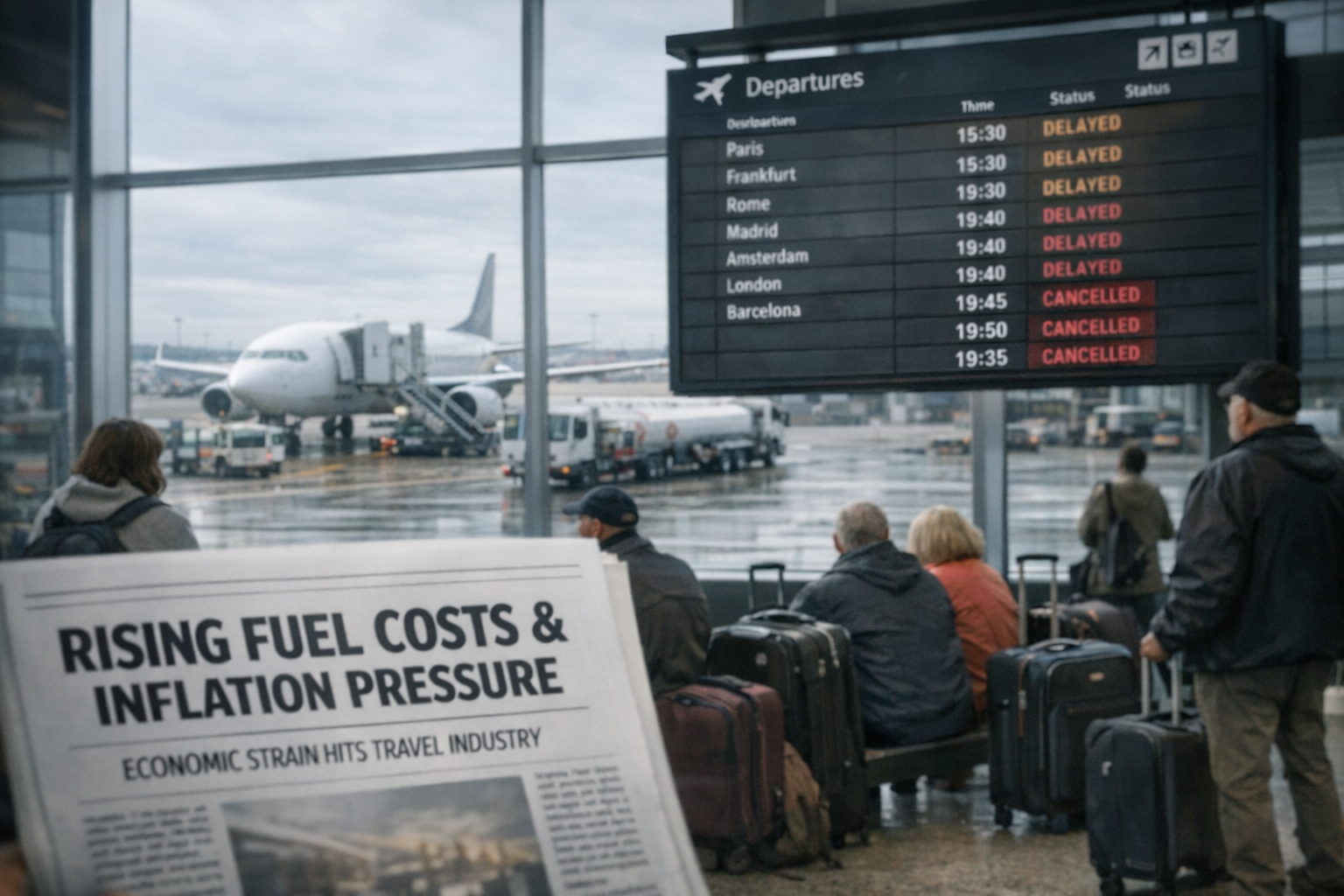
That shift has become especially stark in Europe, where the International Energy Agency’s executive director, Fatih Birol, said the region could have as little as six weeks of jet-fuel supply left if disruption through the Strait of Hormuz continues. The concern points to a more immediate and visible risk than the rise in benchmark oil prices alone: fewer flights, higher fares and another squeeze on supply chains already vulnerable to energy bottlenecks.
In the United States, John Williams, president of the Federal Reserve Bank of New York, said the war had intensified uncertainty and was aggravating inflation pressures through energy. In Europe, policymakers at the European Central Bank have warned of what one official described as a “layer cake of shocks” — a phrase that captures the increasingly tangled mix of war, energy disruption, weaker growth and sticky prices.
And at the International Monetary Fund, economists are drawing attention to a longer-term consequence: as governments increase military spending in response to a more dangerous world, they may find themselves with less room to support growth or protect households from the economic fallout.
A Narrow Waterway, a Wider Threat
At the center of the alarm is the Strait of Hormuz, the narrow maritime passage critical to global energy trade. Since the conflict began on Feb. 28, flows through the strait have fallen sharply, turning what had been a market concern into a physical supply problem.
The IEA said in March that its member countries would release 400 million barrels from emergency reserves, the largest coordinated stock release in the agency’s history. Its latest assessments have described the loss of supply as the biggest disruption in global oil-market history, with Gulf flows through Hormuz collapsing from roughly 20 million barrels a day to a fraction of that.
Strategic reserves can cushion a crude shortage, but the warning on jet fuel underscores a harder question: whether emergency actions aimed at stabilizing oil markets can adequately protect refined products that are essential to day-to-day economic activity. Aviation fuel is particularly important because shortages would be felt quickly by airlines, freight carriers and travelers, and then more broadly through tourism, business travel and cargo networks.
If the disruption proves brief, the damage may remain concentrated in energy and transport. But if it drags on, economists say the effects are likely to spread further into consumer prices, business costs and household confidence.
Central Banks Face a Familiar, Unwelcome Problem
For central bankers, the new risk is that the conflict revives a dilemma they had hoped was fading: slower growth combined with more persistent inflation.
Mr. Williams said he still expected U.S. growth in 2026 to remain positive, in a range of roughly 2 percent to 2.5 percent. But he also signaled concern that inflation could stay elevated, around 2.75 percent to 3 percent, rather than cleanly returning to target. That combination threatens to leave the Federal Reserve in an uncomfortable position, wary of cutting rates too soon even as uncertainty rises.
The ECB is facing a similar bind, with perhaps even less clarity. After holding rates steady in March, it said the war had increased upside risks to inflation and downside risks to growth. The bank has already revised euro-area forecasts in a more troubling direction, lifting its 2026 inflation projection to 2.6 percent while cutting expected growth to 0.9 percent.
For investors, businesses and households, that means monetary policy has become harder to read. A slowdown would ordinarily strengthen the case for lower rates. But if energy and transport disruptions keep feeding through into prices, policymakers may hesitate, fearing that inflation expectations could become unmoored.
That uncertainty is beginning to shape market expectations, with traders and economists increasingly focused not only on how high energy prices might go, but on how broad the inflation pass-through could become — into shipping, food, manufactured goods and services.
The Return of “Guns Versus Butter”
The war is also reopening an old fiscal debate in urgent new form.
In its latest global outlook, the IMF warned that countries raising defense spending often face a sharp deterioration in public finances. Historically, such buildups have worsened fiscal deficits by about 2.6 percentage points of gross domestic product and increased public debt by roughly 7 percentage points within three years.
Those figures matter because governments are entering this period with limited room for error. Many are still carrying heavier debt burdens from the pandemic and the inflation shock that followed. Now they are being asked to finance military preparedness, shield consumers from energy costs and preserve growth at the same time.
The result is a classic “guns versus butter” trade-off: more money for defense can mean less for social programs, infrastructure or targeted economic support, unless governments are willing to borrow more or raise taxes. In slower-growing economies, either choice becomes more painful.
In Europe, where energy exposure is more immediate and security concerns are intensifying, those trade-offs may arrive first. But the tension is global, especially if the conflict proves prolonged and forces a sustained rethink of defense priorities.
Why the Warnings Are Intensifying Now
What has changed in recent days is not only the severity of the conflict, but the breadth of the institutions signaling concern. The IEA is warning of a concrete supply squeeze in aviation fuel. The Fed is acknowledging more uncertainty and higher energy-driven inflation pressures. The ECB is stressing the difficulty of setting rates amid overlapping shocks. And the IMF is pointing to the fiscal costs of a more militarized world.
Taken together, the message is that the economic consequences are spreading from commodity screens into the real economy.
The biggest unanswered question is duration. If traffic through Hormuz normalizes soon, governments and central banks may yet contain the damage. If it does not, the world could be confronting a more entrenched energy shock — one that reaches well beyond oil markets and into airport terminals, grocery bills, national budgets and the next decisions of central bankers.
Sources
Further reading and reporting used to add context:
- https://apnews.com/article/b77b3d7113e88d1862f90db433cb95af
- AP Exclusive: Europe could run out of jet fuel within weeks, IEA warns | AP News
- https://www.theguardian.com/business/live/2026/apr/16/uk-february-gdp-report-economy-iran-war-stock-market-reeves-ftse-sterling-live-updates?filterKeyEvents=false&page=with%3Ablock-69e0bda08f08259d9396297c
- https://www.semafor.com/article/04/16/2026/europe-down-to-six-weeks-of-jet-fuel-iea-chief-says
- https://apnews.com/article/fddc46573a120d8235d0b696350b268d
- https://www.lemonde.fr/en/economy/article/2026/03/07/as-gas-prices-soar-europe-faces-threat-of-an-energy-shock_6751199_19.html
- https://news.sky.com/story/money-latest-fortnum-and-masons-pastry-guru-reveals-supermarket-dessert-he-loves-and-crown-jewel-ingredient-to-buy-online-13040934
- https://privatebank.jpmorgan.com/nam/en/insights/markets-and-investing/tmt/a-balancing-act-the-trade-off-between-debt-and-defense
- https://en.wikipedia.org/wiki/Federal_investigation_into_Jerome_Powell
- https://www.linkedin.com/pulse/feds-williams-inflation-monetary-policy-labor-market-april-amjad-o7wqf
- https://en.wikipedia.org/wiki/2026_Iran_war_fuel_crisis
- https://investinglive.com/centralbank/feds-williams-seeing-emerging-signs-of-supply-chain-disruptions-20260416/
- https://www.bostonwarwick.com/blog/hormuz-crisis-2026
- https://www.metal.com/en/newscontent/103275250
- https://www.imf.org/en/videos/view/6392661643112
- https://en.wikipedia.org/wiki/Economic_impact_of_the_2026_Iran_war
- https://www.newyorkfed.org/newsevents/speeches/2026/wil260416
- https://www.imf.org/en/blogs/articles/2026/04/08/wars-impose-lasting-economic-costs-while-more-defense-spending-means-hard-choices
- https://en.wikipedia.org/wiki/2026_Strait_of_Hormuz_crisis
- https://www.ecb.europa.eu/press/projections/html/ecb.projections202603_ecbstaff~ebe291cd3d.en.html
- https://www.ecb.europa.eu/press/press_conference/monetary-policy-statement/shared/pdf/ecb.ds260319~30247d385d.en.pdf
- https://www.ecb.europa.eu/press/economic-bulletin/html/eb202602.en.html
- https://www.ecb.europa.eu/press/accounts/2026/html/ecb.mg260305~4a9b7afe1c.en.html
- https://www.vtmarketsglobal.com/en/live-updates/43511/
- https://www.investing.com/news/economy-news/ecb-leaves-rates-on-hold-offers-no-clues-on-next-move-4320061
- https://www.investing.com/news/economy-news/ecb-to-cut-rates-again-as-trade-wars-defence-cloud-the-outlook-3910632
- https://www.marctomarket.com/2026/03/april-2026-monthly.html
- https://www.fnpulse.com/en/news/ecb-rate-hike-expectations-surge-stagflation-fears-july-2026
- https://www.investing.com/news/economy-news/euro-zone-markets-steady-as-ecb-offers-no-clues-on-outlook-4320280
- https://www.ecb.europa.eu/stats/ecb_surveys/survey_of_professional_forecasters/html/ecb.spf2026q1.cs.html
- https://www.firstonline.info/en/ECB-inflation-is-falling-faster-than-expected-below-2-already-this-year/
- https://cryptobriefing.com/ecb-holds-rates-steady-amid-layer-cake-of-shocks-as-april-decision-looms/
- https://www.ecb.europa.eu/press/key/date/2026/html/ecb.sp260325_1~6b0b29cdd4.el.pdf?bf9f7f25c34968ac9fab631d6e3ceced=
- https://www.ecb.europa.eu/press/press_conference/monetary-policy-statement/shared/pdf/ecb.ds251218~f264376788.en.pdf
- https://www.reddit.com/r/u_coombswealth/comments/1sho8sw/market_commentary_april_10_2026/
- https://www.reddit.com/r/europeanunion/comments/1rjxclf/eurozone_inflation_rises_unexpectedly_with/
- https://www.iea.org/news/iea-member-countries-to-carry-out-largest-ever-oil-stock-release-amid-market-disruptions-from-middle-east-conflict
- https://www.iea.org/about/oil-security-and-emergency-response
- https://www.iea.org/reports/oil-market-report-march-2026
- https://www.imf.org/en/publications/weo/issues/2026/04/14/world-economic-outlook-april-2026
- World Economic Outlook, April 2026; Chapter 2: Defense Spending: Macroeconomic Consequences and Trade-Offs
- https://www.iea.org/data-and-statistics/data-tools/2026-energy-crisis-policy-response-tracker
- https://www.iea.org/reports/sheltering-from-oil-shocks
- https://www.imf.org/en/publications/fandd/issues/2026/03/high-debt-hard-choices-era-dabla-norris
- https://ieo.imf.org/en/-/media/ieo/files/evaluations/completed/12-16-2025-imf-advice-on-fiscal-policy/fp-bp4-chapter-4-military-spending-in-imf-fiscal-policy-advice.pdf
- https://www.iea.org/news/new-podcast-episode-delves-into-iea-s-historic-release-of-emergency-oil-stocks
- https://resources.newyorkfed.org/newsevents/speeches/2025/wil250411
- https://meetings.imf.org/en/2026/spring/schedule/2026/04/14/the-importance-of-spending-well-207126
- https://meetings.imf.org/en/IMF/Home/Publications/fandd/issues/2025/06/making-germany-grow-again-ulrike-malmendier
- IEA Member countries to carry out largest ever oil stock release amid market disruptions from Middle East conflict – News – IEA