
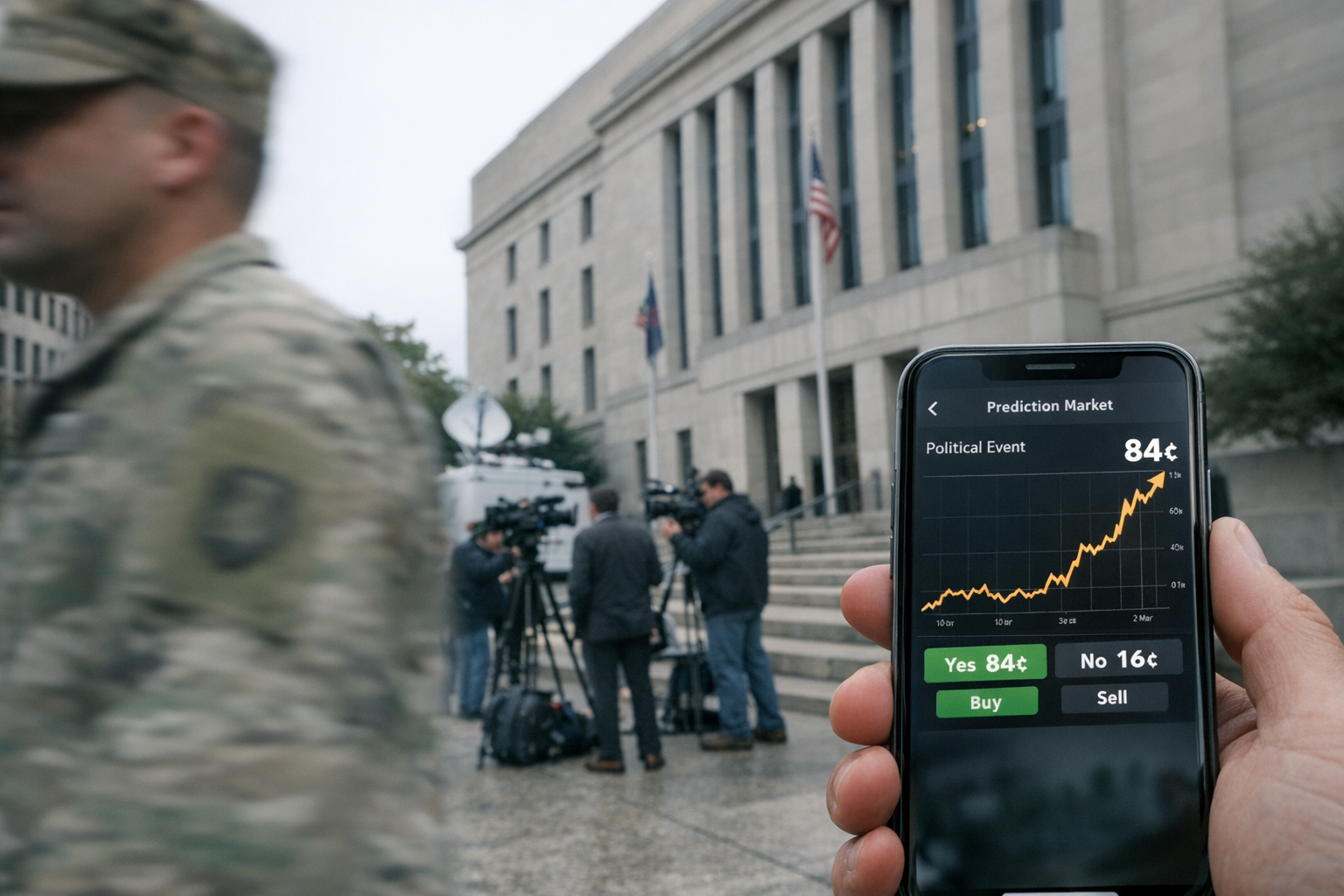
Federal prosecutors on Thursday accused a U.S. Army Special Forces soldier of turning secret knowledge of a mission to capture Venezuela’s president, Nicolás Maduro, into a lucrative betting strategy on a prediction market, a case that is rapidly becoming a landmark test of whether insider-trading principles can be applied to a fast-growing corner of online finance.
The soldier, Gannon Ken Van Dyke, was charged after investigators said he used classified, nonpublic information about “Operation Absolute Resolve,” the January 2026 operation that led to Mr. Maduro’s capture, to place a series of wagers on Polymarket. Prosecutors say he made more than $400,000 in profits.
The Justice Department unsealed the criminal case on April 23, the same day the Commodity Futures Trading Commission filed a parallel civil action. According to the C.F.T.C., Mr. Van Dyke bought more than 436,000 “Yes” shares in a contract asking whether Mr. Maduro would be out of office by Jan. 31, 2026. Those purchases were allegedly made between Dec. 30, 2025, and Jan. 2, 2026, after he had begun participating in planning for the operation.
Authorities say the soldier staked roughly $33,000 across 13 bets and converted that into about $404,000 in gains once the outcome became public.
The allegations are extraordinary on their own: a member of the military accused of profiting from a covert mission he helped prepare. But the case is also significant for what it may signal about the future of prediction markets, where users buy and sell contracts tied to real-world outcomes — elections, court rulings, wars, leadership changes — often with the same speed and speculative fervor found in more traditional markets.
A test case for prediction-market policing
Legal experts and regulators have long debated whether prediction markets are vulnerable to the same kinds of abuse seen in stocks, commodities and sports betting. The accusation against Mr. Van Dyke gives federal authorities a particularly stark example: a trader allegedly using government secrets, not market research or public analysis, to make money on an event contract.
That could make the case a first major U.S. enforcement action to apply insider-trading-style theories to prediction-market trading.
Unlike traditional securities markets, prediction platforms have operated in a murkier and evolving regulatory space. Some, including Kalshi, are regulated in the United States by the C.F.T.C. Others have faced tighter scrutiny over whether and how they may serve American users. As the industry has expanded, so too have concerns that markets tied to geopolitics, military action or elections may invite trading by people with direct, nonpublic knowledge of the outcome.
The Maduro case concentrates those fears into a single prosecution. If the government succeeds, it could provide regulators with a durable template for future cases involving event contracts, especially those touching national security or public office.
Growing unease in Washington
Concern in Washington had already been building before the charges were announced.
In a March 5 letter, Senators Jack Reed of Rhode Island and John Hickenlooper of Colorado urged the C.F.T.C. to investigate trading tied to military events, arguing that such markets posed both national-security dangers and basic market-integrity risks. Their warning reflected a broader unease that speculative contracts on conflict or state action could create incentives for manipulation, misuse of inside information, or the appearance that people with government access were profiting from events they could influence.
Platforms had also begun tightening their own rules. On March 23, Kalshi said it was expanding guardrails, including screening tools and pre-emptive blocks aimed at politicians, athletes and others seen as potentially conflicted participants in certain contracts. Polymarket’s U.S. terms, updated in March, explicitly prohibited trading on material nonpublic information and restricted some insiders from participating in certain political markets.
Those changes came amid a string of episodes that had already unsettled regulators and industry observers, including suspiciously well-timed bets on an Iran cease-fire and enforcement actions involving political candidates betting on their own races.
The allegations against Mr. Van Dyke are likely to intensify pressure on both companies and regulators to show that these markets can be policed before they become larger and more mainstream.
Why this case matters now
Prediction markets have increasingly been promoted by supporters as efficient tools for aggregating information — a way to turn dispersed beliefs into a price signal that can sometimes outperform pundits and polls. But that argument depends on the idea that prices reflect broad public knowledge and honest risk-taking, not privileged access to hidden facts.
The Van Dyke case strikes at that premise.
If traders with classified or otherwise material nonpublic information can quietly build positions in contracts tied to military action, diplomatic negotiations or political outcomes, then the markets may reward access over insight. That raises not only fairness questions but also practical ones for regulators: How should platforms identify insiders? Which categories of markets are too sensitive to permit at all? And who bears responsibility when suspicious trading appears before a major event?
For now, the Maduro case presents the clearest fact pattern imaginable for enforcement — a covert operation, a government insider and a direct financial payoff. What remains less certain is how broadly authorities will try to extend that logic. A military-intelligence case may be easier to prosecute than murkier situations involving campaign staff, corporate advisers, diplomats or people close to negotiations not formally classified but still nonpublic.
The answer could help determine whether this prosecution remains an outlier or becomes the foundation of a broader crackdown.
The broader stakes for the industry
The case arrives at a delicate moment for prediction markets, which have been seeking greater legitimacy even as they attract criticism for turning consequential public events into tradable bets. Their defenders argue that clear rules, surveillance and compliance systems can address abuse just as they do in other financial markets. Their critics say the products themselves create unique temptations, especially when the underlying events involve violence, governance or war.
The charges against Mr. Van Dyke are unlikely to settle that debate. But they do make it harder to dismiss concerns about insider misuse as hypothetical.
Federal prosecutors have not publicly indicated whether additional traders or any platform personnel are under scrutiny. Nor is it yet clear whether Congress or the C.F.T.C. will pursue broader market-wide standards instead of relying largely on platform rules and after-the-fact enforcement.
What is clear is that a market once marketed as a novel way to forecast the future is now confronting a more basic challenge: whether it can keep people from cashing in on secrets before the future arrives.
Sources
Further reading and reporting used to add context:
- https://apnews.com/article/74047663d9ae104127948896fdfb59d9
- https://www.axios.com/2026/04/23/us-soldier-arrested-maduro-bet-polymarket
- https://www.thedailybeast.com/soldier-who-nabbed-nicolas-maduro-for-donald-trump-arrested-after-betting-on-mission/
- https://techcrunch.com/2026/04/23/authorities-arrest-special-forces-soldier-who-allegedly-made-400k-on-polymarket-bet-involving-maduro-operation/
- https://www.washingtonpost.com/national-security/2026/04/23/polymarket-soldier-maduro-bet-charges/
- https://www.washingtonpost.com/national-security/2026/04/23/polymarket-soldier-maduro-bet-charges//
- https://www.pbs.org/newshour/nation/u-s-soldier-charged-with-using-classified-intel-to-win-more-than-400k-in-bet-on-maduro-raid
- https://www.japantimes.co.jp/news/2026/04/24/world/crime-legal/us-soldier-polymarket-classified-data/
- https://www.aljazeera.com/economy/2026/4/23/us-soldier-charged-with-using-polymarket-to-bet-on-nicolas-maduro-abduction
- https://www.venable.com/insights/publications/2026/04/kalshi-and-polymarket-move-to-curb-insider
- https://www.the-independent.com/bulletin/news/maduro-polymarket-bets-soldier-charged-b2964014.html
- https://www.cbsnews.com/news/u-s-special-forces-won-409k-bet-maduro-removal-venezuela/
- https://www.nwpb.org/npr-top-stories/2026-04-23/u-s-soldier-charged-with-using-classified-information-to-bet-on-maduros-removal
- https://www.forbes.com/sites/siladityaray/2026/04/24/soldier-charged-with-using-classified-intel-on-maduro-raid-to-win-400000-on-polymarket//
- https://www.wvia.org/news/2026-04-23/u-s-soldier-charged-with-suspected-polymarket-insider-trading-over-maduro-raid
- https://elpais.com/us/2026-04-24/un-soldado-que-participo-en-la-captura-de-maduro-imputado-tras-ganar-400000-dolares-en-apuestas-sobre-la-operacion.html
- https://en.wikipedia.org/wiki/Kalshi
- CFTC Charges U.S. Service Member with Insider Trading in Nicolás Maduro-Related Event Contracts | CFTC
- https://www.justice.gov/usao-sdny/pr/sdny-announces-recovery-hundreds-millions-dollars-victims-iran-sponsored-terrorism-0
- https://www.justice.gov/usao-ndca/pr/ten-foreign-nationals-charged-international-operation-targeting-cryptocurrency-market
- https://www.justice.gov/usao-edmo/pr/federal-grand-jury-criminal-indictments
- https://www.justice.gov/archive/usao/nys/pressreleases/index0409.html
- https://www.justice.gov/opa/pr/nicol-s-maduro-moros-and-14-current-and-former-venezuelan-officials-charged-narco-terrorism
- https://www.justice.gov/usao-nj/pr/former-commodities-trader-sentenced-151-months-engaging-multi-mullion-dollar-wire-and
- https://www.justice.gov/usao-ne/pr/six-more-defendants-charged-international-atm-jackpotting-scheme
- https://www.justice.gov/opa/pr/five-individuals-charged-2m-virtual-asset-and-securities-manipulation-scheme
- https://www.justice.gov/usao-sdfl/pr/fifteen-defendants-charged-operation-targeting-conversion-bulk-us-cash-proceeds-drug
- https://www.justice.gov/usao-sdny/senior-leadership
- https://www.justice.gov/usao-nj/pr/six-individuals-charged-41-million-insider-trading-and-market-manipulation-scheme
- https://www.cftc.gov/sites/default/files/filings/orgrules/26/03/rules03262642026.pdf
- https://www.cftc.gov/sites/default/files/filings/orgrules/26/03/rules03202641475.pdf
- https://www.cftc.gov/sites/default/files/filings/orgrules/26/01/rules01122636620.pdf
- https://www.cftc.gov/filings/orgrules/rules01162637349.pdf
- https://www.cftc.gov/sites/default/files/filings/orgrules/26/03/rules03262642051.pdf
- https://www.justice.gov/opa/media/1422326/dl
- https://www.justice.gov/usao-sdny/pr/sdny-announces-corporate-enforcement-and-voluntary-self-disclosure-and-cooperation
- https://www.justice.gov/usao-ndoh/pr/las-vegas-man-sentenced-prison-operating-sports-betting-ponzi-scheme-stole-more-85m
- https://www.justice.gov/usao-sdny/pr
- https://www.justice.gov/usao-sdny/pr/us-attorneys-office-sues-town-beekman-preventing-operation-sober-home
- https://www.justice.gov/opa/pr/maryland-man-indicted-unlawful-transmission-and-retention-classified-national-defense
- https://www.justice.gov/opa/pr/department-defense-employee-charged-unlawful-retention-classified-documents
- https://www.justice.gov/legal-careers/job/assistant-united-states-attorney-nys-financial-litigation
- https://www.justice.gov/usao-wdwa/pr/artist-who-falsely-claimed-native-american-heritage-sentenced-violations-indian-arts
- https://www.justice.gov/usao-md/pr/obgyn-physician-agrees-pay-507500-resolve-false-claims-act-allegations-connected
- https://www.justice.gov/usao-sdfl/pr/justice-department-secures-civil-forfeiture-over-20m-foreign-bribery-and-money
- https://www.justice.gov/opa/pr/justice-department-seeks-denaturalize-convicted-gun-trafficker
- https://www.justice.gov/usao-sdny/press-release/file/1261526/dl
- https://www.justice.gov/usao-edpa/media/1423601/dl?inline=
- https://www.justice.gov/multimedia/Court%20Records/United%20States%20v.%20Maxwell%2C%20No.%20120-cr-00330%20%28S.D.N.Y.%202020%29/244.pdf
- https://www.justice.gov/media/1385966/dl
- https://www.justice.gov/usao-sdny/press-release/file/1491266/dl
- https://www.axios.com/local/twin-cities/2026/04/22/kalshi-suspends-democratic-us-house-candidate-matt-klein-primary-race-bet
- https://apnews.com/article/37766ee2922615be1bf6fa193dee1f43
- https://www.bloomberg.com/news/articles/2026-03-23/polymarket-implements-new-insider-trading-rules-after-scrutiny
- https://www.theguardian.com/technology/2026/mar/24/kalshi-polymarket-insider-trading-regulation
- https://www.semafor.com/article/02/26/2026/kalshi-investigates-insider-trading-in-a-first-for-prediction-markets
- https://www.spglobal.com/market-intelligence/en/news-insights/research/2026/03/prediction-markets-create-insider-trading-loophole-as-enforcement-lags
- https://www.axios.com/2026/02/01/polymarket-kalshi-fake-news-misinformation
- https://finance.yahoo.com/markets/options/articles/polymarket-kalshi-insider-trading-scrutiny-204655409.html
- https://www.sportsbookreview.com/news/prediction-market-operators-tighten-insider-trading-march-25-2026/
- https://www.troutman.com/insights/polymarket-buckles-down-on-insider-trading-after-scrutiny-over-suspiciously-timed-bets/?pdf=display
- https://arxiv.org/abs/2604.07355
- https://en.wikipedia.org/wiki/Prediction_market
- https://en.wikipedia.org/wiki/Polymarket
- Letter to CFTC re Prediction Markets on War and Assassination 3.5.26
- https://qnbgroup.qa/sites/qnb/qnbfs/document/en/enDMR30March2026
- https://help.polymarket.com/en/articles/13364264-is-polymarket-the-house
- https://polymarket.com/hi/event/which-crypto-company-will-zachxbt-expose-for-insider-trading/will-company-a-be-accused-of-insider-trading
- https://help.polymarket.com/en/articles/13364060-what-is-polymarket
- https://polymarket.com/tr/event/which-crypto-company-will-zachxbt-expose-for-insider-trading/will-aave-be-accused-of-insider-trading
- https://polymarket.com/event/white-house-of-tweets-march-24-march-31-2026
- https://help.polymarket.com/en/articles/13364481-does-polymarket-have-trading-limits
- https://polymarket.com/id/event/which-crypto-company-will-zachxbt-expose-for-insider-trading/will-world-liberty-financial-be-accused-of-insider-trading
- https://polymarket.com/uk/event/which-crypto-company-will-zachxbt-expose-for-insider-trading/will-binance-be-accused-of-insider-trading
- https://polymarket.com/event/white-house-of-tweets-march-17-march-24-2026
- https://polymarket.com/event/white-house-of-tweets-march-17-march-24-2026/white-house-of-tweets-march-17-march-24-2026-120-139
- https://polymarket.com/event/nothing-ever-happens-march
- https://help.polymarket.com/en/articles/13364478-trading-fees
- https://news.kalshi.com/p/kalshi-new-guardrails-insider-trading-politics-sports
- https://news.kalshi.com/p/kalshi-trading-violation-enforcement-cases
- https://news.kalshi.com/p/kalshi-political-insider-trading-enforcement-update
- https://help.kalshi.com/en/articles/13823807-what-are-trading-hours
- https://news.kalshi.com/p/kalshi-surveillance-insider-trading-prevention
- https://help.kalshi.com/en/articles/13823788-trading-break
- https://help.kalshi.com/en/articles/13823785-can-finance-professionals-trade-on-kalshi
- https://news.kalshi.com/p/how-kalshi-keeps-traders-safe
- https://kalshi.com/docs/bracket-challenge/OFFICIAL_RULES.pdf
- https://help.kalshi.com/en/articles/13823765-how-is-kalshi-regulated
- https://help.kalshi.com/en/articles/13823821-market-faqs
- https://news.kalshi.com/p/what-is-kalshi-f573
- https://help.kalshi.com/markets/markets-101/market-rules
- https://kalshi.com/docs/kalshi-member-agreement.pdf
- CFTC Charges U.S. Service Member with Insider Trading in Nicolás Maduro-Related Event Contracts | CFTC
- New guardrails to prevent insider trading and manipulation in politics and sports
- US soldier charged with using classified intel to win $400K Polymarket bet on Maduro raid