
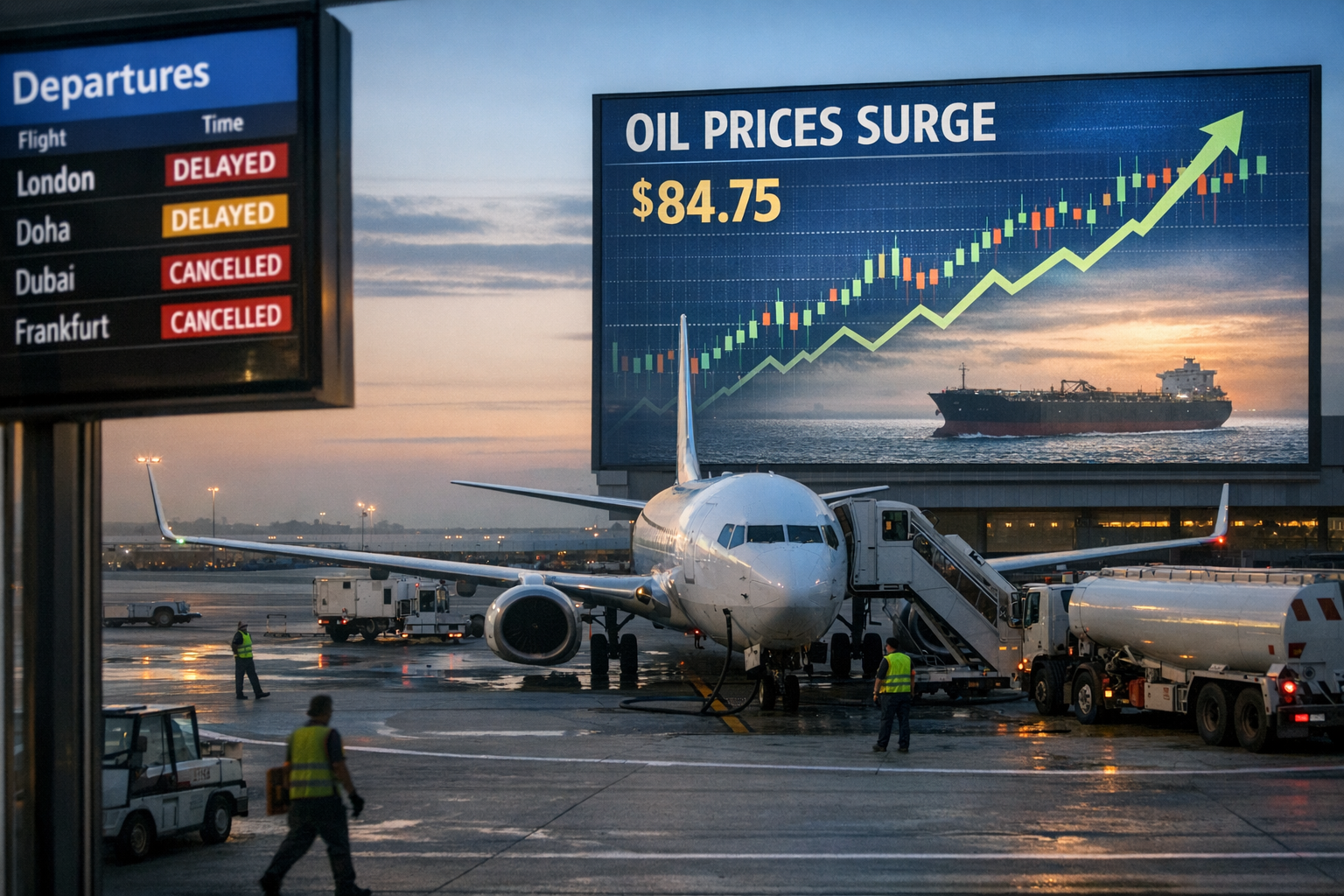
Oil and aviation are rattled as Israel-Iran fighting resumes
Oil prices surged on Monday and the airline industry warned of a deeper profit squeeze after Israel and Iran resumed exchanging strikes, shattering a fragile lull and reviving fears that a conflict already nearing 100 days could spill further across the Middle East’s most critical energy routes.
Brent crude climbed about 4.3 percent to roughly $97 a barrel, while West Texas Intermediate rose by a similar amount to around $94, as traders reacted to the first direct exchange between Israel and Iran since an April 8 cease-fire. The renewed fighting immediately sharpened concerns that disruptions around the Strait of Hormuz — one of the world’s most important oil arteries — could persist or worsen.
The shock was felt far beyond crude markets. Airlines, already struggling with sharply higher fuel bills, said the latest jump in energy prices threatened to push costs still higher in an industry where profits are notoriously thin and price increases are difficult to pass on without hurting demand.
The International Air Transport Association now expects the global airline industry’s net profit to fall to $23 billion in 2026, roughly half last year’s level. Fuel costs alone are projected to rise to $350 billion, up from $252 billion in 2025, with jet fuel expected to average $152 a barrel — nearly 70 percent higher than a year earlier.
“The big unknown,” Willie Walsh, IATA’s director general, said in discussing the outlook, “is how long travelers and shippers can tolerate the higher costs.”
Chokepoints return to the center of the market’s fears
At the heart of the latest market stress is not simply the fighting itself, but where it is taking place.
Roughly one-fifth of the world’s oil and liquefied natural gas supply normally passes through the Strait of Hormuz, the narrow waterway between Iran and Oman that connects the Persian Gulf to global markets. Even the possibility of tighter restrictions, delays to tanker traffic or military miscalculation there can send prices sharply higher.
Now traders are also weighing the risk of disruption farther west. Renewed threats by Iran-backed Houthi forces against shipping near the Bab el-Mandeb Strait, at the southern entrance to the Red Sea, have added another layer of vulnerability. That passage is a vital route for oil and goods moving toward the Suez Canal and Europe. If attacks intensify there, the market could face a second choke point under pressure at the same time.
That dual threat has made investors especially sensitive to every sign that the conflict may broaden. Oil had already remained well above prewar levels during the months of fighting, even as diplomats searched unsuccessfully for a more durable settlement. Monday’s strikes suggested to markets that the confrontation had entered a more dangerous phase.
Airlines face a familiar crisis, but with less room for error
For aviation executives, the return of hostilities has reinforced a bleak arithmetic: every sustained move upward in oil prices is quickly reflected in jet fuel, one of the largest costs for carriers.
The industry has tried to project calm. Airline leaders gathering in Rio de Janeiro for IATA’s annual meeting have emphasized that planes are still flying and that the direst predictions of immediate fuel shortages have not yet materialized. But behind that confidence is a growing recognition that a prolonged period of expensive fuel could reshape the year’s finances.
Airlines have some tools to cushion the blow, including fuel hedging, route changes and higher fares. But those defenses are unevenly available, and they come with limits. Many carriers, especially in competitive leisure markets, cannot raise prices indefinitely without deterring travelers. Cargo operators face similar pressure as shippers look for cheaper alternatives when transport costs rise.
That leaves the sector exposed to a narrow and uncomfortable margin. Even in stronger years, airlines tend to generate modest profits relative to their revenue base. A large jump in fuel spending can erase gains quickly.
The result for passengers is likely to be gradual rather than sudden: higher ticket prices, tighter capacity on some routes and greater pressure on airlines to trim costs elsewhere.
Why this matters now
The renewed strikes have landed at a moment when the global economy was already contending with persistent geopolitical risk and fragile confidence in energy markets.
For consumers and businesses, higher oil prices can feed into transportation, shipping and manufacturing costs, potentially pushing up inflation just as many central banks have been trying to keep price pressures in check. For airlines, the effect is more immediate and direct, because jet fuel costs cannot be avoided and demand can weaken quickly if fares rise too far.
The next question is whether Monday’s flare-up proves brief or marks the start of a sustained new escalation. Markets are watching three things in particular: whether Israel and Iran continue trading strikes; whether movement through Hormuz eases or tightens; and whether the Houthis translate threats in the Red Sea into more aggressive action around Bab el-Mandeb.
If those risks intensify, oil could rise further, deepening the strain on airlines and broadening the economic fallout. If they ease, some of Monday’s spike may reverse. For now, though, the latest fighting has delivered a clear message to markets: after months of war, the Middle East’s energy and transport lifelines remain acutely exposed.
Sources
Further reading and reporting used to add context:
- https://apnews.com/article/c16dc4917512f7436a3921a4b044b98b
- https://apnews.com/article/a4b9336d67a15d19d9aa5394e5a30be6
- https://www.axios.com/2026/06/03/economic-outlook-oecd-iran
- https://www.axios.com/2026/06/04/oil-iran-boston-fed-research
- https://www.axios.com/2026/06/04/iran-oil-prices-market-less-impact
- IATA – Middle East Disruptions and High Fuel Prices Halve Airline Industry Profitability
- https://www.brecorder.com/news/40424486/oil-prices-climb-more-than-4-after-israeli-strikes-on-iran-and-lebanon
- https://www.theguardian.com/business/2026/jun/07/air-fare-rises-inevitable-as-airlines-face-extra-100bn-jet-fuel-bill-this-year
- https://www.aljazeera.com/news/2026/6/7/by-the-numbers-100-days-of-the-us-israel-war-on-iran
- https://www.investing.com/news/commodities-news/oil-prices-rise-more-than-2-on-israel-strikes-on-lebanon-4729704
- https://www.riotimesonline.com/airline-profits-2026-halve-fuel-iata-rio-2026/
- Oil prices climb more than $4 after Israeli strikes on Iran and Lebanon
- https://ca.investing.com/news/commodities-news/oil-prices-rise-as-new-middle-east-hostilities-flare-and-talks-stall-4672687
- https://www.forexfactory.com/news/1402325-100-days-of-the-iran-war-how-global
- https://www.investing.com/news/commodities-news/oil-jumps-as-usiran-conflict-escalates-disrupts-shipping-4533568
- https://www.investing.com/news/economy-news/two-months-into-iran-war-economic-strain-mounts-across-emerging-markets-4638518
- https://www.investing.com/news/economy-news/analysisiran-war-volatility-strains-trading-in-worlds-biggest-markets-4586655
- https://netzender.com/irans-threats-against-this-red-sea-choke-point-are-a-big-vulnerability-for-the-oil-market
- https://www.lloydslistintelligence.com/resources/blog/waves-of-houthi-attacks-fail-to-dent-daily-transits-through-bab-el-mandeb-chokepoint
- https://www.axios.com/2026/03/30/iran-war-houthis-yemen-red-sea
- https://www.investing.com/news/commodities-news/explainerwhy-is-it-so-easy-for-iran-to-shut-the-strait-of-hormuz-4560576
- https://www.internazionale.it/ultime-notizie-reuters/2026/06/01/iran-is-stopping-message-exchanges-with-u-s-may-block-hormuz-tasnim-news-agency-says
- https://www.investing.com/news/commodities-news/factboxenergy-facilities-and-shipping-hit-during-usisraeli-war-on-iran-4601106
- https://apnews.com/article/0f919596403d2f851196451f4532717e
- https://www.lemonde.fr/en/opinion/article/2026/04/14/the-strait-of-hormuz-crisis-shows-that-the-seas-are-no-longer-spaces-of-freedom-but-territories-whose-control-comes-at-a-price_6752418_23.html
- https://abcnews.com/amp/International/options-dwindle-oil-middle-east-bab-el-mandeb/story?id=131546139
- https://ca.investing.com/news/commodities-news/iran-is-stopping-message-exchanges-with-us-may-block-hormuz-tasnim-news-agency-says-4669143
- https://time.com/article/2026/04/08/bab-el-mandeb-strait-iran-houthis-threat-trade-hormuz-war-ceasefire/?amp=true%5C
- https://time.com/article/2026/04/08/bab-el-mandeb-strait-iran-houthis-threat-trade-hormuz-war-ceasefire/
- https://pgjonline.com/news/2026/march/oil-lng-supply-at-risk-as-hormuz-disruptions-threaten-global-flows
- https://ca.investing.com/news/commodities-news/oil-falls-after-trump-says-us-would-help-free-ships-stranded-in-strait-of-hormuz-4605161
- https://ca.investing.com/news/commodities-news/russias-sechin-says-us-companies-benefit-from-strait-of-hormuz-closure-4678821