
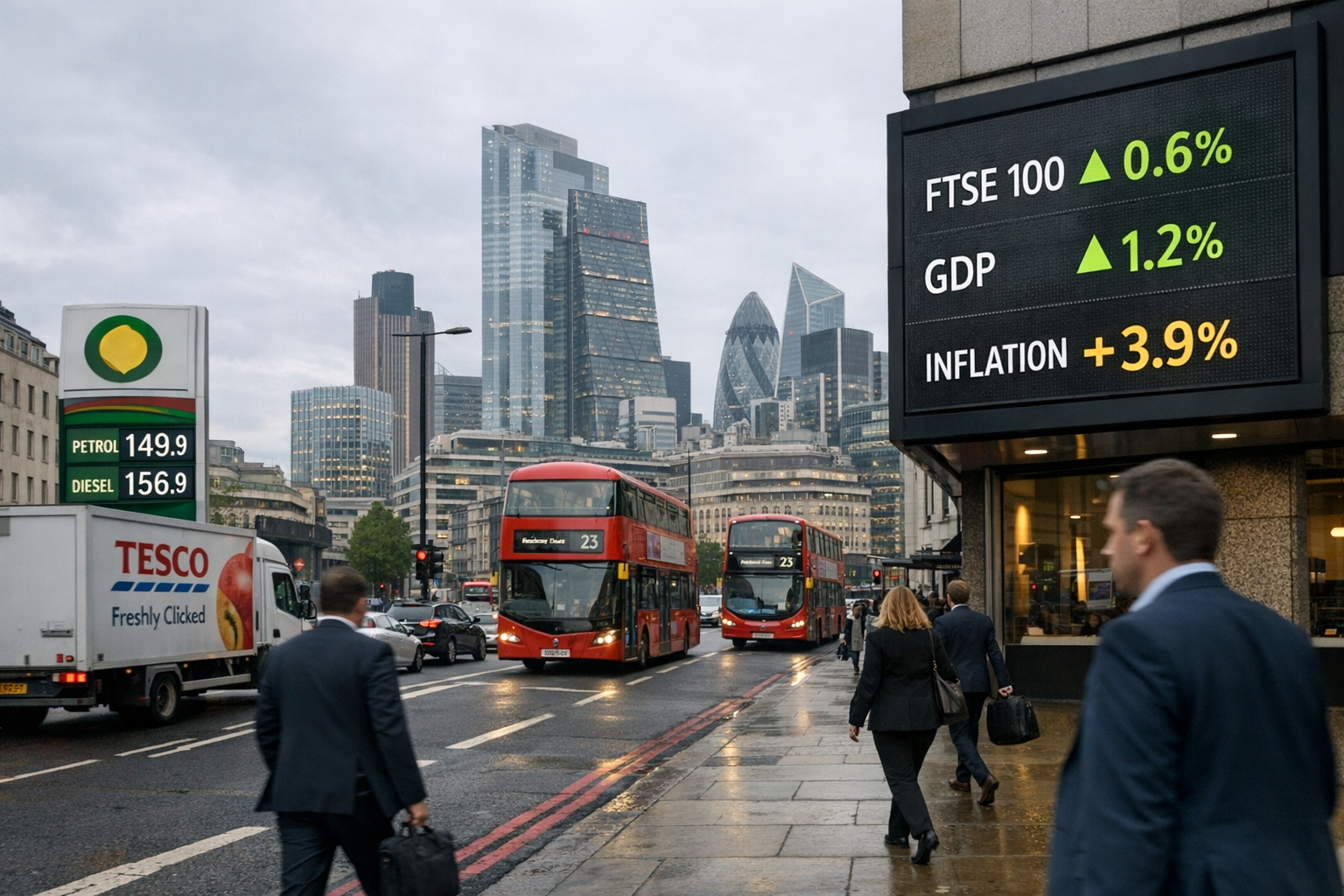
A Stronger February, and a Darker Spring
Britain’s economy grew far faster than expected in February, offering an encouraging sign that momentum had begun to build before war in the Middle East clouded the outlook and revived fears of a fresh squeeze on households and businesses.
Official figures released on Wednesday showed gross domestic product rose 0.5 percent in February from the previous month, well above economists’ forecasts of 0.1 percent. January’s reading was also revised up, to 0.1 percent growth from flat. Services, production and construction all contributed to the increase, according to the Office for National Statistics.
The data suggested that, at least through much of February, the economy was in better shape than many analysts had assumed after a long stretch of weak growth. For a government that has made economic expansion its central political test, the figures were a welcome reprieve.
But the relief was quickly tempered by a stark caveat: the O.N.S. said the numbers cover the period before the conflict with Iran began on Feb. 28, meaning they do not reflect the shock that has since spread through energy markets, trade routes and business confidence.
A Recovery Threatened by War
That timing is now central to the debate over Britain’s economic prospects. Chancellor Rachel Reeves called for immediate de-escalation, warning that an extended conflict, or further disruption in the Strait of Hormuz, could damage energy security, snarl supply chains and unsettle financial markets.
Her concerns are increasingly being echoed in the private sector. Tesco, Britain’s largest supermarket chain, said annual profits had risen 8.5 percent to £2.4 billion, but cautioned that profits could come under pressure in the coming year because of the uncertainty created by the Middle East conflict.
The juxtaposition — stronger output before the war, rising anxiety after it — captures the bind facing Britain. The country entered the spring with signs of improving activity, only to confront a shock that could simultaneously restrain growth and push up prices.
Economists describe that combination as a negative supply shock. In practical terms, it means businesses may face higher shipping, fuel and input costs at the same time consumers are hit with dearer energy, food and transport. It also complicates the task of the Bank of England, which may find it harder to cut interest rates quickly if inflation risks intensify again.
Why the Numbers Matter
The February data matter partly because they suggest the economy had more underlying momentum than bleak sentiment had implied. Britain has struggled to generate sustained growth, and even before the latest conflict, the official outlook was subdued.
In March, the Office for Budget Responsibility cut its forecast for 2026 growth to 1.1 percent. The Bank of England had also been projecting only a modest expansion. Then, this week, the International Monetary Fund said the conflict had darkened the outlook further, reducing its forecast for British growth in 2026 to 0.8 percent and identifying the country as among the advanced economies more exposed because of its dependence on imported energy.
The Bank of England’s Financial Policy Committee has described the conflict as a “substantial negative supply shock” to the global economy, underscoring the risk that Britain could face a familiar and politically painful mix of stagnation and inflation.
That is why an apparently backward-looking monthly growth figure has taken on outsized importance. It offers evidence that the economy was not flatlining before the latest crisis. But it also may represent the high-water mark before a more difficult period.
The Risks Ahead
Much now depends on whether the disruption proves short-lived or persistent. If energy prices stabilize and shipping routes recover quickly, the damage could be limited. But if fighting drags on and the Strait of Hormuz remains under threat, the effects could ripple through fuel costs, supermarket prices, industrial production and borrowing conditions.
The I.M.F.’s latest forecasts assume only a relatively moderate rise in energy prices and a conflict that does not worsen substantially. A more severe scenario would almost certainly mean weaker growth and higher inflation than policymakers are now preparing for.
There are also pressing domestic questions. It remains unclear whether February’s strength carried into March, whether businesses will delay investment and hiring, and whether the government may eventually need to provide more targeted support if rising costs begin to hit consumers and companies more broadly.
For now, Britain has been handed a rare piece of good economic news — but one that already looks fragile. The latest figures showed an economy with signs of life. The weeks since have raised the possibility that any recovery could again be tested by forces far beyond its shores.
Sources
Further reading and reporting used to add context:
- https://www.gov.uk/government/statistics/announcements/gdp-monthly-estimate-uk-february-2026-time-series
- https://www.gov.uk/government/statistics/forecasts-for-the-uk-economy-february-2026
- https://uk.finance.yahoo.com/news/rachel-reeves-warns-significant-economic-125905834.html/
- https://www.independent.co.uk/news/business/scott-bessent-iran-rachel-reeves-keir-starmer-chancellor-b2958250.html
- https://www.theguardian.com/business/live/2026/mar/03/spring-forecast-rachel-reeves-statement-economic-plan-obr-oil-gas-stock-markets-live-updates?page=with%3Ablock-69a71f7f8f085ed1e38a49a7
- https://apnews.com/article/b0651ac8156e88b6953283edd2e4f8e7
- https://www.bankofengland.co.uk/monetary-policy-report/2026/february-2026
- https://www.ons.gov.uk/economy/grossdomesticproductgdp/bulletins/gdpmonthlyestimateuk/january2026
- https://www.cnbc.com/2025/04/11/uk-gdp-february-2025.html
- https://uk.investing.com/news/economy-news/uk-finance-minister-says-too-early-to-assess-iran-conflict-impact-on-economy-4552310
- https://www.ukfinance.org.uk/data-and-research/economic-insight/monthly-economic-review-march-2026
- https://www.theguardian.com/business/live/2026/apr/14/iran-war-hurting-global-economic-growth-imf-meeting-rachel-reeves-oil-price-stock-markets-latest-updates
- https://www.bloomberg.com/news/articles/2026-03-11/reeves-says-unwise-to-speculate-on-uk-impact-of-iran-war
- https://moneyweek.com/economy/inflation/uk-inflation-january-2026
- https://moneyweek.com/economy/uk-economy/uk-gdp-latest
- https://www.london.gov.uk/sites/default/files/2026-02/londons_economy_today_no282_260226.pdf
- https://researchbriefings.files.parliament.uk/documents/SN02783/SN02783.pdf
- https://en.wikipedia.org/wiki/2026_in_the_United_Kingdom
- https://en.wikipedia.org/wiki/2026_Iran_war
- https://researchbriefings.files.parliament.uk/documents/CBP-9040/CBP-9040.pdf
- https://en.wikipedia.org/wiki/Economy_of_the_United_Kingdom
- https://cdn.financialreports.eu/financialreports/media/filings/6230/2026/RNS/6230_rns_2026-04-02_ae48cea8-0607-4700-8d11-9f0e188994fb.pdf
- https://moneyweek.com/personal-finance/mortgages/mortgage-higher-costs-support-rachel-reeves
- https://apnews.com/article/3c62028a8c0ecaf22ab6a0921d051d20
- https://apnews.com/article/b5d922874c1e817cc66698df635530b8
- https://www.theguardian.com/politics/2025/jun/23/rachel-reeves-middle-east-oil-price-industrial-strategy
- https://en.wikipedia.org/wiki/2026_Kharg_Island_attack
- https://en.wikipedia.org/wiki/2026_Iran_war_fuel_crisis
- https://committees.parliament.uk/oralevidence/17302/html/
- https://en.wikipedia.org/wiki/Naval_blockade_of_Iran
- https://www.theguardian.com/uk-news/2026/mar/03/rachel-reeves-middle-east-obr-spring-forecast
- https://www.gov.uk/government/news/reeves-i-will-always-act-to-defend-british-interests
- https://en.wikipedia.org/wiki/2026_Strait_of_Hormuz_crisis
- https://www.europeans.today/2026/03/03/conflict-in-the-middle-east-makes-official-economic-forecasts-immediately-out-of-date/
- https://m.investing.com/news/economy-news/uks-reeves-says-too-early-to-assess-middle-east-conflicts-economic-impact-93CH-4554010?ampMode=1
- https://en.wikipedia.org/wiki/Economic_impact_of_the_2026_Iran_war
- https://hansard.parliament.uk/commons/2026-03-09/debates/5DA573C7-B4B0-462E-BD48-EFAE52E3FCCA/MiddleEastEconomicUpdate
- https://s203.q4cdn.com/450659508/files/doc_financials/2025/q1/22add136-5bbc-4322-9ce4-962016580ef1.pdf
- https://hansard.parliament.uk/Commons/2026-03-24/debates/DCD105CF-8C8D-4630-A54E-EDFDE38AD54F/MiddleEastEconomicUpdate
- https://www.tescoplc.com/preliminary-results-202425/
- https://www.tescoplc.com/tesco-announces-180m-investment-in-colleague-pay/
- https://www.tescoplc.com/interim-results-trading-statement-202526/
- https://www.tescoplc.com/protondx-crowned-winner-of-the-2025-tesco-agri-t-jam-innovation-challenge/
- https://www.tescoplc.com/media/owobgr2m/tesco-plc-interim-results-2526-press-release.pdf
- https://www.tescoplc.com/tesco-invests-in-christmas-vegetable-price-cuts/
- https://www.tescoplc.com/preliminary-results-202223/
- https://www.tescoplc.com/news/2024/preliminary-results-202324/
- https://www.rns-pdf.londonstockexchange.com/rns/6755K_2-2025-12-8.pdf
- https://www.tescoplc.com/investors/financial-calendar/
- https://www.tescoplc.com/tesco-announces-a-multi-million-pound-investment-to-future-proof-its-growing-store-network/
- https://bank.tescoplc.com/tesco-celebrates-milestone-of-500th-electric-customer-home-delivery-van/
- https://www.rns-pdf.londonstockexchange.com/rns/3973V_1-2026-3-4.pdf
- https://bank.tescoplc.com/tesco-cuts-price-of-more-than-500-key-products-including-fruit-veg-tuna-and-rice/
- https://www.tescoplc.com/media/mxfjrk4x/tesco-plc-preliminary-results-2425-press-release.pdf
- https://www.rns-pdf.londonstockexchange.com/rns/1665Y_1-2026-3-25.pdf
- https://www.rns-pdf.londonstockexchange.com/rns/3436N_1-2025-6-18.pdf
- https://bank.tescoplc.com/tesco-pledges-1-500-stronger-starts-apprenticeship-places-to-support-england-s-young-workforce/
- https://www.lemonde.fr/en/economy/article/2026/04/14/middle-east-war-weakens-luxury-industry_6752406_19.html
- https://uk.finance.yahoo.com/news/retail-sales-tepid-middle-east-230100715.html
- https://www.thestar.com.my/news/world/2026/03/28/finland-consumer-confidence-drops-to-near-two-year-low-amid-mideast-tensions
- https://www.sahmcapital.com/news/content/update-1-sika-dampens-sales-expectations-due-to-middle-east-conflict-2026-03-24
- https://www.mnb.hu/letoltes/eng-ir-digitalis-31.pdf
- https://uk.finance.yahoo.com/news/inflation-spotlight-tesco-disclose-latest-140024067.html/
- https://whtc.com/2026/03/27/european-shares-fell-amid-uncertainty-over-mideast-war/
- https://kuwaittimes.com/uploads/pdf/2026/03/15/kt_pdf-20260315-1.pdf
- https://www.abnamro.com/research/en/our-research/eurozone-pmis-show-economy-moving-above-neutral-mark-at-start-of-q2
- https://evrimagaci.org/gpt/tesco-shares-surge-amid-supply-chain-concerns-536464
- https://finance.yahoo.com/news/tesco-grows-fy-2024-25-115115740.html
- https://www.bankaustria.at/files/halbjahresfinanzbericht_2025_en.pdf
- https://uk.marketscreener.com/news/doubts-over-middle-east-peace-continue-to-weigh-on-equity-markets-ce7e51d9d88afe25
- https://thepeninsulaqatar.com/pdf/20260329_1774732776-464.pdf
- https://www.nasdaq.com/articles/european-markets-fall-middle-east-tensions-escalate
- https://www.openpr.com/news/3539900/what-the-conflict-in-the-red-sea-spells-for-global-shipping
- https://www.ons.gov.uk/economy/grossdomesticproductgdp/bulletins/gdpmonthlyestimateuk/december2025
- https://www.ons.gov.uk/economy/grossdomesticproductgdp/bulletins/gdpmonthlyestimateuk/march2025
- https://www.ons.gov.uk/economy/grossdomesticproductgdp/bulletins/gdpmonthlyestimateuk/november2025
- https://www.ons.gov.uk/releases/gdpmonthlyestimateukmarch2026
- https://www.ons.gov.uk/economy/grossdomesticproductgdp/bulletins/gdpmonthlyestimateuk/february2025
- https://www.ons.gov.uk/economy/grossdomesticproductgdp/bulletins/gdpfirstquarterlyestimateuk/octobertodecember2025
- https://www.ons.gov.uk/economy/grossdomesticproductgdp
- https://www.ons.gov.uk/economy/grossdomesticproductgdp/bulletins/gdpmonthlyestimateuk/january2025
- https://www.ons.gov.uk/economy/grossdomesticproductgdp/bulletins/gdpmonthlyestimateuk/october2025
- https://www.ons.gov.uk/economy/grossdomesticproductgdp/bulletins/quarterlynationalaccounts/latest
- https://www.ons.gov.uk/economy/economicoutputandproductivity/output/bulletins/economicactivityandsocialchangeintheukrealtimeindicators/26february2026
- https://www.ons.gov.uk/economy/grossdomesticproductgdp/bulletins/gdpmonthlyestimateuk/february2025/pdf
- https://www.ons.gov.uk/economy/grossdomesticproductgdp/bulletins/gdpmonthlyestimateuk/march2025/pdf
- https://www.ons.gov.uk/economy/grossdomesticproductgdp/bulletins/gdpmonthlyestimateuk/january2026/pdf
- https://www.ons.gov.uk/economy/nationalaccounts/uksectoraccounts/articles/quarterlyeconomiccommentary/octobertodecember2025/pdf
- https://www.ons.gov.uk/economy/grossdomesticproductgdp/bulletins/gdpfirstquarterlyestimateuk/octobertodecember2025/pdf
- https://www.ons.gov.uk/economy/grossdomesticproductgdp/bulletins/gdpmonthlyestimateuk/december2025/pdf
- https://www.ons.gov.uk/releases/gdpmonthlyestimateukfebruary2025
- https://www.ons.gov.uk/economy/grossdomesticproductgdp/bulletins/gdpmonthlyestimateuk/april2025
- https://www.ons.gov.uk/economy/grossdomesticproductgdp/bulletins/gdpfirstquarterlyestimateuk/januarytomarch2025
- https://www.ons.gov.uk/releases/gdpmonthlyestimateukapril2025
- https://www.ons.gov.uk/releases/gdpmonthlyestimateukfebruary2025timeseries
- https://www.ons.gov.uk/datasets/gdp-to-four-decimal-places
- https://backup.ons.gov.uk/wp-content/uploads/sites/3/2025/05/GDP-monthly-estimate-UK-March-2025.pdf
- https://www.ons.gov.uk/economy/grossdomesticproductgdp/bulletins/gdpmonthlyestimateuk/january2025/pdf
- https://www.theguardian.com/politics/2026/apr/15/rachel-reeves-donald-trump-iran-war-uk-us
- https://www.theguardian.com/business/live/2026/apr/14/iran-war-hurting-global-economic-growth-imf-meeting-rachel-reeves-oil-price-stock-markets-latest-updates?page=with%3Ablock-69de2e5e8f08dd62b7029cff
- https://asiatimes.com/2026/04/imf-warns-trumps-iran-war-could-unleash-global-recession/
- https://apnews.com/article/0e37b712aee645d20af5b79acd207ddf
- https://www.standard.co.uk/news/politics/energy-bills-gas-electricity-oil-iran-war-donald-trump-b1273378.html
- https://www.cnbc.com/2025/03/06/us-will-collapse-irans-economy-by-shutting-down-its-oil-industry-treasury-secretary-says.html
- https://www.theguardian.com/politics/live/2026/apr/01/keir-starmer-rachel-reeves-iran-energy-bills-supermarket-cost-of-living-uk-politics-latest-news-updates?filterKeyEvents=false&page=with%3Ablock-69cd32df8f083e12572a7e68
- https://www.washingtonpost.com/politics/2026/04/03/trump-iran-midterms-gas-prices/
- https://www.lemonde.fr/en/international/article/2026/02/28/france-germany-uk-s-balancing-act-in-response-to-us-israeli-offensive-against-iran_6750969_4.html
- https://uk.news.yahoo.com/chancellor-warns-iran-conflict-likely-084102214.html
- https://www.businessday.co.za/world/americas/2026-04-15-under-pressure-finance-ministers-call-for-full-iran-war-ceasefire/
- https://www.independent.co.uk/bulletin/news/reeves-trump-us-iran-war-b2957524.html
- https://www.scribd.com/document/1015327104/The-Independent-16-March-2026
- https://apnews.com/article/2595edb52849560135f352ca5746ed85
- https://www.imf.org/en/news/articles/2026/04/13/pr26117-joint-statement-by-the-heads-iea-imf-wbg
- https://apnews.com/article/7643ff47d58f2a1d6314dae0f0a455bd
- https://www.theguardian.com/business/live/2026/apr/15/stock-markets-iran-war-peace-deal-reeves-bessent-imf-business-latest-news-updates?filterKeyEvents=false&page=with%3Ablock-69dfad988f08259d9396208d
- https://www.gov.uk/government/news/joint-statement-by-chancellor-of-the-exchequer-rachel-reeves-and-spanish-minister-of-economy-trade-enterprise-carlos-cuerpo-caballero
- https://www.mfa.gov.tr/joint-statement-issued-by-the-consultative-ministerial-meeting-of-foreign-ministers-of-the-group-of-arab-and-islamic-countries-on-iranian-aggressions-19-march-2026.en.mfa
- https://www.gov.uk/government/news/joint-e3-leaders-statement-on-iran-1-march-2026
- https://nationaltoday.com/us/dc/washington/news/2026/04/12/global-finance-leaders-grapple-with-economic-fallout-from-iran-war/
- https://www.dawn.com/news/1976395/imf-chief-says-rapid-recovery-of-gobal-economy-still-possible-if-war-ends-in-two-weeks
- https://www.mofa.go.jp/fp/pc/pageite_000001_00016.html
- https://www.gov.uk/government/publications/uk-india-13th-economic-and-financial-dialogue-joint-statement/joint-statement-13th-india-uk-economic-and-financial-dialogue
- https://en.wikipedia.org/wiki/2025%E2%80%932026_Iran%E2%80%93United_States_negotiations
- https://en.wikipedia.org/wiki/Iran_Prosperity_Project
- https://www.axios.com/2026/04/15/iran-war-imf-world-bank
- https://apnews.com/article/e3d8a239509abb50757f8c8d42fb32d8
- https://apnews.com/article/f70405a5ef0526371bd7b577b13c4796
- https://moneyweek.com/economy/uk-economy/growth-downgrade-uk-iran-war-imf
- https://www.axios.com/2026/04/14/imf-iran-inflation-economy
- https://www.axios.com/2026/04/14/iran-war-global-economic-growth-damage-forecast
- https://www.theguardian.com/business/live/2026/apr/14/iran-war-hurting-global-economic-growth-imf-meeting-rachel-reeves-oil-price-stock-markets-latest-updates?page=with%3Ablock-69de4d788f08dc6e5aa27f30
- EFOs – Office for Budget Responsibility
- https://uk.finance.yahoo.com/news/imf-head-says-global-growth-outlook-is-lower-due-to-war-in-iran-142300705.html/
- https://www.theguardian.com/business/live/2026/mar/03/spring-forecast-rachel-reeves-statement-economic-plan-obr-oil-gas-stock-markets-live-updates?page=with%3Ablock-69a6dddb8f08619ce36bf228
- https://www.aljazeera.com/economy/2026/4/14/imf-cuts-global-growth-forecast-during-hormuz-blockade
- https://mediacenter.imf.org/news/imf—3q-world-economic-outlook/s/ec9072f8-6904-4e8a-8d1b-a87030e587cc
- https://www.geraldedelman.com/insights/spring-forecast-summary/
- https://www.washingtonpost.com/business/2026/04/14/imf-global-economic-forecast-war//
- https://www.gov.uk/government/news/spring-forecast-2026-the-right-economic-plan-for-britain
- https://www.imf.org/en/publications/weo/issues/2026/04/14/world-economic-outlook-april-2026
- https://obr.uk/efo/economic-and-fiscal-outlook-november-2025/
- https://www.cbi.org.uk/articles/business-briefing-the-2026-spring-statement/
- https://assets.publishing.service.gov.uk/media/69a6d7b62e1f4fbda4252208/economic-and-fiscal-outlook-march-2026-web-accessible.pdf
- https://www.theeiu.org/upload/reports/2026/03%20Mar/Dudley_Economic_Monitor.pdf
- https://www.imf.org/-/media/Files/Publications/WEO/2025/April/English/text.ashx
- https://www.tescoplc.com/preliminary-results-202324/
- https://www.tescoplc.com/interims2024
- https://www.tescoplc.com/tesco-mobile-extends-eu-roaming-offer-to-2026/
- https://www.tescoplc.com/tesco-continues-to-strengthen-its-scottish-sourcing-credentials-with-100-scotch-beef-and-salmon-in-scottish-stores-by-spring-2026/
- https://www.tescoplc.com/media/f1pf1fvi/25-06-12-tesco-plc-q1-trading-statement-2526.pdf
- https://www.tescoplc.com/tesco-thanks-armed-forces-with-free-breakfasts-1/
- https://www.tescoplc.com/tesco-reveals-top-nostalgic-90s-treats-to-celebrate-30-years-of-clubcard/
- https://www.tescoplc.com/media/hkjbexki/prelims-fy-2425-slide-master_for-website_v2.pdf
- https://www.tescoplc.com/preliminary-results-202021/
- https://www.tescoplc.com/media/jkya4eia/tesco-plc-preliminary-results-2425-webcast-transcript.pdf
- https://www.tescoplc.com/tesco-stores-welcome-students-as-part-of-prince-s-trust-achieve-initiative/
- https://apnews.com/article/917584878bbdc8d19dc6bc55c8509556
- https://www.theguardian.com/business/live/2026/apr/14/iran-war-hurting-global-economic-growth-imf-meeting-rachel-reeves-oil-price-stock-markets-latest-updates?page=with%3Ablock-69de424b8f08dd62b7029dba
- https://apnews.com/article/8ae8177a162890b47cd4b02d0d29a6c4
- https://apnews.com/article/2d7b9761e53d3d490c3181a1fa89651b
- https://www.theguardian.com/business/live/2026/apr/14/iran-war-hurting-global-economic-growth-imf-meeting-rachel-reeves-oil-price-stock-markets-latest-updates?filterKeyEvents=false&page=with%3Ablock-69de2ac28f08dc6e5aa27da6
- https://uk.finance.yahoo.com/news/uk-faces-worst-growth-price-135634395.html
- https://www.axios.com/2026/03/13/iran-inflation-jobs-gdp
- https://www.independent.co.uk/news/business/ons-gdp-iran-government-middle-east-b2948910.html
- https://www.goldmansachs.com/insights/articles/uk-gdp-is-expected-to-grow-1-point-4-percent-this-year-despite-weaker-employment?agp=eas&chl=og&cid=cb&cre=ukmacrostehn&plc=feed&plt=fb
- https://moneyweek.com/investments/house-prices/halifax-house-prices-iran-us-conflict
- https://uk.finance.yahoo.com/news/uk-economy-grows-gdp-072215688.html
- https://www.investing.com/news/economic-indicators/uk-economy-grows-05-in-february-official-figures-show-3980647
- https://www.cnbc.com/2025/07/11/uk-gdp-data-for-may-2025.html
- https://economictimes.indiatimes.com/news/international/world-news/uk-economy-limped-into-the-end-of-last-year-before-iran-war/articleshow/129918322.cms
- https://www.theguardian.com/business/live/2026/mar/03/spring-forecast-rachel-reeves-statement-economic-plan-obr-oil-gas-stock-markets-live-updates?page=with%3Ablock-69a70b9e8f085ed1e38a4819
- https://www.linkedin.com/news/story/tesco-shares-fall-due-to-price-war-6376916/
- https://www.theguardian.com/business/live/2026/apr/01/oil-tumbles-stock-markets-gold-bonds-dollar-middle-east-war-manufacturing-factories-news-updates?filterKeyEvents=false&page=with%3Ablock-69ccc7fa8f08bf2ab1d0dbef
- https://uk.finance.yahoo.com/news/ftse-100-live-london-slumps-middle-east-crisis-us-iran-israel-oil-gas-prices-091931875.html
- https://retail.economictimes.indiatimes.com/amp/news/food-entertainment/grocery/uk-supermarket-tesco-warns-on-profits-as-competition-rises/120189394
- https://www.tradingview.com/news/reuters.com%2C2025%3Anewsml_L5N3QO0CM%3A0-uk-s-tesco-warns-profit-to-fall-as-it-prepares-for-price-war/
- https://uk.finance.yahoo.com/news/ftse-100-live-stocks-oil-iran-israel-us-090520112.html
- https://uk.finance.yahoo.com/news/ftse-100-live-stocks-trump-iran-war-us-oil-prices-090324444.html
- https://www.globalbankingandfinance.com/britains-tesco-shine-light-inflation-risks-iran-war/
- https://www.investing.com/news/stock-market-news/ftse-100-today-stocks-fall-as-war-uncertainty-persists-oecd-slashes-uk-outlook-4582480
- https://uk.news.yahoo.com/tesco-promises-strong-deals-amid-080500363.html
- https://thepeninsulaqatar.com/pdf/20260402_1775078495-511.pdf
- https://www.reddit.com/r/u_minimarketuk/comments/1s3k4do/global_news_summary_25_march_2026/
- https://www.reddit.com/r/u_minimarketuk/comments/1sir0bf/global_news_summary_11_april_2026/
- https://softpanorama.org/Skeptics/Financial_skeptic/Energy/Energy_and_financial_system/paper_oil.shtml
- https://ar.businesshubme.com/search.php?word=billion
- https://www.diffbot.com/insights/every-company-affected-by-sanctions/
- https://www.khor-reports.com/archive-palmoil/tag/USA
- https://ar.businesshubme.com/search.php?word=trading
- https://edwardbetts.com/monograph/Suez_canal_1869
- https://edwardbetts.com/monograph/shareholder_value
- https://mecco.colorado.edu/summaries/special_issue_2025.html
- https://edwardbetts.com/monograph/Savings_and_loan_crisis
- https://edwardbetts.com/monograph/deindustrialization
- https://marketresearchworld.net/index.php?Itemid=35&option=com_xmap
- https://dli-invest.github.io/ytube_nlp/
- https://www.theguardian.com/business/2026/mar/26/middle-east-conflict-will-damage-uk-economy-more-than-any-other
- https://www.theguardian.com/business/2026/mar/13/uk-economy-flatlined-january-iran-war-global-energy-prices-inflation
- https://www.theguardian.com/business/live/2026/mar/13/uk-gdp-report-economy-growing-iran-energy-shock-rachel-reeves-us-consumer-confidence-news-updates?filterKeyEvents=false&page=with%3Ablock-69b42b398f08300dbfa3e5ca
- https://www.theguardian.com/business/live/2026/mar/05/wizz-air-profits-warning-iran-travel-middle-east-crisis-airlines-china-diesel-gasoline-exports-news-updates?filterKeyEvents=false&page=with%3Ablock-69a943d38f08b6123206a29a
- https://www.theguardian.com/business/live/2026/mar/05/wizz-air-profits-warning-iran-travel-middle-east-crisis-airlines-china-diesel-gasoline-exports-news-updates?filterKeyEvents=false&page=with%3Ablock-69a9a1c08f08696491ea14f0
- https://www.theguardian.com/business/live/2026/mar/24/brent-crude-oil-100-dollars-a-barrel-middle-east-iran-stock-markets-economic-growth-latest-news-updates/
- https://www.theguardian.com/business/live/2026/mar/05/wizz-air-profits-warning-iran-travel-middle-east-crisis-airlines-china-diesel-gasoline-exports-news-updates?filterKeyEvents=false&page=with%3Ablock-69a943c98f08b6123206a299
- https://www.theguardian.com/business/live/2026/apr/02/uk-record-rise-fuel-prices-mortgage-shock-stock-markets-iran-war-oil-dollar-news-updates?page=with%3Ablock-69ce0b838f082fa268c5ccab
- https://www.theguardian.com/business/live/2026/mar/13/uk-gdp-report-economy-growing-iran-energy-shock-rachel-reeves-us-consumer-confidence-news-updates?filterKeyEvents=false&page=with%3Ablock-69b3b87c8f08300dbfa3dfd6
- https://www.theguardian.com/business/2025/dec/12/uk-economy-shrank-unexpectedly-before-budget-data-shows
- https://www.theguardian.com/business/live/2026/apr/01/oil-tumbles-stock-markets-gold-bonds-dollar-middle-east-war-manufacturing-factories-news-updates?filterKeyEvents=false&page=with%3Ablock-69ccc6dc8f0877c4498e4458
- https://www.theguardian.com/business/live/2026/apr/02/uk-record-rise-fuel-prices-mortgage-shock-stock-markets-iran-war-oil-dollar-news-updates?page=with%3Ablock-69ce30798f08e0e61fbf65e7
- https://recruiters.theguardian.com/assets/files/inclusive_recruitment/The-Guardian-Jobs-guide-to-inclusive-recruitment.pdf
- https://usadvertising.theguardian.com/assets/files/the-guardian-us–corporate-sustainability_-consumer-sentiments-research-x-script.pdf
- https://advertising.theguardian.com/assets/files/media-kit-2023.pdf
- https://recruiters.theguardian.com/assets/files/hr_tech/HRTechGuide_GuardianJobs.pdf
- https://advertising.theguardian.com/assets/files/the-guardian-advertising-awards-2025-t%26cs-%281%29.pdf
- https://www.axios.com/2026/04/09/supply-chain-energy-iran-imf
- https://www.bankofengland.co.uk/financial-policy-committee-record/2026/april-2026
- https://apnews.com/article/61ba5dd5dfb6586a3c612189fc800f67
- https://apnews.com/article/a9fdbdf21313f103e1c6490fb66dd218
- https://uk.finance.yahoo.com/news/middle-east-conflict-sparked-major-185824588.html
- https://www.bankofengland.co.uk/-/media/boe/files/monetary-policy-summary-and-minutes/2026/monetary-policy-summary-and-minutes-march-2026.pdf
- https://www.bankofengland.co.uk/-/media/boe/files/financial-policy-committee-record/2026/fpc-summary-and-record-april-2026.pdf
- https://www.trustnet.com/news/13472399/bank-of-england-and-federal-reserve-hold-rates-as-iran-conflict-weighs-on-rate-cut-hopes
- https://finance.yahoo.com/economy/policy/articles/uk-faces-worst-growth-price-135634395.html
- https://fnpulse.com/en/news/boe-march-19-2026-iran-oil-shock-forces-dramatic-market-repricing-hold-expected
- https://www.insurancejournal.com/news/international/2026/04/01/864210.htm
- https://en.wikipedia.org/wiki/United_Kingdom_involvement_in_the_2026_Iran_war
- https://www.ubp.com/en/news-insights/newsroom/ubp-house-view-april-2026
- https://www.imf.org/en/news/articles/2026/04/14/tr-04142026-press-briefing-transcript-world-economic-outlook-spring-meetings-2026
- https://blog.e8markets.com/article/bank-of-england-holds-steady-at-375-navigating-post-iran-war-shock
- https://www.ainvest.com/news/morgan-stanley-bets-boe-cut-q2-2026-iran-conflict-ends-2603/
- GDP monthly estimate, UK – Office for National Statistics
- Middle East: Economic Update – Hansard – UK Parliament
- Inflation in spotlight as Tesco to disclose latest trading
- Bank of England holds interest rates and hints of increases as Iran war jolts inflation outlook
- UK growth forecasts slashed by IMF as Iran war hurts global economy – as it happened | Business | The Guardian
- Financial Policy Committee Record – April 2026 | Bank of England
- Press Briefing Transcript: World Economic Outlook, Spring Meetings 2026