
A new class of AI winners emerges
The stock market’s artificial-intelligence boom, once dominated by chip designers at the center of the frenzy, is rapidly minting a broader set of winners.
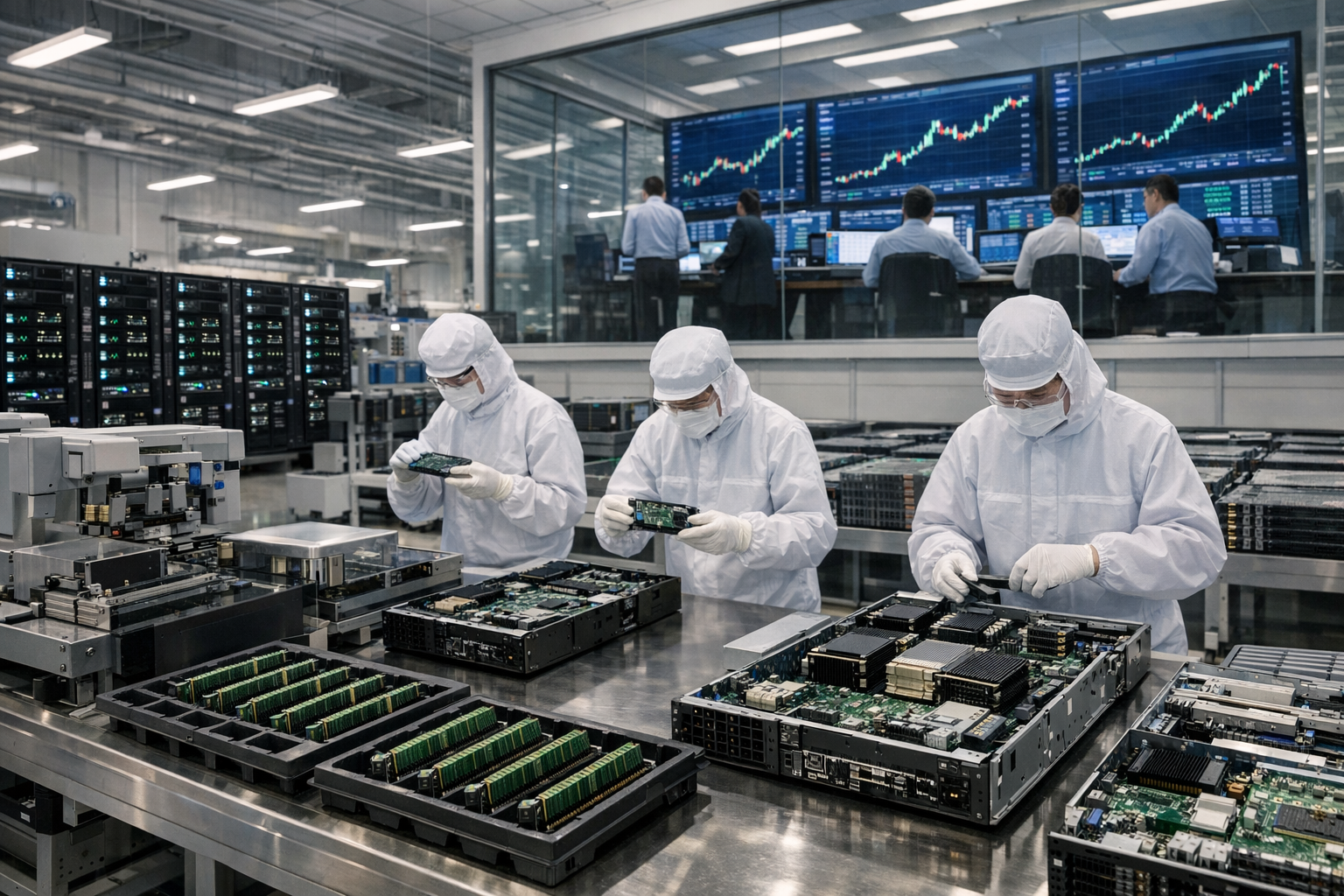
Micron Technology crossed a $1 trillion market value on Tuesday after its shares surged 19 percent, while SK Hynix joined the trillion-dollar club a day later, rising more than 11 percent as investors poured into South Korean semiconductor stocks. Their ascent reflects a new phase of the AI trade: a rush into the companies making the memory chips, advanced packaging and server hardware needed to keep the industry’s expansion on track.
The rally spread across Taiwan as well after Nvidia’s chief executive said the company planned to lift its annual spending there to roughly $150 billion, a striking signal of how much of the world’s AI build-out now depends on Taiwan’s manufacturing network. Shares of major suppliers including TSMC, Foxconn, Wistron and Quanta moved higher, as investors bet that demand for AI servers will continue to cascade far beyond the companies designing the processors themselves.
Together, the moves suggest that Wall Street and Asian markets are no longer treating the AI boom as a story about a handful of superstar chip firms. Instead, investors are increasingly rewarding the less glamorous — but indispensable — parts of the supply chain that turn AI ambition into hardware.
Memory moves to the center
At the heart of the latest surge is a growing conviction that memory, especially high-bandwidth memory, or HBM, has become one of the industry’s tightest bottlenecks.
HBM is critical for training and running advanced AI systems because it allows processors to handle massive amounts of data at high speed. As companies race to build out AI data centers, demand for those chips has outstripped supply, giving memory makers an unusual degree of pricing power in a business long known for brutal cycles of boom and bust.
That dynamic has transformed the fortunes of Micron and SK Hynix. Investors, who once tended to value memory companies as cyclical commodity producers, are increasingly treating them as strategic gatekeepers in the AI era. Analysts now expect memory demand to exceed supply through 2028, a view that would have seemed aggressive not long ago in an industry notorious for overcapacity and collapsing prices.
Micron has said that its entire 2026 output of HBM is already sold out, a sign of how fiercely customers are competing to lock in supply. Earlier this year, reports indicated that major technology companies were even willing to help finance SK Hynix’s capacity expansion to secure future deliveries, underscoring the urgency of the scramble.
Samsung, already one of the world’s largest memory makers, has also benefited from the reappraisal. But the rise of Micron and SK Hynix above the trillion-dollar threshold marks a particularly stark shift in investor thinking: memory is no longer being treated as a side beneficiary of AI demand, but as a core constraint on the industry’s growth.
Taiwan’s central role
Nvidia’s spending plans put fresh emphasis on another truth of the current AI economy: even as excitement centers on software models and advanced chips, much of the real leverage sits with Taiwan’s industrial base.
TSMC remains the linchpin, manufacturing many of the world’s most advanced semiconductors. But the AI server boom has also elevated the importance of companies such as Foxconn, Wistron and Quanta, which assemble the complex systems that cloud providers and corporate customers are rushing to deploy.
That network has already been gaining momentum. Earlier this year, TSMC raised its revenue outlook and capital spending plans, citing strong AI-chip demand. Nvidia’s latest comments reinforced the view that spending on AI infrastructure is likely to remain enormous — and that Taiwan will remain one of its biggest beneficiaries.
The response in the market was immediate. Taiwan chip and electronics shares climbed, while some China-linked semiconductor names moved in the opposite direction. Cambricon, a mainland Chinese chip company, fell sharply, highlighting a widening split in how investors view the global AI hardware race.
A deeper divide in the chip world
That divergence points to one of the most consequential themes in semiconductors today: the AI supply chain is becoming more polarized.
On one side are companies closely tied to the leading edge of AI production — particularly those in the United States, South Korea and Taiwan — where investors see durable demand, strong customer commitments and relative insulation from some of the industry’s fiercest uncertainty. On the other are firms whose prospects are more clouded by geopolitics, export controls and weaker access to the most advanced ecosystems.
Nvidia’s decision to deepen spending in Taiwan only sharpens that divide. It reinforces the dominance of non-Chinese suppliers at a time when the world’s largest AI deployments still rely heavily on manufacturing and memory capabilities concentrated outside mainland China.
For markets, that means the AI rally is no longer simply about who can design the fastest processor. It is also about who can fabricate it, who can package it, who can feed it with memory and who can assemble it into a working server quickly enough to meet demand.
Why the stakes are rising now
The broader significance of this week’s rally lies in what it says about investor expectations. Markets are betting not just that AI spending will stay elevated, but that shortages in critical components will persist long enough to sustain premium valuations.
That is a powerful wager. If supply remains constrained, companies like Micron and SK Hynix could continue to command higher prices and stronger margins than memory makers historically have. If Taiwan’s contract manufacturers and assemblers remain central to AI deployment, the gains may spread further through the supply chain.
But the risks are equally clear. If chipmakers expand capacity too quickly, the old memory cycle could reassert itself. If corporate AI spending cools or data-center customers turn more cautious, today’s valuations could come under pressure. And any escalation in geopolitical tensions around trade, technology or Taiwan could quickly reorder the list of presumed winners.
For now, though, the market is sending a decisive message: the AI boom has entered a new stage, one in which the companies enabling scale — not just invention — are becoming some of the world’s most valuable businesses.
Sources
Further reading and reporting used to add context:
- https://www.tomshardware.com/tech-industry/micron-begins-producing-americas-most-advanced-dram-at-its-virginia-fab
- https://www.tomshardware.com/tech-industry/big-tech/samsung-reportedly-set-to-distribute-up-to-usd26-6-billion-to-staff-in-ai-driven-semiconductor-bonuses-after-last-minute-union-deal-average-payouts-could-approach-usd400-000-per-chip-employee
- https://apnews.com/article/71cc7b49f2ca3462a118878c93c75940
- https://www.investing.com/news/stock-market-news/ai-boom-puts-sk-hynix-on-the-cusp-1-trillion-market-value-4687077
- https://www.investing.com/news/stock-market-news/micron-joins-1-trillion-club-as-ai-race-powers-memory-chip-boom-4710313
- https://www.investing.com/news/stock-market-news/sk-hynix-crosses-1-trillion-market-cap-on-ai-boom-4711043
- https://www.forbes.com/sites/aliciapark/2026/05/26/micron-joins-the-trillion-dollar-club-after-surging-18-tuesday/
- https://www.investing.com/news/stock-market-news/micron-hits-1-trillion-market-value-for-first-time-93CH-4710309
- https://www.thestar.com.my/tech/tech-news/2026/05/14/ai-boom-puts-sk-hynix-on-the-cusp-1-trillion-market-value
- https://www.fidelity.com/news/article/default/202605262342RTRSNEWSCOMBINED_KBN3RY00N-OUSBS_1
- https://www.streetinsider.com/Reuters/AI%2Bboom%2Bputs%2BSK%2BHynix%2Bon%2Bthe%2Bcusp%2Bof%2B%241%2Btrillion%2Bmarket%2Bvalue/26488221.html
- https://www.marketscreener.com/news/sk-hynix-joins-1-trillion-club-after-samsung-micron-on-ai-chip-boom-ce7f5ad2dc8ef02d
- https://www.investing.com/news/stock-market-news/micron-closes-in-on-1-trillion-market-value-as-ubs-triples-shareprice-target-4710257
- https://www.ndtv.com/us-markets/micron-stock-jumps-18-to-reach-1-trillion-market-cap-due-to-this-reason-11551659
- https://m.investing.com/news/economy-news/sk-hynix-joins-1-trillion-club-after-samsung-micron-on-ai-chip-boom-4711159?ampMode=1
- https://www.tomshardware.com/tech-industry/sk-hynix-customers-offer-to-buy-its-euv-machines-and-fund-new-fab-lines-as-memory-capacity-hits-zero
- https://www.reddit.com/r/stocks/comments/1toqa3x/sk_hynix_hits_1_trillion_valuation_as_ai_boom/
- https://en.wikipedia.org/wiki/Samsung
- https://www.tomshardware.com/tech-industry/jensen-huang-urges-super-micro-to-tighten-compliance
- https://www.pcgamer.com/software/ai/amd-is-putting-usd10-billion-into-taiwan-investments-to-accelerate-next-gen-ai-infrastructure-with-some-fancy-new-tech-on-the-way/
- https://www.investing.com/news/stock-market-news/nvidia-to-spend-150-billion-a-year-in-taiwan-epicentre-of-ai-revolution-says-ceo-4711555
- https://economia.uol.com.br/noticias/reuters/2026/05/27/nvidia-gastara-us150-bi-por-ano-em-taiwan-diz-ceo.htm
- https://www.streetinsider.com/Reuters/Nvidia%2Bto%2Bspend%2B%24150%2Bbillion%2Ba%2Byear%2Bin%2BTaiwan%2C%2B%27epicentre%27%2Bof%2BAI%2Brevolution%2C%2Bsays%2BCEO/26552105.html
- https://wabx.net/2026/05/26/nvidia-ceo-says-taiwan-is-epicentre-of-ai-revolution/
- https://www.marketscreener.com/news/nvidia-to-spend-150-billion-a-year-in-taiwan-epicentre-of-ai-revolution-says-ceo-ce7f5ad2df88f124
- https://international.astroawani.com/global-news/nvidia-spend-us150-billion-year-taiwan-epicenter-ai-revolution-says-ceo
- https://www.moneycontrol.com/artificial-intelligence/nvidia-to-spend-150-billion-a-year-in-taiwan-epicentre-of-ai-revolution-says-ceo-article-13932363.html
- https://www.onvista.de/news/2026/05-27-nvidia-plant-jaehrliche-investitionen-von-150-milliarden-dollar-in-taiwan-0-20-26515701
- https://www.zonebourse.com/actualite-bourse/nvidia-va-investir-150-milliards-de-dollars-par-an-a-taiwan-l-epicentre-de-la-revolution-de-l-ia-ce7f5ad2df88f124
- https://www.nst.com.my/amp/business/corporate/2026/05/1449466/nvidia-spend-us150bil-year-taiwan-epicentre-ai-revolution
- https://cybernews.com/ai-news/nvidia-150-billion-taiwan-epicentre-ai-revolution/
- https://www.onvista.de/news/2026/05-27-nvidia-plant-jaehrliche-investitionen-von-150-milliarden-dollar-in-taiwan-0-19-26515701
- https://www.tomshardware.com/tech-industry/artificial-intelligence/nvidias-asian-supply-chain-hits-90-percent-of-production-costs
- https://www.tomshardware.com/desktops/servers/nvidia-books-entire-server-plant-capacity-through-2026-pushing-out-other-potential-customers-to-build-blackwell-and-rubin-ai-servers
- https://www.reddit.com/r/it/comments/1tox445/jensen_huang_to_invest_150_billion_annually_in/
- https://www.reddit.com/r/AMD_Stock/comments/1touhwv/nvidia_to_spend_150_billion_a_year_in_taiwan/
- https://wixx.com/2026/05/26/nvidia-ceo-says-taiwan-is-epicentre-of-ai-revolution/
- https://www.933thedrive.com/2026/05/26/nvidia-ceo-says-taiwan-is-epicentre-of-ai-revolution/
- https://english.aaj.tv/news/330459582/nvidia-to-spend-150-billion-a-year-in-taiwan-epicentre-of-ai-revolution
- https://uk.marketscreener.com/news/nvidia-to-spend-150-billion-a-year-in-taiwan-epicentre-of-ai-revolution-says-ceo-ce7f5ad2df88f124
- https://www.tomshardware.com/tech-industry/cambricons-q1-revenue-hits-423-million-as-chinas-domestic-ai-chip-market-accelerates
- https://www.investing.com/news/stock-market-news/tsmc-lifts-revenue-forecast-pledges-more-capital-spending-to-meet-ai-chip-demand-4616954
- https://www.tomshardware.com/tech-industry/chinese-tech-firm-cambricon-looks-to-step-into-nvidia-void-triple-ai-chip-production-next-year-seeks-to-rival-huawei-but-production-remains-a-concern
- https://www.tradingview.com/news/reuters.com%2C2025%3Anewsml_L3N3S10TS%3A0-chipmakers-and-ai-linked-stocks-climb-after-nvidia-results-tariff-block/
- https://www.marketscreener.com/news/s-korea-taiwan-stocks-end-at-record-closing-highs-powered-by-chip-gains-ce7f59dcdf88ff26
- https://www.tradingview.com/news/reuters.com%2C2025%3Anewsml_L4N3QV0TL%3A0-u-s-chipmakers-rise-as-tsmc-lifts-spirits-after-nvidia-led-tumble/
- https://en.wikipedia.org/wiki/Nvidia
- https://www.reddit.com/r/NVDA_Stock/comments/1td3dhp/reuters_tsmc_says_global_chip_market_to_hit_15/
- https://www.reddit.com/r/IndiaFinance/comments/1tnyyfb/taiwan_becomes_worlds_5th_largest_stock_market_as/
- https://www.itpro.com/hardware/how-enterprise-storage-vendors-are-responding-to-the-memory-crunch
- https://www.tomshardware.com/pc-components/gpus/pcb-shots-appear-of-intels-crescent-island-revealing-a-single-gpu-setup-and-pads-for-20-lpddr5x-modules
- https://www.techradar.com/computing/computing-components/ram-crisis-could-soon-get-worse-as-disruption-in-strait-of-hormuz-shipping-hits-supply-chain-hard
- https://www.investing.com/news/stock-market-news/tsmc-likely-to-book-fourth-straight-quarter-of-record-profit-oninsatiable-ai-demand-4609143
- https://www.investing.com/news/stock-market-news/strong-asml-tsmc-forecasts-signal-ai-spending-boom-is-intact-4617583
- https://www.investing.com/news/economy-news/sk-hynix-joins-1-trillion-club-after-samsung-micron-on-ai-chip-boom-4711159
- https://whtc.com/2026/05/26/micron-joins-1-trillion-club-as-ai-race-powers-memory-chip-boom/
- https://ca.investing.com/news/stock-market-news/tsmc-set-to-post-50-quarterly-profit-jump-extend-record-earnings-oninsatiable-ai-demand-4567777
- https://www.investing.com/news/stock-market-news/exclusivesk-hynix-flooded-with-unprecedented-offers-from-big-tech-firms-to-secure-chip-supplies-4670341
- https://www.moneycontrol.com/news/business/companies/micron-joins-1-trillion-club-as-ai-race-powers-memory-chip-boom-13932092.html
- https://www.marketscreener.com/news/tsmc-lifts-revenue-forecast-pledges-spending-to-meet-ai-chip-demand-ce7e50dddc8ff725
- https://finance.yahoo.com/markets/stocks/articles/tsmc-set-post-50-quarterly-000551299.html
- https://finance.yahoo.com/sectors/technology/articles/strong-asml-tsmc-forecasts-signal-104833111.html
- https://investor.tsmc.com/english/encrypt/files/encrypt_file/reports/2025-04/7630274eecc1197a4e3ea6a415f44a47204fe10a/TSMC%201Q25%20Transcript.pdf
- https://www.reddit.com/r/RigBuild/comments/1t7y1mx/sk_hynix_buried_under_customer_cash_offers_to/
- Micron joins $1 trillion club as AI race powers memory chip boom By Reuters
- Micron joins $1 trillion club as AI race powers memory chip boom
- TSMC lifts revenue forecast, pledges more capital spending to meet AI chip demand By Reuters
- Nvidia to spend $150 billion a year in Taiwan, ’epicentre’ of AI revolution, says CEO By Reuters